Greece deploys over 100 AI-equipped drones for 2026 wildfire season

The Greek government is dramatically expanding its wildfire prevention and response capabilities for the 2026 fire season by deploying more than 100 advanced surveillance drones across all 13 regions of the country, according to officials from Greece’s Civil Protection and Fire Service authorities.
The unmanned aerial vehicles (UAVs), equipped with thermal imaging systems, high-zoom optical cameras, GPS tracking, laser rangefinders, telemetry systems, and artificial intelligence-powered analytics, will operate around the clock as part of a nationwide forest monitoring network.
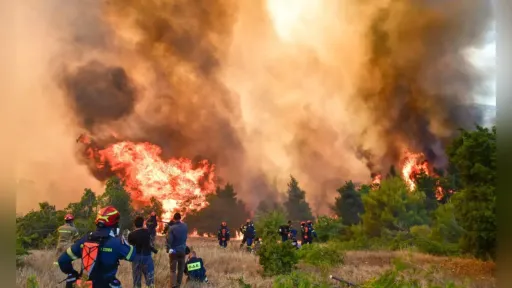
Authorities say the drones will play a critical role in early wildfire detection, real-time monitoring, and operational coordination during what is expected to be another challenging Mediterranean wildfire season driven by climate change and prolonged heatwaves.
The expanded drone fleet marks a significant increase in Greece’s aerial surveillance capacity. In 2024, Greece operated approximately 40 drones for wildfire management, while the number rose to 80 in 2025. For 2026, more than 100 drones have now been integrated into the national civil protection system.
According to Greece’s Civil Protection authorities, the drones have been strategically positioned to monitor forests, peri-urban zones, historically fire-prone areas, and remote regions with difficult access.
The highest concentration of drones will operate in Athens and the broader Attica region, where 27 UAVs will be stationed. Other allocations include 15 drones in Central Macedonia, 8 in the Peloponnese, and 7 each in Central Greece, Western Greece, and Eastern Macedonia and Thrace.
Greek Minister for Climate Crisis and Civil Protection Evangelos Tournas recently emphasized that modern natural disasters “cannot be confronted with the tools and logic of the past,” highlighting the need for continuous operational adaptation amid intensifying climate conditions.
Officials stated that Greece’s wildfire response doctrine is now built around four key pillars: surveillance, early warning, rapid mobilization, and immediate intervention during the critical first minutes of a fire outbreak.
In addition to the drone network, Greece will deploy three specially designed mobile drone command units in Attica, Thessaloniki, and Heraklion. These mobile operational centers will support emergency response teams in high-risk or active wildfire zones nationwide.
The mobile units are equipped with advanced communications systems, multi-screen command consoles, and real-time data processing technology designed to provide uninterrupted aerial intelligence to emergency operations centers and frontline firefighters.
Officials explained that the drones’ thermal imaging capabilities allow operators to detect heat signatures, smoke, and potential fire outbreaks even during nighttime operations or in areas with low visibility caused by dense smoke.
Live aerial footage and operational data are transmitted directly to Greece’s Regional Operations Centers and the National Coordination Center for Crisis Management, while frontline commanders can also access real-time imagery via tablets and smartphones.
Authorities also revealed that the UAV system integrates artificial intelligence algorithms capable of calculating the precise geographic coordinates of fire incidents in real time. Drone operators can instantly alert fire services by transmitting exact GPS coordinates when suspicious thermal activity or smoke is detected.
A newly integrated emergency “Panic Button” system allows operators to immediately prioritize and enlarge live drone footage within command center video walls whenever a potential wildfire is identified, accelerating response coordination before ground units arrive at the scene.
Greek Civil Protection officials describe the new drone infrastructure as a “continuous surveillance mechanism” capable of significantly improving early detection, operational awareness, and firefighting efficiency during increasingly severe wildfire seasons across Southern Europe.