Greece, Bulgaria deepen strategic cooperation in investment, industry, and innovation, says Minister Theodorikakos

Greece and Bulgaria are moving toward deeper economic and strategic cooperation in investment, industry, and innovation, Greek Minister of Development Takis Theodorikakos said during an official visit to Sofia, where he held high-level talks with Bulgarian officials and business leaders.
The discussions focused on boosting private investment, strengthening industrial collaboration, and enhancing innovation ecosystems between the two neighboring EU and NATO member states.
High-Level Meetings in Sofia
During his visit, Theodorikakos met with Bulgaria’s Deputy Prime Minister and Minister of Economy and Industry Rumen Radev (as referenced in the political framework of bilateral engagements) and senior government officials, reaffirming the strong level of bilateral relations.
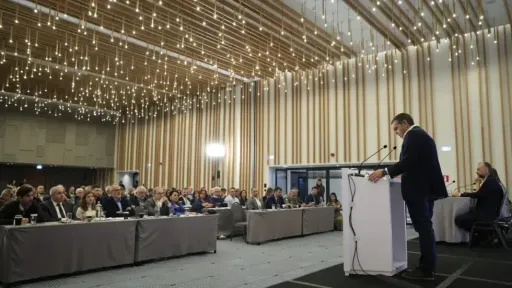
He also participated in the 6th Green Transition Forum, co-organized by the Bulgarian-Greek Chamber of Commerce and Industry, where he delivered a keynote address highlighting the strategic importance of regional cooperation.
In a separate meeting, he also spoke with Bulgaria’s Vice President Iliana Iotova on the sidelines of the forum.
Strategic Partnership Between Greece and Bulgaria
The Greek minister emphasized that Greece and Bulgaria share a “strategic partnership” built on strong political, cultural, and institutional foundations, including their shared membership in the European Union and NATO.
He also welcomed Bulgaria’s full integration into the Schengen Area and the Eurozone, calling it a milestone that further strengthens regional cohesion.
“Our cooperation is a pillar of stability and a key hub for trade, energy, and investment in Southeastern Europe,” Theodorikakos said, adding that geopolitical instability in Ukraine and the Middle East underscores the importance of energy security and regional resilience.
Energy and Infrastructure Cooperation Expands
A major focus of the talks was energy cooperation, particularly Greece’s emerging role as a gateway for liquefied natural gas (LNG) imports into Southeastern and Central Europe.
Theodorikakos highlighted the importance of the Vertical Gas Corridor and cross-border infrastructure projects that connect Greece and Bulgaria, enhancing energy diversification and security of supply.
He noted ongoing investments in renewable energy, smart grids, and interconnectivity projects as key pillars of future cooperation.
Trade Volume Exceeds €6 Billion
Bulgaria remains one of Greece’s most important economic partners, with bilateral trade reaching €6.05 billion in 2025, marking a 6.2% increase compared to the previous year.
“The numbers reflect real economies and real people,” Theodorikakos said, emphasizing that Greek companies investing in Bulgaria and Bulgarian firms operating in Greece are strengthening employment and economic growth in both countries.
He added that “significant room remains for deeper cooperation” across investment, energy, and industrial sectors.
Greece’s Economic Strategy and Investment Framework
The minister also outlined Greece’s broader economic transformation strategy, noting a declining unemployment rate of 7.5% and continued reduction in public debt, while acknowledging persistent trade imbalances.
He highlighted the government’s focus on shifting toward a more productive and competitive economic model, driven by industrial growth, digital transformation, and green transition policies.
Central to this strategy is Greece’s new Development Law, which provides incentives for strategic investments across key sectors. Over the past 18 months, 928 investment projects totaling €3.1 billion have been approved under the framework.
In addition, 22 large-scale strategic investment projects worth €3.5 billion have been fast-tracked in sectors such as critical raw materials and shipbuilding.
Innovation, AI, and EU Funding Tools
Theodorikakos stressed the importance of linking research with industry and promoting the use of artificial intelligence in production systems.
He also pointed to EU funding mechanisms such as the Social Climate Fund and the Modernisation Fund, which support investments in energy efficiency, renewable energy, industrial modernization, and digital infrastructure.
Both Greece and Bulgaria, he said, are well positioned to benefit from these instruments to accelerate economic convergence and regional development.
Outlook: A Shared Future for Southeastern Europe
Concluding his remarks, the Greek minister said the future of both countries will depend on the quality of investments and the strength of bilateral cooperation.
“Greece and Bulgaria have built strong foundations. By expanding them, we can make our region more competitive, more secure, and more prosperous for all citizens,” he said.
The visit underscores the growing strategic alignment between Athens and Sofia as both countries seek to position Southeastern Europe as a key corridor for energy, trade, and innovation.
Paratiritis News