Çanakkale Martyrs commemorated in Komotini

An event was organised in Komotini on the occasion of the Martyrs' Remembrance Day and the acceptance of the National Anthem.
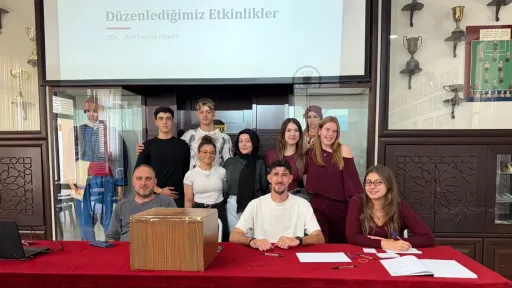
A ceremony was held at the Consulate General of Türkiye in Komotini on Tuesday, 19 March, on the occasion of the adoption of the National Anthem of Türkiye and the Martyrs' Remembrance Day.
The commemoration event started with a minute of silence for the martyrs and followed by the National Anthem. The National Anthem was performed by Demirkan Baltacı, a secondary school student from Xanthi, on the piano.
In his speech at the ceremony, İbrahim Şerif, President of the Advisory Board of the Turkish Minority of Western Thrace and Mufti of Komotini, emphasised the importance of martyrdom. İbrahim Şerif reminded that nearly 8 thousand people from our region were martyred in the Çanakkale Wars.
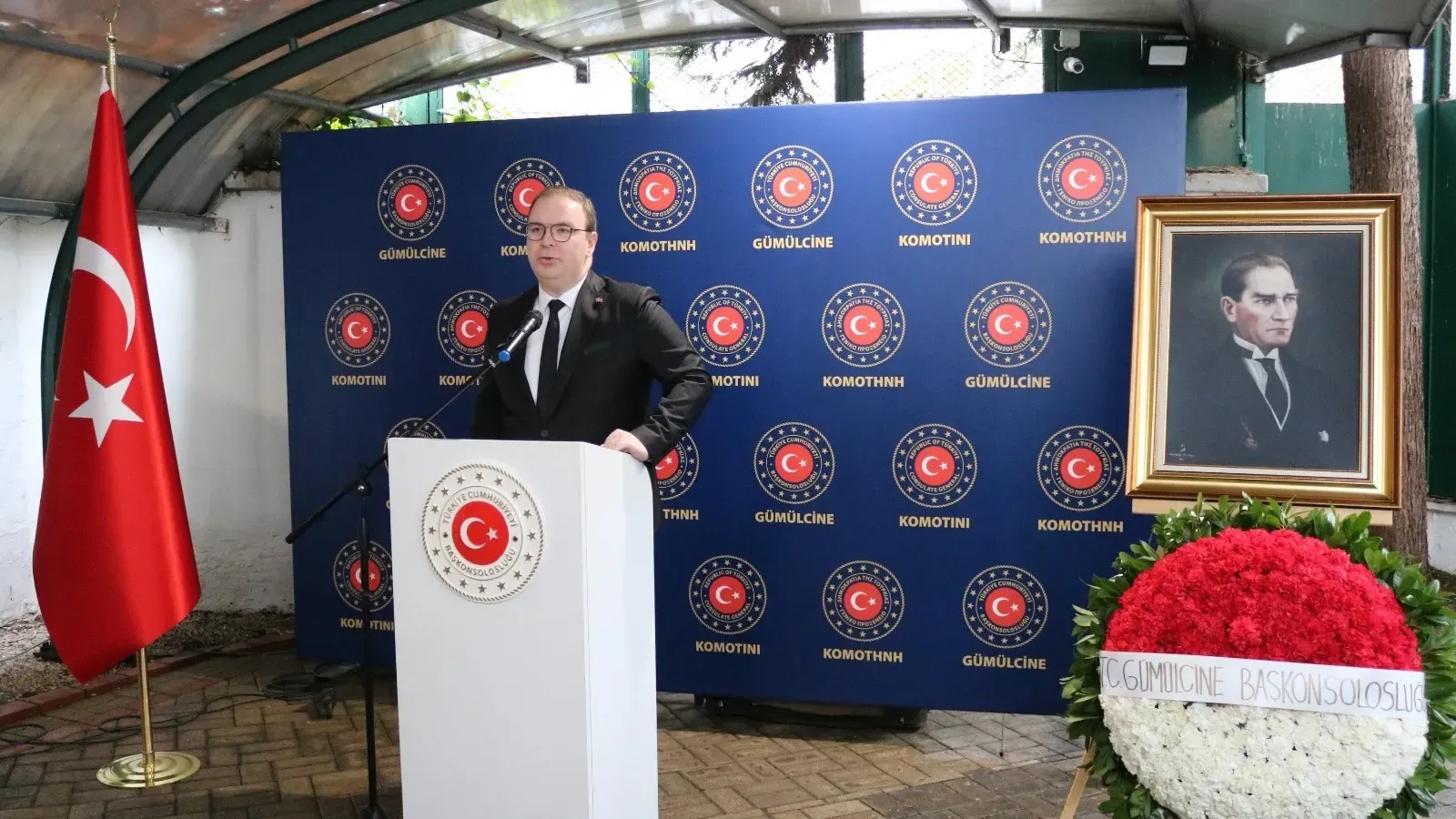
Consul General of Türkiye in Komotini Aykut Ünal expressed the following in his speech
"Of course, commemorating the Patriotic Poet Mehmet Akif Ersoy, Çanakkale and our martyrs does not fit in just one day. Mehmet Akif, who invited our nation to wake up with his poems, showed how a war can be told with all its effects with the Çanakkale Epic. If the Çanakkale Epic is talked about so much today, this is partly due to the magnificent poetry of the Patriotic Poet.
Mehmet Akif, who reveals his art by taking strength from the nation's spirit of struggle, wishes the nation to gather under one flag. In order to achieve this goal, he expresses his verses to ensure this unity.
We see this desire strongly in the National Anthem he wrote during the war. Hamdullah Suphi Tanrıöver, the Minister of National Education of the period, who opened the competition for the National Anthem and evaluated the poems, recounts: 'None of the hundreds of poems that came for the competition could be compared with the one written by Akif. When it was the turn of Akif's work and shortly after I started to read the poem, the whole Assembly stood up spontaneously and as soon as the poem was finished, a thunder of applause broke out and the MPs made me read the poem again and again. The result was now understood. The National Anthem of our nation had been determined.
The speeches of the poet, who helps us get up with his poems, are also to the point. We listen to Mehmet Akif: 'We will forever overcome the sedition, mischief, factionalism, tribalism, and a thousand other causes of separation and disunity that have been introduced between us, and we will stand hand in hand, head to head. Nations collapse only when the bonds between them are dissolved, when everyone falls into their own troubles, their own moods, and their love of securing their own interests. Well, what is the state of the West? Their ships are crossing the seas, their railway is travelling the world, their aeroplanes are flying through the air. Scientists devote their lives to research, and the people work and read endlessly. But as their power increases, so do their ambitions. They have finished Asia and Africa. Now it is our turn. If you have read the Treaty of Sevres, you will realise that what they want from us is no longer land. This time they want our lives, our existence.
Distinguished guests
The road to victory in war is hard. The losses are many. Victory comes with the sacrifices of martyrs and veterans, on their shoulders. You know the shortcomings and sacrifices in our struggle for existence and liberation. This part of my speech will focus on the Çanakkale Victory. 18 March represents a great victory, a spirit and a stance. It shows that a target thought to be easy to cross cannot be crossed. Today, our ships passing through the Dardanelles, in honour of this great victory and those who gifted us this victory, do not record "Dardanelles is passed" in their logs. They express their respect and gratitude as "Dardanelles exited" and "Martyrs' Monument saluted". The Victory at Sea and the land battles also gave us a leader.
We are blessed that Lieutenant Colonel Mustafa Kemal laboured, persevered, became a troop commander in the Gallipoli War and appeared on the stage of history. Here he displayed his tactical and strategic genius and changed the course of events. He did not stop behind the front line either, he made his staff and soldiers giants. His standing on the Gallipoli Peninsula like a giant bullet-proof statue not only frustrated the ambitions of the Entente States, but also allowed Istanbul to breathe a sigh of relief during the War of the World War.
In other words, one cannot speak of a Gallipoli War without Mustafa Kemal Atatürk. I will share an assessment from the British army records. 'Although only a few hours had elapsed since Mustafa Kemal assumed command of the northern sector, it was his fierce attack on the morning of 9 August that halted the much delayed advance of the 9th Army and defeated it. 24 hours later, following his own reconnaissance, he made a brilliant counter-attack at Conkbayırı, which put the Turks in a position of complete domination on the ridges of Sarıbayır. It is one of the rare occasions in history when the attacks of a single division commander, Mustafa Kemal, on three separate occasions, had such a profound effect not only on the course of a battle, but perhaps on the whole war, perhaps on the fate of a nation.
This assessment is in the nature of praise. Of course, a leader can be praised in his own country. But this praise is characterised by the fact that, at that time, it comes from the enemy. If the praise comes from enemies, especially those whose armies have suffered heavy defeats, there can be no doubt that it is objective and realistic.
Starting from our heroes on the fronts, we respectfully commemorate all our security officers, civil servants including the officials of our Ministry of Foreign Affairs, and citizens who were martyred in the most treacherous, cowardly and inhumane attacks of terrorist organisations. Today, our greatest duty towards our beloved martyrs is to unite our hearts around the values for which they were martyred and to reinforce our unity and solidarity. The greatest respect we will show to their cherished memories is to stand on the side of right, law, justice, brotherhood, unity and solidarity. May Allah never give opportunity to those who want to sow seeds of sedition, mischief and discord."
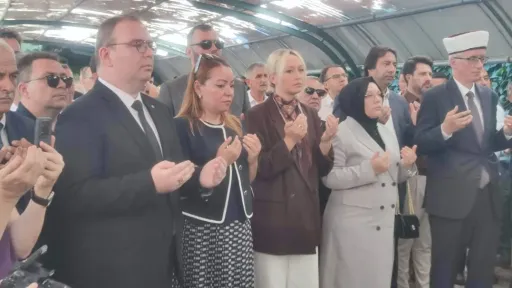
After Council General Ünal’s meaningfull speech Mustafa Trampa, Mufti of Xanthi, made the prayer for the martyrs at the ceremony.
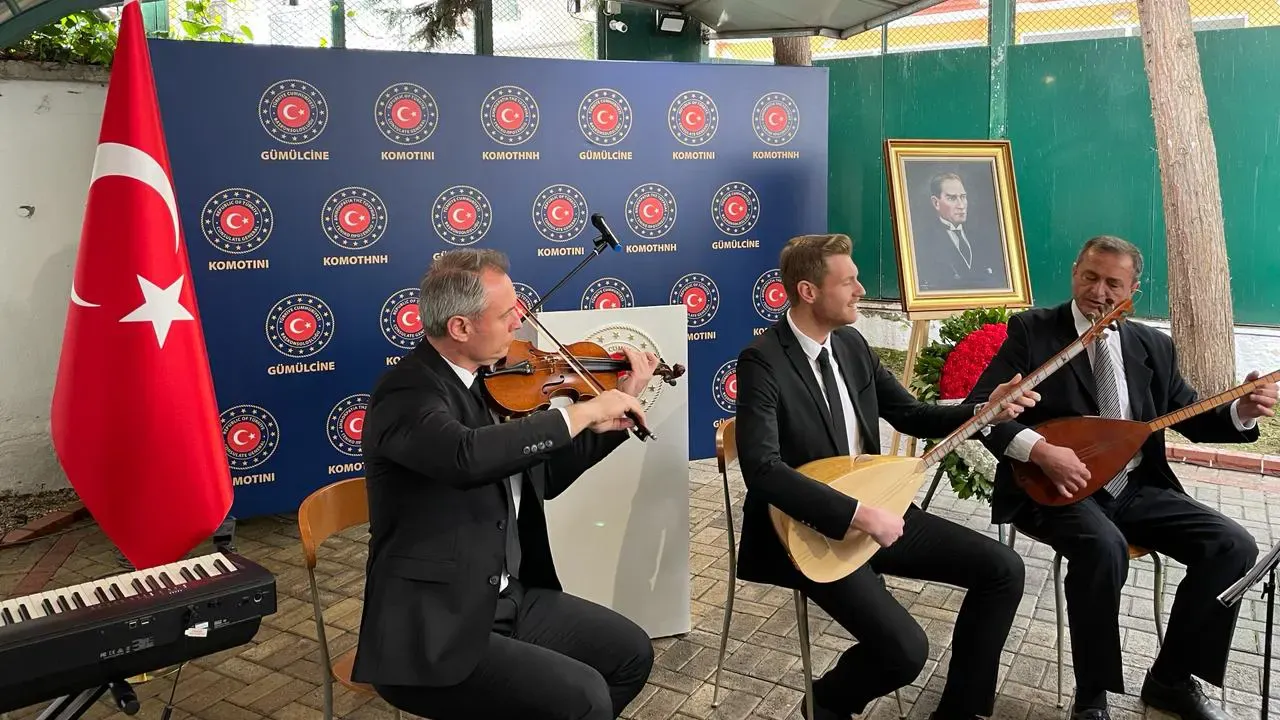
Afterwards, folk songs were performed by music teachers Mehmet Mustafa, Batuhan Hasan and Mümin Ali.
Merve Mehmet, one of the Consulate General officers, was the presenter of the ceremony.
The commemoration event was attended by the heads and executives of minority institutions and organisations and a large number of cognates.