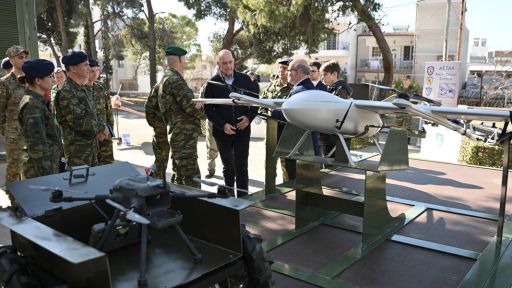
Greece launches ‘Trojan Horse 2026’ exercise focused on drones and electronic warfare

The Greek Armed Forces have launched a new military exercise aimed at evaluating the operational effectiveness of recently acquired and domestically developed defense technologies, with a particular focus on unmanned systems and electronic warfare capabilities.
According to local reports, the joint live tactical exercise, titled “Trojan Horse 2026” (Doureios Ippos 2026), is being conducted under the supervision of the Hellenic National Defence General Staff (GEETHA) from June 8 to June 11. The medium-scale exercise is designed to simulate realistic battlefield conditions and assess the performance of advanced military systems in operational scenarios.
Military planners have reportedly placed special emphasis on electronic warfare operations, reflecting lessons learned from recent conflicts, including the war in Ukraine and escalating military confrontations involving Iran, Israel, and the United States. The exercise is intended to test capabilities such as communications jamming, disruption of satellite navigation systems, and electromagnetic spectrum control—areas increasingly viewed as decisive factors in modern warfare.
The activities are centered primarily in the region of Thrace but extend across multiple operational zones, including parts of the Peloponnese and the Ionian Sea. The Andravida Air Base serves as the main command and coordination hub for the exercise’s various operational scenarios.
Domestic Defense Industry Takes Center Stage
A key component of the exercise is the participation of Greece’s domestic defense industry. Eleven companies were selected by the Hellenic Center for Defense Innovation (ELKAK) from a pool of 25 applicants seeking to deploy their systems during the drills.
Selection criteria focused on technological maturity and the ability of the systems to respond effectively to demanding operational scenarios developed by military planners. The exercise will feature domestically produced unmanned aerial vehicles (UAVs), loitering munitions, unmanned surface vessels, and counter-drone systems.
Officials expect participating companies to gain valuable operational data and practical experience by testing their technologies in conditions designed to closely replicate the realities of contemporary combat environments.