The Effects of the Turkish-Greek Population Exchange Agreement in Türkiye and Greece

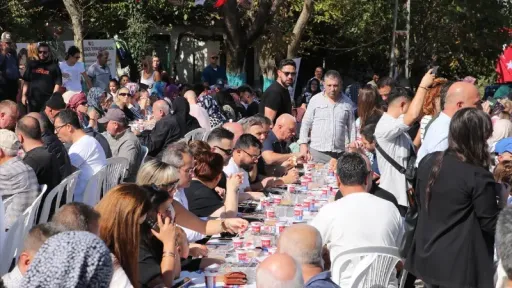
Galatasaray University Faculty of Law Faculty Member Prof. Dr. Rıdvan Akın said that while the Turkish-Greek Population Exchange Agreement caused major problems in Greece, Türkiye successfully solved this process.
Prof. Dr. Akın spoke at the panel organised by Trakya University Atatürk's Principles and Revolution History Research and Application Centre.
Galatasaray University Faculty of Law Faculty Member Prof. Dr. Rıdvan Akın said that while the Turkish-Greek Population Exchange Agreement caused major problems in Greece, Türkiye successfully solved this process.
Prof. Akın made a presentation titled "Social and political consequences of the exchange" at the panel "Rethinking the Turkish-Greek Population Exchange in the 100th Anniversary of the Republic" organised by Trakya University Atatürk's Principles and Revolution History Research and Application Centre at the Central Library Conference Hall.
Stating that the winning of the National Struggle and the achievements obtained in the ongoing process were 'great victories' in terms of Turkish history, Akın stated that the same process was characterised as the 'Asia Minor Catastrophe' for Greece.
Akın pointed out that what happened between Türkiye and Greece throughout history had significant effects on political and social life.
Prof. Akın reminded that the Greek army that landed in Anatolia after World War I was defeated by the Turkish army led by Mustafa Kemal Atatürk, and stated that more than 1 million Greeks migrated to Greece with the Turkish-Greek Population Exchange Agreement.
Explaining that Greece paid a heavy price during this period, Akın said, "As a result, we can say that Greece was left under the exchange. There was no regime stability. Greece was occupied during World War II. Greece experienced great difficulties during this period. Türkiye, on the other hand, did not experience such traumas thanks to Atatürk. We came out of here with the Republic."
In the panel, Marmara University Faculty Member Assoc. Prof. Dr. Neval Konuk Halaçoğlu made a presentation titled "The architectural heritage we left after the exchange".
Assoc. Prof. Dr. Halaçoğlu said that there are many artefacts from the Ottoman period in Greece.
Halaçoğlu pointed out that although there are many artefacts that have survived to this day, there are no Ottoman or Turkish artefacts registered with the Greek Ministry of Culture and said, "The number of registered artefacts is zero. These artefacts are called Muslim mosques, Muslim fountains or Post-Byzantine period. The official authorities of Greece not only reject these artefacts from the beginning, but also ensure that they are physically hidden."
AA