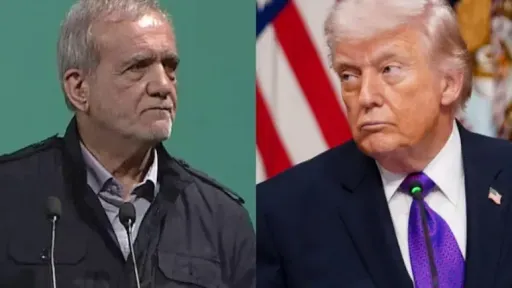
US expands strikes on Iran as regional tensions escalate

The United States launched a new wave of military strikes against Iran late Monday, targeting military installations along the country's southern coastline as Washington intensified its campaign against Tehran's military capabilities linked to the Strait of Hormuz.
The US Central Command (CENTCOM) said the five-hour operation concluded at 10:15 p.m. ET on July 13 and struck military targets in Bushehr, Chah Bahar, Jask, Konarak, Abu Musa and Bandar Abbas.
According to CENTCOM, US forces used precision-guided munitions against Iranian coastal defense systems, missile and drone sites, as well as maritime military assets, saying the operation was intended "to further degrade Iran's ability to attack commercial shipping."
The latest operation marked the third consecutive night of US strikes ordered by President Donald Trump.
Speaking at the White House, Trump said the United States was targeting Iran's capabilities related to the Strait of Hormuz while reinstating a blockade against the country. He also maintained that a diplomatic agreement with Tehran remained possible despite the escalation.
CENTCOM added that more than 50,000 US service members remain deployed across the Middle East.
Casualties reported in Southwestern Iran
Iranian officials said four people were injured after projectiles struck the southwestern city of Omidiyeh in Khuzestan province early Tuesday.
According to Deputy Governor Valiollah Hayati, the attack occurred at around 2:10 a.m. local time. Iranian authorities are continuing to assess the damage.
The incident came as military exchanges between the United States and Iran intensified following the collapse of a June ceasefire agreement brokered by Qatar and Pakistan. President Trump declared the ceasefire over on July 8 after renewed hostilities.
Jordan intercepts missiles
Jordan's Armed Forces said they intercepted four missiles that entered the kingdom's airspace from Iran early Tuesday.
The military said the interceptions were carried out to protect Jordan's sovereignty and resulted in no casualties or property damage. Officials warned that any future violations of Jordanian airspace would be met with "utmost firmness."
Iran's Islamic Revolutionary Guard Corps (IRGC) later said it had launched ballistic missiles at a US air base in Jordan, claiming the facility had been used in operations against Iran.
Strait of Hormuz incidents raise shipping concerns
Maritime security concerns deepened after two United Arab Emirates tankers were struck while transiting the southern shipping lane of the Strait of Hormuz in Omani territorial waters.
The UAE Defense Ministry identified the vessels as the *Mombasa* and *Al Bahiyah*, saying one Indian crew member aboard the *Mombasa* was killed and eight others were injured, including four seriously. Fires broke out on both vessels but were later brought under control.
The UAE condemned the attack as a violation of international law and said it reserved the right to take measures to protect its national interests.
Separately, the UK Maritime Trade Operations (UKMTO) agency reported that another tanker was struck by an unidentified projectile approximately 40 nautical miles northeast of Qalhat, Oman. Authorities are investigating the incident and have advised vessels in the area to exercise caution.
Iran accuses US over tanker route
Iran's IRGC Navy accused the United States of encouraging two supertankers to use what it described as an unauthorized route through the Strait of Hormuz before the vessels were disabled.
According to the IRGC, the tankers switched off their navigation systems, ignored repeated warnings and attempted to transit a mined route, endangering other shipping. Iranian authorities did not specify what struck the vessels or claim responsibility for the incident.
The IRGC warned that continued cooperation with the United States and attempts to use the disputed route would delay the reopening of the Strait of Hormuz and worsen the global energy crisis.
Iran also claimed it had targeted military facilities at the US Juffair base in Bahrain during a second phase of Operation Nasr-2, including ammunition depots, a satellite communications center and radar systems. Bahrain's Interior Ministry urged residents to seek shelter after warning sirens sounded.
Tehran rejects US allegations on Yemen
Iran rejected US accusations that it used a recent flight to Yemen to transport military personnel and equipment to the Houthi group under the cover of a funeral delegation.
In a statement to the United Nations, Iran's mission described the allegations as "entirely baseless" and a "fabricated accusation" intended to mislead the Security Council.
The response came after US Deputy Representative to the UN Tammy Bruce alleged that an Iranian flight arriving in Houthi-controlled Sanaa on July 3 had transported members of the Islamic Revolutionary Guard Corps, including drone and missile specialists, in support of the Houthis.
Iran maintained that its engagement with the Sana'a authorities is consistent with UN resolutions and aimed at supporting a Yemeni-led political process.
Source:AA