Trial over Tempi train crash gets underway, with 36 defendants in the dock

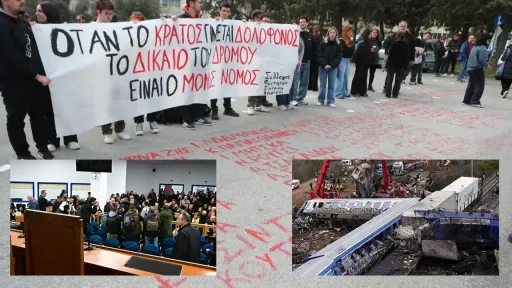
The trial for the tragic rail accident at Tempi on 28 February 2023 began amid protests and the consideration of procedural issues on Monday, including questions over the adequacy of the space and the suitability of the venue adapted as a court room for the trial, in which there are 36 defendants and hundreds of lawyers, family members of the 57 victims, witnesses, members of organisations and representatives of the mass media.
The trial before the Larisa Three-Member Court of Appeal for Felonies is taking place in a specially adapted room within the Thessaly University Conference Centre in the city. In addition to the 36 individuals on trial, there are at least 230 parties - both individuals and legal entities, including relatives of victims, survivors, Bar Associations, and unions - expected to appear in support of the prosecution, while the number of witnesses exceeds 352.
The trial will examine the events that led to the head-on collision at 23:18 on February 28, 2023 between an Intercity passenger train heading toward Thessaloniki and a freight train heading in the opposite direction on the same track. The collision killed 57 people, most between the ages of 15 and 25, and left hundreds injured, 32 of them seriously.
The defendants come from across the entire spectrum of the Greek railway sector - including OSE, ERGOSE, the Supervisory Authority RAS, the transport ministry and Hellenic Train - covering the period from 2016 to February 2023.
Thirty-three of the 36 defendants were referred to trial for the offense of "dangerous interference with rail transport with possible intent, through acts hazardous to transport safety, from which there could have arisen a general danger to property and a risk to human life, an act which resulted in: (a) the death of a large number of people, (b) serious bodily harm to more individuals, and (c) significant damage to public utility infrastructure, committed repeatedly and jointly." The offense carries a maximum sentence of life imprisonment, while they also face additional charges of causing deaths and injuries through negligence.
In addition to the station master on duty and two of his colleagues in the previous shift, who had left early on that day, leaving him alone, the defendants include dozens of more senior figures involved in the running of the railroad.
The charges were drawn up following an investigation lasting almost 2.5 years by Special Appeals Court Examining Magistrate Sotiris Baikamis, who examined various issues having to do with the operation and safety of the railway network, beyond the station master's actions that sent the passenger train down the wrong track. They included the supervisor who allowed him to be put on duty alone that night, despite his inexperience, those that approved his transfer to the specific post in the first place, despite his not meeting the relevant age limit, and those that approved a single-person night shift at the station.
They also include charges for the failure to repair damage to signalling and remote management of the trains on that section of the railway, the failure to impose speed limits, the failure to complete contract 717 that involved these systems, the fact that the radio-communication system on the trains was not working and failure to properly supervise the safety of the railroad's operation in that section of the line.
ΑΜΝΑ