'Foundation property being sold by appointed Christians'

Greece continues to implement its assimilation and oppression policies towards the Turks in Rhodes. It was stated that Greek authorities on the island appointed Christian officials to Muslim foundations and sold Turkish assets.
Rhodes, Kos and Dodecanese Turks Culture and Solidarity Association President Prof. Dr. Mustafa Kaymakçı said that on the Greek island of Rhodes, Christian officials appointed by the Greek authorities to Muslim Turkish foundations, instead of protecting foundation properties, sold them based on the law known as "Katalipsis", which was enacted in 1970.
Rhodes, with a population of approximately 140,000, is deprived of many constitutional rights such as religion, worship, and education in their mother tongue.
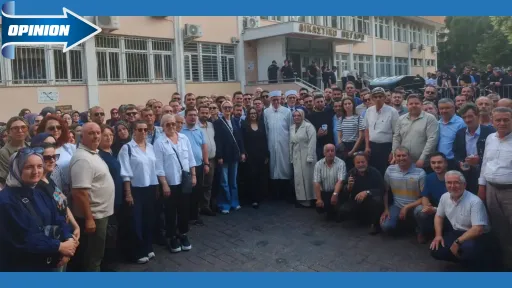
Rhodes Kos and Dodecanese Turks Culture and Solidarity Association President Prof. Dr. Theologian-preacher Abdurrahim Kuru, who was appointed as a religious officer to Rhodes by Mustafa Kaymakçı and the Chosen Mufti of Komotini in 2020, evaluated the problems of Rhodes Turks regarding religion, freedom of worship and foundations to AA correspondent.
Prof. Dr. Kaymakçı stated that Greece had enacted a law known as "Katalipsis" in 1970, stating that "immovable properties and properties that are not notified to the land registry office within 10 years are transferred to the treasury", adding, "On the grounds of this provision, foundation properties belonging to Turks are usurped on the islands, and the problem of foundations continues to this day. "Although it is legally forbidden to sell foundation properties, many foundation properties were donated by foundation administrators appointed by the Greek authorities or sold for less than their value. Our kinsmen were also prohibited from participating in tenders for the sale of foundation properties." he said.
"The Turks of Rhodes, who are defined as 'Muslim Greeks', are also forbidden to learn about their religion Islam.
Noting that the Turks of Rhodes have many rights guaranteed by international treaties and conventions, especially the Greek constitution, Kaymakçı said that the main problems of the Turks on the island were "citizenship, learning Turkish, the usurpation of religious worship rights, the atmosphere of hatred and oppression, the destruction of the cultural heritage left by the Ottoman Turks. and the matter of foundations".
Kaymakçı noted that instead of solving these problems like a modern state, Greece applied various methods to assimilate the Turks of the Dodecanese Islands culturally, and said:
"Schools teaching Turkish in Rhodes and Kos were closed on the basis of bilingualism since 1972. Our kinsmen, who go to Greek public schools, cannot use their right to Islamic religious education, although they are exempted from Orthodox religion classes. They recognize them as 'Muslims', not with their 'Turkish' identity. The dilemma that arises with this is that the Turks of Rhodes, who are defined as 'Muslim Greeks', are forbidden to learn about their religion, Islam either."
Noting that Greece has activities to break the ties of the Dodecanese Turks with their other Turkish kinsmen and to destroy the architectural monuments belonging to the Turks, Kaymakçı said, "Greek governments make the Foundation Office to make constant expenses and sell their lands and properties, and the Foundation Office is weakened. Greek governments do not implement this practice. Sometimes, they make people who betray the trust entrusted to them by appointing them to the board of directors of the foundations. The gradual expropriation of the Turkish-Islamic foundations on the islands or their attempts to sell the foundation properties also harms the sense of belonging of the Turks on the islands, which is directly linked to their spatial identity".
"Muslim Turks on the island need religious representation"
Kaymakçı stated that problems related to foundation properties cause serious problems regarding religious life and cultural identity, and said, "Problems related to foundation properties create consequences that hinder the freedom of education and worship of Rhodes Turks. The fact that Muslim Turks on the islands can enjoy their freedom of education, religion, and worship is the property of the foundation. Solving the problem of foundations will not only ensure the restricted civil and social freedom of the Turks on the islands, but also contribute to the preservation of Turkish identity and the strengthening of their sense of place and homeland."
Kaymakçı stated that the Muslim Turks on the islands are not represented in the religious sense and that they do not have equal opportunities with the citizens of Greek origin:
"The absence of a leader who can protect the rights of the community or carry out religious affairs poses a great danger to the identity of the island Turks. There is no mufti institution in Rhodes. It is quite clear that a strong authority to keep the Turks together should fill this gap. Despite all this, we observe that Turks in the island maintain their sensitivity towards religion through many actions such as celebrating their religious days and holidays, visiting cemeteries. The answers to the questions asked about religion show that religion is an important phenomenon that strengthens the sense of belonging for Turks living on the islands."
"Nobody knows the amount of foundation assets, income-expenditure, etc."
Abdurrahim Kuru stated that the main problem in the Greek Islands stems from the fact that Muslim Turks do not have "minority status." Rhodes came under the rule of Italy during the 1912 Balkan War, and Germany dominated the island in 1943. Two years later, it was under British rule in 1945 and left to Greece in 1947".
Noting that only one of the 14 mosques in Rhodes is open for worship today, Kuru said:
"The only mosque in Rhodes that is open for worship is Pargalı İbrahim Pasha. This mosque is open for prayers other than morning prayers and Friday prayers during the tourism season. It is open for evening prayers in the remaining months, and it is unclear when it will open at other times. There is also the Süleyman Pasha Mosque. Eid prayers are allowed in this mosque because it is big. There is a person appointed to Pargalı İbrahim Pasha Mosque as a religious officer by the Greek state. He is originally from Mehrikoz Village of Komotini. Of course, this person was not accepted by the people. Rhodes Island' "Although Islam was not accepted by the Muslim Turks, it did not carry out any work towards it. When the religious education is not given to this, the religious sensitivities of the people have weakened considerably. The rate of going to the mosque on the island is very low at the moment."
Explaining that "unqualified" people were appointed to Turkish foundations in Rhodes by the Greek authorities and that these institutions were not managed transparently, Kuru said, "The President of the Rhodes Foundations Administration is a primary school graduate. The General Secretary of the 5-person foundation committee is a Greek woman. Actually, she is the administrator of the foundation. The amount of foundation assets. "No one knows about matters such as income and expenditure. No one is given any clear and accurate information. According to the statements of our compatriots, some foundation properties were sold with false documents and false witnesses (Muslim Turkish from Rhodes)."
Kuru also noted that the marriages between Turks and Greeks are increasing day by day, "Turkish and Greek marriages are increasing day by day. The interesting thing is that if a Muslim Turk marries a Christian, a "civil marriage" will be held and children born from their marriage to Muslim Turks will be baptized.