Grand Mosque of Paris publishes guide as France debates Islam and secularism

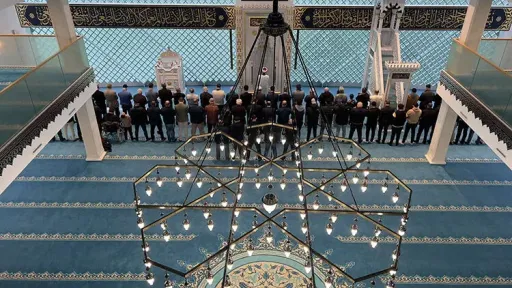
In a move reflecting France’s ongoing effort to reconcile Islam with its secular republican model, the Grand Mosque of Paris has released a 1,000-page handbook outlining how the faith can be practiced within the framework of the Republic.
Presented as a practical guide rather than a purely theological text, the publication arrives amid renewed debates over laïcité — France’s distinctive form of secularism — and the place of Muslims in public life. Its timing has given the work a political dimension, positioning it as both a religious reference and a civic manifesto.
Chems-Eddine Hafiz, rector of the mosque, said the aim is to “explain Islam to the Republic and explain the Republic to Muslims,” while helping counter what he described as the “disastrous image” of Islam in public discourse.
Two commissions were convened to examine how Islamic practice can align with republican principles, particularly secularism. The guide stresses that there is “no incompatibility between Muslim prescriptions and civil law,” advocating coexistence within France’s legal framework.
France’s distinct model of Laïcité
Any debate on religion in France inevitably centers on laïcité, rooted in the landmark 1905 law separating church and state. The law guarantees freedom of conscience while requiring strict neutrality from public authorities.
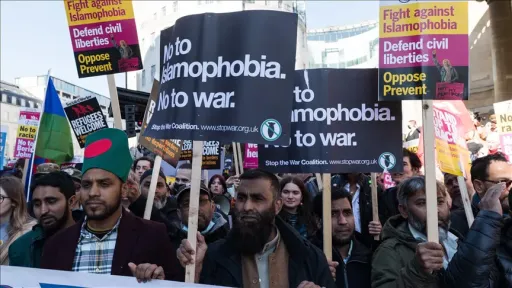
Originally designed to curb the political influence of the Catholic Church, critics argue that the principle has increasingly been invoked in ways that disproportionately affect Muslim communities.
Observers distinguish between a “secularism of law,” which enforces institutional neutrality, and a more expansive “secularism of control,” which some see as restricting visible religious expression.
Tensions around Islam’s place in France intensified in 1989 with the Creil headscarf affair, when three Muslim schoolgirls were expelled for refusing to remove their headscarves in class. The controversy reignited national debate and ultimately contributed to the 2004 law banning conspicuous religious symbols — including Islamic headscarves, large crosses and kippahs — in public schools.
More recently, authorities banned the abaya in public schools, arguing it contravenes religious neutrality. Supporters of the measure described the garment as a religious marker, while critics on the left denounced the decision as discriminatory and conflating culture with religion.
A broader social debate
Public discussion has also been shaped by terrorist attacks and broader concerns over security, often placing Islam at the center of political discourse. Sociological research indicates that since the 1980s, the notion of a “Muslim problem” has gained traction in segments of French debate.
At the same time, others argue that the issue is rooted less in theology than in social exclusion, pointing to discrimination and the marginalization of immigrant communities. According to recent surveys, 34% of Muslims report experiencing religion-based discrimination, up from 27% in 2016.
Against this backdrop, the new handbook seeks to reframe the conversation by emphasizing compatibility rather than confrontation.
Whether the initiative will ease tensions or simply highlight the depth of France’s unresolved debate over secularism remains uncertain. What is clear, however, is that the question of Islam’s place within the Republic continues to shape the country’s political and social landscape.