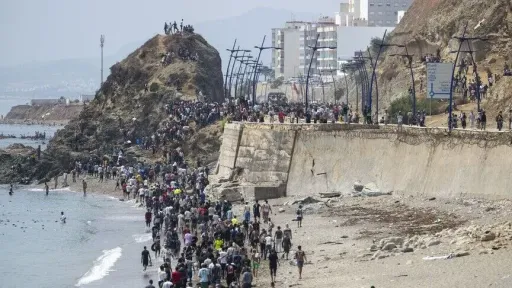
Spain defends Ceuta Border policy as Italy pushes EU for offshore migrant hubs

Spain has insisted that irregular entry into its North African enclaves of Ceuta and Melilla does not confer the right to remain in the country or travel freely within the European Union, as Italy prepares to propose the creation of EU-funded migrant return hubs outside the bloc in response to the latest migration crisis.
The exchange comes ahead of an emergency meeting of EU interior ministers, where migration and border management are expected to dominate discussions following the recent mass arrivals in Ceuta.
Spain: Supreme Court ruling does not alter immigration rules
Spain's Foreign Ministry rejected suggestions that a recent Supreme Court ruling had changed the country's immigration framework, stressing that existing border procedures remain fully in force.
According to the ministry, the ruling merely clarifies the legal procedures applicable to migrants arriving by sea and does not amend Spain's Immigration Act, invalidate border refusals, create new legal pathways into the country or prevent authorities from carrying out returns.
Officials also highlighted the reinforcement of border infrastructure, including a 500-meter maritime containment barrier at the Tarajal breakwater, describing the measure as compatible with both the court ruling and existing return procedures.
Spanish authorities said that nearly all migrants who crossed into Ceuta on July 30 had already been returned to Morocco.
The ministry further emphasized that Ceuta and Melilla operate under a unique border regime within Europe, involving an initial control at the frontier with Morocco and a second Schengen check before any travel by air or sea to mainland Spain. It reiterated that no individual may travel to mainland Spain without first undergoing police identification procedures.
Madrid also dismissed speculation that the recent arrivals could benefit from Spain's extraordinary regularization program, noting that the measure applies exclusively to migrants already residing in the country before Jan. 1, 2026. Those who entered on July 30 are not eligible, the ministry said, adding that "the only route is the legal one."
Italy to seek EU-backed return centers outside Europe
Meanwhile, Italy is expected to present a proposal for EU-financed migrant return centers outside the bloc, modeled on its Albania facilities, during Tuesday's ministerial meeting.
According to Italian media reports, Interior Minister Matteo Piantedosi will advocate establishing repatriation hubs in third countries, primarily in Africa, to process irregular migrants before their return to countries of origin.
Countries reportedly under consideration include Rwanda, Ghana, Senegal, Tunisia, Libya, Mauritania, Egypt, Uganda, Ethiopia, as well as Uzbekistan, Armenia and Montenegro.
The proposal follows Italy's decision to suspend Schengen-related arrangements with Spain for one month after the surge in migrant arrivals in Ceuta.
Rome is also expected to call for stricter implementation of the EU's Generalized Scheme of Preferences Plus (GSP+) mechanism, arguing that trade benefits for developing countries should be more closely linked to cooperation on the readmission of nationals residing illegally in the European Union.
Madrid and Rome exchange criticism
The migration crisis has also intensified diplomatic tensions between Spain and Italy.
Spanish Foreign Minister José Manuel Albares criticized Rome's handling of the situation, saying Italy had failed to demonstrate solidarity with Spain despite Madrid's previous support during migration emergencies on the Italian island of Lampedusa.
"There have been governments that did not rise to the occasion. The Italian government was one of them," Albares said, calling on European partners to show the same solidarity Spain had demonstrated in past crises.
Italian Foreign Minister Antonio Tajani rejected the criticism, arguing that Italy's migration policies should be judged by results rather than political statements.
"I do not respond to the Spanish foreign minister; the numbers do," Tajani said.
He cited government data showing irregular migrant arrivals in Italy had fallen significantly since 2023, attributing the decline to bilateral agreements with countries of origin and transit aimed at promoting legal migration while combating human trafficking.
Tajani also defended Italy's temporary suspension of Schengen-related arrangements with Spain, describing the measure as fully consistent with EU treaties.
Referring to the situation in Ceuta, he argued that more than 5,000 migrants who entered the enclave from sub-Saharan Africa could neither be returned to Morocco nor easily repatriated to their countries of origin.
"What will become of them? Where will they go?" Tajani asked, urging European partners to adopt more effective common solutions to irregular migration.
Source:AA