World leaders press for action on Gaza and UN reform

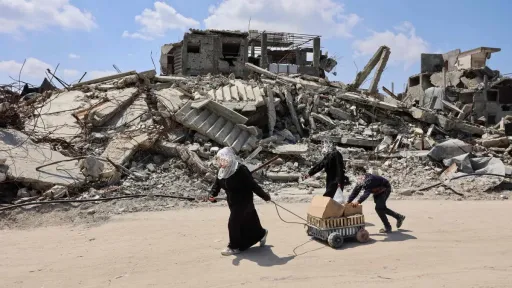
World leaders used the UN General Assembly this week to demand stronger international action over the war in Gaza, warn against further escalation in the Middle East and call for reforms to the global system.
Spanish Prime Minister Pedro Sanchez, French President Emmanuel Macron, Jordanian Foreign Minister Ayman Safadi and other leaders sharply criticized the humanitarian situation in Gaza and Israeli policies in the occupied West Bank, while US Secretary of State Marco Rubio warned against the emergence of another regional flashpoint.
The Palestinian issue featured prominently across the General Assembly despite the US refusal to grant Palestinian President Mahmoud Abbas a visa to attend the meetings in New York.
Sanchez calls for Security Council reform
Sanchez called for a fundamental reform of the UN Security Council, including fairer regional representation and the abolition of the veto held by its five permanent members.
He argued that no country should be able to act as “judge in its own case” because of its political power.
Sanchez said the principles of peace, sustainability and equal opportunity were under pressure from governments and political forces seeking to return the international system to a “dark past.”
He also condemned what he called the “genocide” being carried out by Israeli Prime Minister Benjamin Netanyahu in Gaza and cited Spain’s sanctions against Russia and arms embargo on Israel as examples of Madrid’s response to conflicts.
The Spanish leader accused opponents of multilateralism of deliberately weakening international institutions by challenging international rules, obstructing organizations and then portraying them as ineffective.
Sanchez also backed the election of a woman from Latin America as the next UN secretary-general, saying the organization had never been led by a woman.
Macron warns of crisis in international law
Macron said the international community’s credibility was at stake over the situation in Gaza, criticizing restrictions on humanitarian assistance and the continuing violence in the occupied West Bank.
He said claims that peace had been achieved in Gaza had not been matched by sufficient humanitarian deliveries and called the situation unacceptable.
Macron also warned that international humanitarian law and the Geneva Conventions were under severe pressure, saying civilian infrastructure and human rights were being damaged in conflicts around the world.
He called for reforms to the Security Council, including greater representation for new members and regions, and urged countries to establish stronger international rules governing artificial intelligence.
Jordan calls for measures against Israeli policies
Jordanian Foreign Minister Ayman Safadi said Israel would continue policies undermining the prospects for peace unless it faced effective international measures.
Safadi called for stronger action against settlement expansion, land confiscation and the worsening humanitarian situation in Gaza.
He said international support for a two-state solution must be translated into practical measures, describing the establishment of a Palestinian state as the only path to a lasting peace.
The comments came during a meeting on the sidelines of the General Assembly attended by representatives from 29 countries and the European Union.
Morocco urges ceasefire and aid access
Moroccan Foreign Minister Nasser Bourita called for full adherence to the Gaza ceasefire and urged uninterrupted humanitarian assistance to the enclave.
Bourita said Morocco would participate in international stabilization efforts for Gaza, including through training Palestinian police, establishing a military field hospital and deploying senior officers to internal security forces.
He reaffirmed Morocco’s support for an independent Palestinian state based on the 1967 borders, with East Jerusalem as its capital, and for the Palestinian Authority and UNRWA.
Bourita also warned that Israeli measures in the occupied West Bank, including land seizures and settler violence, could undermine the territorial basis of a future Palestinian state.
Bosnia warns against repeating past failures
Bosnia and Herzegovina’s Presidency Chairman Denis Becirovic warned the international community against remaining passive in the face of mass suffering in Gaza.
Drawing on Bosnia’s experience during the 1990s war, Becirovic said the international community must respond to widespread violations and hold perpetrators accountable.
He linked the Gaza conflict to broader global instability, including the war in Ukraine, conflicts in the Middle East and the crisis in Sudan.
Becirovic also called for action against efforts to glorify convicted war criminals, citing the legacy of the Bosnian war and the case of former Bosnian Serb military commander Ratko Mladic.
Washington warns against new West Bank crisis
Rubio said the Trump administration does not want to see a new crisis erupt in the West Bank, describing another escalation as an unnecessary additional flashpoint for the region.
He cited the fragile situation surrounding Gaza, tensions involving Lebanon, Iran and Yemen, and wider regional instability.
Rubio said Washington had communicated its position to the parties involved but declined to discuss potential US military responses to developments involving the Houthis.
He also reaffirmed US commitments to Saudi Arabia and accused Iranian-backed groups of targeting regional energy infrastructure and civilians.
Palestinian issue remains central
The Palestinian issue remained prominent at the General Assembly despite the US decision not to grant Abbas a visa.
Palestinian Presidency spokesman Nabil Abu Rudeineh said the attempt to prevent Abbas from attending had failed to sideline the Palestinian cause.
Abbas instead addressed the assembly through a recorded video after the General Assembly approved the arrangement.
Palestine has held nonmember observer state status at the UN since 2012. A majority of UN member states recognize the State of Palestine, while its bid for full UN membership continues to face obstacles in the Security Council.
The statements from leaders across Europe, the Middle East and beyond underscored the central role of Gaza, Palestinian statehood and reform of international institutions in this year's UN General Assembly debate.
Source:AA