Israeli forces withdraw from Hebron after 10-day siege

Palestinian governor announces return of displaced residents as retired Israeli general warns of deepening national crisis.
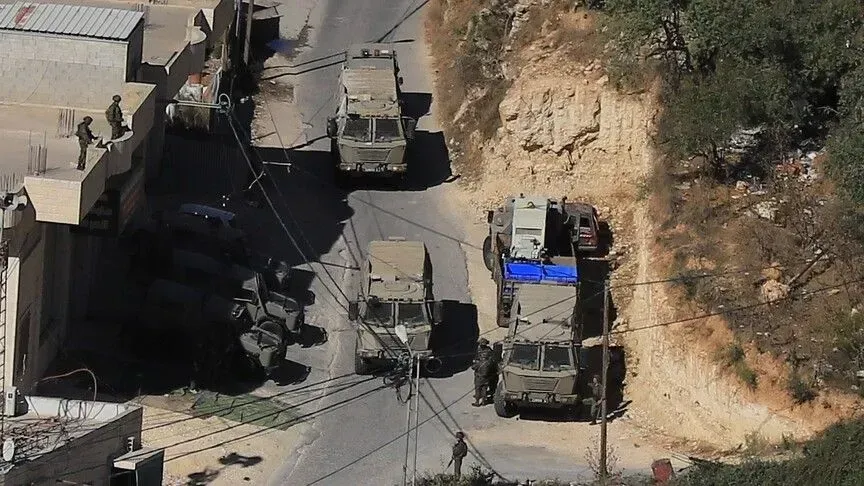
Israeli forces have withdrawn from the entire city of Hebron in the occupied West Bank after a 10-day military operation that displaced thousands of Palestinians, disrupted education and caused widespread damage to homes and infrastructure.
Hebron Governor Khaled Dudin announced Monday that Palestinian security forces had taken full control of the area following the Israeli withdrawal, allowing displaced families to return to their homes.
“Relevant authorities and Palestinian security forces are monitoring developments on the ground and working to provide the necessary conditions for residents to return safely,” Dudin said.
The Israeli operation, launched on October 23 following a shooting attack that killed two Israeli soldiers and wounded three others, involved extensive movement restrictions, home demolitions and the seizure of Palestinian properties for military use.
According to the Hebron Governorate, more than 3,300 Palestinians were displaced or otherwise affected, particularly in the Al-Jalda and Ein Deir Baha areas. At least 15 homes and other structures were demolished.
Education severely disrupted
The military operation also left nearly 80,000 Palestinian students unable to attend school during the previous week, according to the General Union of Palestinian Teachers.
A total of 220 public, private and UN-run schools in the central Hebron education district were affected by the closures, the union said in a statement carried by the Palestinian news agency WAFA.
The disruption left displaced children without access to textbooks and proper study facilities, while teachers faced difficulties reaching their workplaces.
The union also reported that Israeli forces detained 10 teachers from Jinba Basic Mixed School for several hours on Sunday along Khallat al-Dabaa Road in Masafer Yatta, south of Hebron.
Their vehicle was held, leaving students waiting for their teachers and disrupting the school day.
The union condemned the restrictions and detentions, describing them as an assault on the right to education and the dignity of Palestinian communities.
It called on international education organisations and teachers' unions to pressure governments to ensure safe access to schools and protect students and educators.
Israeli general warns of national collapse

Meanwhile, retired Israeli Major General Itzhak Brik has issued a stark warning about what he described as a deepening crisis within Israel, arguing that the country faces serious military, economic and institutional weaknesses.
In an opinion article published Sunday by the Israeli newspaper Maariv, Brik said Israel was losing international legitimacy and allies and could struggle to withstand prolonged diplomatic and economic isolation.
He described the situation as a comprehensive national crisis rather than a temporary political dispute.
Brik, a former commander of military colleges and former defence ministry ombudsman for soldiers' complaints, raised concerns about the condition of Israel's ground forces, warning of declining morale and structural weaknesses that could undermine the country's ability to respond to multiple security threats.
He also pointed to the economic burden of prolonged warfare, putting Israel's national debt at approximately 1.4 trillion shekels, or $445 billion.
Brik warned that potential economic sanctions, restrictions on arms supplies and growing international isolation could further intensify the pressure on the country.
He also criticised Prime Minister Benjamin Netanyahu's proposal to use cryptocurrencies to counter possible European sanctions, describing the idea as unrealistic.
Political divisions deepen
The retired general further warned that internal divisions were threatening Israeli society, describing the situation as a form of silent civil conflict.
He claimed that doctors, scientists, technology entrepreneurs and other highly skilled professionals were leaving the country, potentially weakening sectors that have contributed to Israel's economic and technological development.
Brik also accused the political leadership of undermining public institutions and the rule of law.
His warnings come amid continuing political uncertainty following the October 27 parliamentary elections.
Netanyahu's bloc secured 53 seats in the 120-member Knesset, while the opposition bloc led by Yashar party leader Gadi Eisenkot won 48. Arab parties secured the remaining 19 seats.
Neither of the two main blocs reached the 61 seats required for a parliamentary majority.
The developments in Hebron and the warnings from a former senior Israeli military commander come against the backdrop of continuing regional tensions, international criticism and growing debate within Israel over the political, military and economic consequences of prolonged conflict.
Source:AA