NATO leaders gather in Ankara for summit focused on defense spending, Ukraine and industrial cooperation

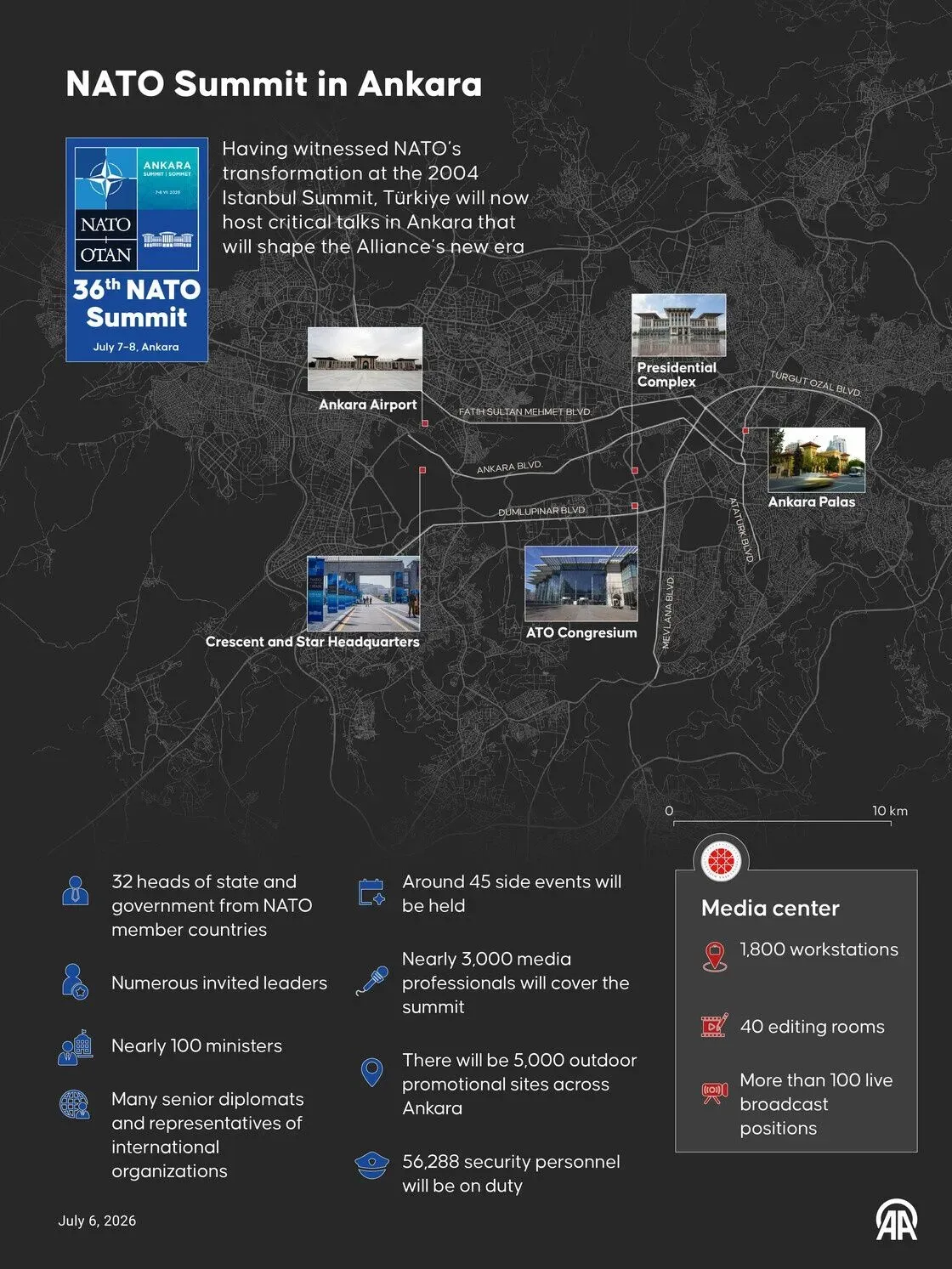
The 2026 NATO Summit opened in Ankara on Tuesday, bringing together leaders of the alliance's 32 member states, partner countries and senior officials for two days of talks expected to shape NATO's future priorities.
Defense spending, continued support for Ukraine, strengthening the alliance's defense industrial base and transatlantic burden-sharing are at the center of the agenda. Ukrainian President Volodymyr Zelenskyy is expected to participate in summit events.
Türkiye is hosting its second NATO summit after Istanbul in 2004 and is using the gathering to highlight its growing role within the alliance and its expanding defense industry.
Erdogan, Rutte discuss summit agenda
Ahead of the summit, Turkish President Recep Tayyip Erdogan met NATO Secretary General Mark Rutte at the Presidential Complex in Ankara.
According to Türkiye's Communications Directorate, the two discussed the summit agenda as well as regional and global developments.
Erdogan said Türkiye had completed preparations for the summit and expressed hope that it would produce positive outcomes. He emphasized the importance of addressing issues ranging from collective defense to enhanced defense industry cooperation among allies, while also highlighting the significance of the Defense Industry Forum taking place alongside the summit.
Defense spending tops agenda
Defense spending is expected to dominate discussions as allies seek to translate commitments made at the 2025 NATO Summit in The Hague into concrete military capabilities.
At last year's summit, NATO members agreed to raise defense and security-related spending to 5% of gross domestic product by 2035. Under the plan, at least 3.5% would be allocated to core military spending, while up to 1.5% could be invested in broader security priorities, including cyber defense, military mobility, critical infrastructure and defense industries.
Leaders are expected to review national implementation plans and discuss ways to accelerate military readiness through increased investment in personnel, weapons systems, ammunition and air defense.
The issue remains politically sensitive as many European governments face budgetary pressures while responding to longstanding U.S. calls for greater European contributions to collective defense.
Rutte calls for stronger military capabilities
Speaking before the summit, Rutte said NATO was already benefiting from Türkiye's defense industrial output and highlighted defense company ASELSAN as one example among approximately 3,000 Turkish defense firms.
"NATO is already very much profiting from what Türkiye is doing in terms of the defense industrial output," he said, adding that Turkish companies are supporting numerous allied countries.
Rutte also thanked Erdogan and the Turkish government for hosting the summit, describing the venue as "fantastic."
He stressed that increased defense spending must be translated into deployable military capabilities.
"Allies must translate our economic might into military capabilities," he said, urging members to invest in drones, missiles and air defense interceptors.
Rutte said NATO would announce tens of billions of dollars in new defense contracts during the summit's Defense Industry Forum, describing the effort as part of a broader expansion of allied defense production.
Ukraine remains central issue
Continued support for Ukraine is expected to remain one of the summit's defining topics as allies seek to demonstrate unity more than four years after Russia's invasion.
Leaders are expected to review progress on military assistance, including air defense systems, ammunition supplies and defense industrial cooperation with Kyiv.
Rutte described Russia's latest missile and drone attacks on Ukrainian cities as "another horrific attack" and said Ukraine's security remained closely linked to NATO's own security.
Türkiye has continued supporting Ukraine through military cooperation while maintaining diplomatic channels with Russia and previously hosting peace negotiations.
Zelenskyy is expected to participate in meetings of the NATO-Ukraine Council and hold discussions with allied leaders during the summit.
Defense industry cooperation in focus
A major feature of the summit is the NATO Summit Defense Industry Forum, which brings together senior NATO officials, defense ministers, military commanders and executives from leading defense companies.
The forum is expected to feature announcements of new defense contracts and multinational procurement initiatives aimed at increasing production capacity after shortages exposed during the war in Ukraine.
As host nation, Türkiye is showcasing its defense industry, with the Presidency of Defense Industries organizing a high-level reception at Turkish Aerospace Industries facilities in Kahramankazan, where domestic defense products will be displayed and indigenous aircraft will conduct demonstration flights.
Germany highlights European responsibility
Germany's Deputy Defense Minister Nils Schmid said the Ankara summit would demonstrate that European allies are assuming greater responsibility within NATO.
He said the meeting should send "a clear signal of unity," strengthen the transatlantic partnership and reaffirm NATO's central role in collective defense.
Schmid noted that all European allies now exceed NATO's previous 2% defense spending target and that Germany plans to reach the alliance's new 3.5% core defense spending benchmark by 2029, six years ahead of schedule.
He also said European allies were preparing for a gradual increase in their own defense capabilities as the United States shifts greater strategic attention toward the Indo-Pacific, emphasizing that any future reduction of U.S. forces in Europe should be carried out in close coordination with NATO partners.
Türkiye's strategic role emphasized
Schmid described Türkiye as a key contributor to NATO's defense posture, pointing to its role in Black Sea security, the alliance's southern flank and regional stability in the Middle East.
He also highlighted opportunities for closer German-Turkish defense industry cooperation, particularly in advanced technologies, drones and long-range missile systems, saying Germany is examining various options to address capability gaps as European allies expand defense production.
The Ankara summit is expected to conclude on Wednesday with allied leaders reviewing progress on defense spending commitments, military support for Ukraine and initiatives aimed at strengthening NATO's defense industrial capacity.
Source:AA