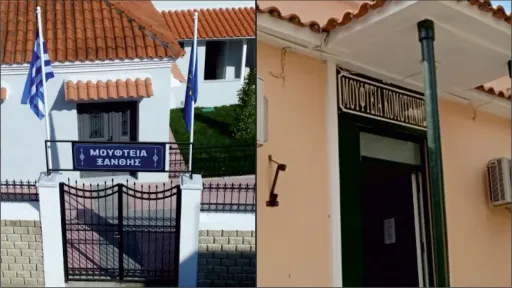
İskeçe tax office set to become taxpayer service centre under centralisation plan

Greece’s Independent Authority for Public Revenue plans to transform the İskeçe tax office into a taxpayer service centre, while the new regional tax centre is expected to be based in Dedeağaç. The proposal has drawn criticism from local figures and opposition from tax office employees, who warn that centralisation could make tax services less accessible across the region.
The tax office in İskeçe (Xanthi) is set to lose its traditional functions and become a taxpayer service centre as Greece continues to reorganise its tax administration through a network of centralised specialist units.
According to local newspaper Empros, the regional tax centre is expected to be headquartered in Dedeağaç (Alexandroupoli), a decision that has prompted criticism over the choice of location and concerns about the impact on taxpayers and public-sector employees.
THREE SPECIALISED TAX CENTRES
Greece’s Independent Authority for Public Revenue (AADE) has been transferring responsibilities from traditional local tax offices, known as DOYs, to three specialised structures:
- KEFODE (Tax Procedures and Service Centres): Handles income tax, value-added tax (VAT), taxpayer registration and compliance.
- KEVEIS (Assessment and Collection Centres): Manages revenue collection, outstanding tax debts and payment arrangements.
- KEFOK (Capital Tax Centres): Deals with property taxation, including E9 declarations, ENFIA property tax, transfers and inheritance.
In areas where the new centres have been established, former tax offices have been converted into Taxpayer Service Units (YFEs). These units often remain in the same buildings but focus primarily on assisting citizens with digital tax services, particularly people who have limited digital skills. They no longer retain the full range of functions previously handled by local tax offices.
The centralisation process has already been implemented in Attica, where the transition was completed in the summer of 2024, and in Thessaloniki in September 2026, according to the report. The reorganisation is now progressing in other parts of Greece.
CONTROVERSY OVER THE REGIONAL CENTRE'S LOCATION
Former regional councillor Michalis Amoridis has questioned the decision to base the regional tax centre in Dedeağaç (Alexandroupoli) rather than İskeçe (Xanthi).
Amoridis argues that İskeçe has a centrally located, publicly owned office building with sufficient space to accommodate the new structure without additional rental costs. He also maintains that the city offers a more accessible location for residents across the wider region.
He cited the potential burden on residents travelling from Drama to Dedeağaç (Alexandroupoli) to resolve tax-related matters and argued that economic development in Eastern Macedonia and Thrace should benefit all regional units rather than concentrate in one area.
Amoridis also criticised local political representation, arguing that İskeçe has not secured sufficient investment and administrative functions to prevent further regional decline. These comments reflect his assessment of the decision and its potential consequences.
TAX OFFICE EMPLOYEES OPPOSE CENTRALISATION
Employees at the İskeçe (Xanthi) tax office also oppose the restructuring model, according to Empros. They argue that dividing responsibilities among different centres could create difficulties for taxpayers, accountants, lawyers and public employees.
A representative identified in the report as Mr Nitis said the centralisation of tax services was not supported by employees. He warned that although staff members were not necessarily being transferred, the failure to replace departing personnel could gradually weaken local departments.
Under the proposed system, taxpayers and professionals handling their cases may need to contact different centres depending on the nature of the matter, including units in Gümülcine (Komotini), Dedeağaç (Alexandroupoli) or other cities. Previously, a broader range of services could be handled through the İskeçe (Xanthi) tax office.
Employees also recalled that nationwide union action last year temporarily halted the establishment of the centres in İskeçe. According to the report, local municipal councils, the chamber of commerce and other organisations issued statements supporting their concerns.
The employees' federation is planning further work stoppages, and staff are expected to participate in the nationwide public-sector strike called by ADEDY for 12 November, the newspaper reported.
The planned transformation of the İskeçe (Xanthi) tax office has therefore raised broader questions about how Greece's tax administration can balance administrative centralisation with local accessibility, particularly for residents and professionals who rely on in-person assistance.