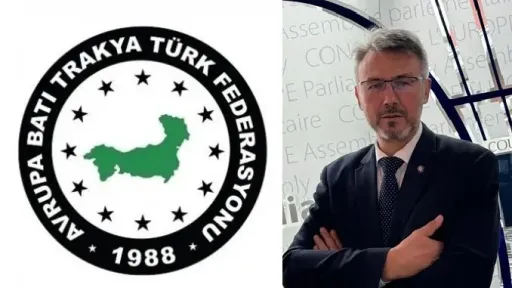
Ahmet Kara on the legal struggle of the Western Thrace Turks

Ahmet Kara on the Legal Struggle of the Western Thrace Turks
We spoke with Lawyer Ahmet Kara about the legal struggle of the Western Thrace Muslim Turkish Minority both within the country and on the international arena.
Lawyer Ahmet Kara from the İskeçe Bar Association is an experienced Western Thracian Turkish jurist who has so far handled and is still handling many cases related to association, freedom of the press, human and minority rights of the Western Thrace Turks.
Interview: Cemil KABZA
Q: Mr. Kara, what is the legal status of the Western Thrace Turks? With which treaties and conventions have they remained as a minority? Could you briefly summarize?
A: The Western Thrace Turks have an official minority status regulated in the section entitled Protection of Minorities between Articles 37 and 45 of the Lausanne Peace Treaty. For this reason, they were excluded from the Turkish–Greek Population Exchange signed on 30 January 1923, before the Lausanne Peace Treaty and as an annex to the main treaty.
Q: Various interpretations are made on the Lausanne Treaty. Why is the Lausanne Treaty so important for the Western Thrace Turks, does it still have validity today?
A: The Lausanne Peace Treaty is of importance as it is the treaty regulating the status of the Western Thrace Turks. Since it regulates the rights possessed by minority members, it is, so to speak, the source of existence of the minority. Of course, the Lausanne Peace Treaty is valid today as well. However, the problem is that our country Greece, contrary to its rhetoric regarding this treaty, does not comply with the provisions of the treaty in practice. It grants almost none of the rights regulated by the treaty to the minority.
Q: Are the treaties and bilateral protocols signed between Türkiye and Greece still valid, if there are changes what are they?
A: The treaties, conventions, and protocols signed between Türkiye and Greece continue to remain valid. Especially in the field of education and culture, there are important treaties and protocols, and in my opinion, apart from some changes aimed at implementation, there are no changes spoiling the spirit of the agreements. However, as I mentioned earlier, our country Greece, to which we are bound by citizenship, does not fully fulfill the obligations of these treaties and protocols it signed.
Q: Since 1981 Greece has been a full member of the EU. How much does it implement the EU acquis?
A: It is quite difficult to say that Greece has fully internalized and implemented the acquis of the EU, of which it has been a member since 1981. In fact, this incompatibility is valid not only in terms of minority rights but also in matters concerning daily life, and Greece is sentenced to pay heavy fines due to these incompatibilities, in other words, violations of EU law.
Q: Greece is also a member of the European Court of Human Rights (ECHR). What is the rate of applicability of the decisions given against the Greek state by the ECHR?
A: As you mentioned, Greece is among the members of the Council of Europe. Therefore, it has also accepted the competencies of the judicial organ of the Council, the ECHR. According to the statistical information provided by the Legal Council of the State representing Greece before the ECHR, as of 1.04.2024, there are 2450 applications against Greece before the ECHR. This number corresponds to 3.8% of the total number of applications before the ECHR and places Greece 5th among the countries against which applications have been filed. It would not be wrong to say that Greece implements the ECHR decisions given against it. However, unfortunately, this positive attitude is not valid for the ECHR decisions regarding Minority Associations. Greece insists on not implementing the ECHR decisions concerning associations attempted to be established by Turkish and Macedonian minority members.
Q: As we know, the ECHR has also convicted Greece on issues of refugees, racism, xenophobia, migration, human and minority rights. Does Greece implement the ECHR decisions, is it obliged to, and if it does not, is there a penalty?
A: As I also stated in the answer to the previous question, Greece pays attention to implementing the decisions given against it by the ECHR, except those related to Minority associations. Already, according to Article 46, Paragraph 1 of the European Convention on Human Rights (ECHR), each member undertakes to implement the decisions of the ECHR. According to Paragraph 4 of the same article, if the Committee of Ministers is of the opinion that a member state refuses to comply with a final ECHR judgment, after notifying the relevant state, it may bring the matter before the ECHR. If the ECHR determines that the member state has violated the provision of Article 46, Paragraph 1, sanctions up to expulsion from the Council may be applied to the relevant state.
Q: How compatible is the Greek judicial structure with the EU acquis and the world human rights acquis? Are there areas where changes need to be made?
A: Although Greece has been a member of the Council of Europe since 1949 and of the EU since 1981, it is unfortunately difficult to say that its legislation is very compatible with the EU acquis and international conventions on Human Rights. Greater effort must certainly be made so that the legislation becomes more in line with the EU acquis and human rights. However, in my opinion, in addition to the legal arrangements to be made, the judges who will implement these provisions must also behave objectively and make decisions in accordance with the case law of the ECHR.
Q: What is the perspective of the Greek judicial system especially on cases concerning human and minority rights and freedom of the press of the Western Thrace Turks?
A: Unfortunately, the judiciary of Greece has not shown good performance up to today in this matter. It is observed that there are quite a lot of judicial decisions against minority members with unfounded justifications in the field of freedom of association, minority rights, and freedom of the press. In short, judges mostly do not sign objective decisions in cases concerning minority members.
Q: Should Western Thrace Turks trust the Greek judicial system and the ECHR decisions?
A: As a jurist, it would not be very correct rhetoric to say that people should not trust the judicial decisions of the country they are citizens of. However, as I mentioned earlier, unfortunately in cases where members of the Turkish minority are parties, it is seen that objectivity is often not observed. As for ECHR decisions; up to today we observe that the ECHR has given quite objective and correct decisions in cases concerning the Turkish minority. Therefore, we can regard the decisions of the ECHR as more trustworthy.
Q: Finally, how should the decisions given by the ECHR in favor of the İskeçe Turkish Union (ITB) but which Greece has not implemented, and the most recent ones in favor of the İskeçe Province Turkish Women’s Cultural Association be interpreted, what expectations should the minority have?
A: As I stated earlier for ECHR decisions, the decisions given by the ECHR in applications concerning especially freedom of assembly and association, about associations that were closed or not allowed to be established because the word Turkish was in their names, are the clearest indication of how wrong is the practice of our country Greece in this matter of right. In this context, following the decisions regarding İskeçe Turkish Union, Meriç Minority Youth Association, Rhodope Province Turkish Women’s Cultural Association, and the more recently announced İskeçe Province Turkish Women’s Cultural Association, in my opinion, Greece, even if unwillingly, will have to implement these decisions. Already, the requirement of democracy and Human Rights is this. Implementation of these decisions means also a change in the state’s perspective toward the Turkish Minority, which is the ideal and desired by the minority members as well. In addition, implementation by our country Greece of the said decisions concerning these associations will pave the way for the restoration of the legal personality of the Gümülcine Turkish Youth Union and the Western Thrace Turkish Teachers’ Union, which did not apply to the ECHR for different reasons.
Q: As a member of the Western Thrace Muslim Turkish Minority and a jurist, what is your final message to the Western Thrace Turks?
A: As a lawyer who is a member of the Western Thrace Muslim Turkish Minority, my message to my kinsmen is that they should be braver in protecting and seeking their rights in every field. As long as we do not give up the struggle for rights, success will eventually be achieved.
Mr. Ahmet Kara, we thank you for this meaningful interview. We believe that your thoughts will contribute to a better understanding of the issues faced by the Western Thrace Turkish Minority. We once again thank you for sparing time and for your sincere answers, and we wish you success in your work.
[This interview prepared by Millet Newspaper editor Cemil Kabza was published in the August 2025 issue of İnsicam Magazine with the Western Thrace File.]