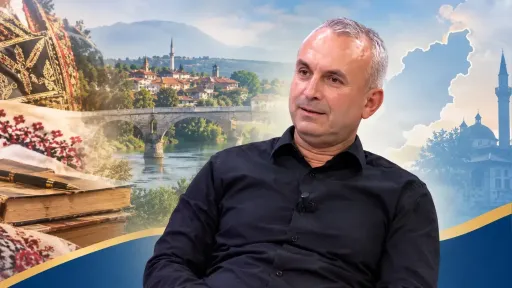
Historian Gürhan Yellice evaluates the repercussions of the Treaty of Lausanne in Greece

Continuing his studies in Greece, Dokuz Eylül University Atatürk's Principles and Revolution History Institute Lecturer Assoc. Prof. Dr. Gürhan Yellice explained how the Lausanne Peace Treaty, which is a turning point on the way to the establishment of the Republic of Türkiye, which was built on fully independent and national foundations under the leadership of Gazi Mustafa Kemal Atatürk, was received on the Greek front and what it means today.
Yellice, in a statement to AA correspondent, said that the Treaty of Lausanne, which entered its 100th anniversary, not only determined the borders of Türkiye and Greece, but also meant the end of the period of wars that continued uninterruptedly for 12 years in terms of world history.
Yellice stated that a climate of great disappointment and uncertainty prevailed in Greek politics and society after the War of Independence, which was considered as the "Asia Minor Disaster" in Greece, and that the soldiers led by Greek officers Colonel Plastiras and Colonel Gonatas ensured the abdication of King Constantine, dissolved the parliament, tried many people they held responsible for the defeat and executed 6 people a few days after the start of the Lausanne negotiations.
Gürhan Yellice emphasised that the revolutionary committee deployed the Greek army in Thrace before the negotiations and sent former Prime Minister Eleftherios Venizelos to the negotiations and said: "In the eyes of the committee, Venizelos was the only person who could minimise the damage that would result from the defeat with his diplomatic skills and experience. Venizelos, who ruled the country between 1910 and 1920, was familiar with all the issues to be negotiated, knew Greece's strengths and weaknesses well, and had close relations with the leaders of the allied states."
"War could have broken out during the negotiations"
Yellice stated that the negotiations in Lausanne were interrupted on 4 February 1923 due to "Greece's refusal to pay war indemnity", "the insistence of the allies on the continuation of the capitulations" and "Britain's determination not to give up Mosul" and that Greece put the war on its agenda again in this period, and evaluated that "When the negotiations were interrupted in Lausanne, war could have broken out between Turkey and Greece."
Yellice stated that the interruption of the negotiations caused a great excitement in the block within the Greek army, especially Plastiras, the leader of the revolutionary committee, who urgently needed a victory:
"Plastiras declared a new mobilisation and put the army on the Thracian border on alert and started to organise it to fight at any moment. His aim was to occupy Eastern Thrace and, if possible, even Istanbul through a fait accompli, thus making the trauma caused by the heavy defeat bearable, opening up space for the immigrants coming from Anatolia and consolidating his power by gaining prestige in the eyes of the Greek society. Greek archival sources clearly reveal that during the period when the negotiations were suspended and even resumed, Venizelos in Lausanne on the one hand and the military leadership in Athens on the other made strategic assessments about the war, tried to convince the allies on this issue, and carried out diplomatic initiatives before Romania and Yugoslavia in order to keep Bulgaria neutral."
Yellice stated that the diplomatic efforts of the Turkish delegation in Lausanne for peace, the common formula found on the issue of war indemnity, the determination of the allies not to allow any development that would threaten the "new order that was established with difficulty" prevented the outbreak of a new war, and that Greece was also concerned that Bulgaria could occupy Western Thrace in the event of a new war.
"The Treaty was a great disappointment for Greece in general"
Yellice underlined that the Lausanne Peace Treaty was seen by the supporters of Venizelos as "finally achieving peace", but it did not create excitement in Greece in general and continued as follows:
"Some people saw the Treaty as a great defeat. Because for Greece, the treaty meant that the project of creating a 'Greater Greece dominating two continents and five seas' by significantly restricting Turkish sovereignty in Anatolia with the Megali Idea and the Treaty of Sèvres had ended in a fiasco. The 'Eastern Question', the 'Asia Minor Question' had been concluded not as planned by Greece and the Great Powers, but within the framework of the resistance in Anatolia and the will of this resistance. Therefore, the treaty was a great disappointment for Greece in general. While some in Greece thought that this reality should be accepted, that the treaty promised a 'secure' future for Greece and that the focus should be on removing the economic and social wreckage caused by the war, others did not want to accept the results of the war and the conditions of the Treaty of Lausanne. This group was extremely angry, believing that they had been betrayed by the Great Powers and that the Treaty had been a great defeat; the exchange and economic hardship had fuelled this anger over time."
Yellice reminded that there are still those in Greece who consider the treaty as a defeat and said: "The Lausanne Peace Treaty is the only treaty signed after the First World War that still preserves its validity. In the eyes of Greece, the treaty, which was extremely controversial in 1923 in terms of its results, is today considered as a 'safe harbour'. The balance of Lausanne is considered to be of vital importance and its blessed conditions are not wanted to be discussed in any way."