New democracy leads as political discontent deepens

New Democracy maintains a clear lead in voting intention, while the latest Interview poll shows widespread political dissatisfaction and limited public appetite to reward the government.
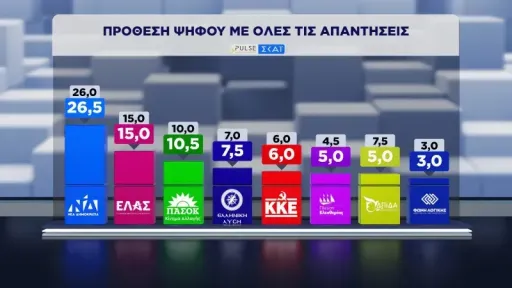
New Democracy receives 26.3% in voting intention, 12.6 percentage points ahead of the Elas party at 13.7. Pasok follows in third place with 11.9%, while Greek Solution records 9.2% and the Communist Party 6.3%.
Elpida for Democracy stands at 4%, Voice of Logic at 3.2%, and both Course of Freedom and MeRA25 at 2.8%.
Syriza receives 2.2%, Democrats 1.5%, Niki 0.6% and New Left 0.4%. Another party is selected by 4.1%, while undecided voters account for 11%.
New democracy reaches 29.1% in estimate
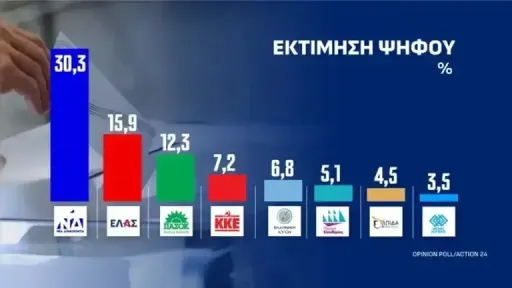
In the poll’s estimate of the electoral result, New Democracy rises to 29.1%, compared with 15.5% for Elas, giving the ruling party a 13.6-point lead.
Pasok is estimated at 13.2%, followed by Greek Solution at 9.4% and the Communist Party at 7%.
Elpida for Democracy is estimated at 4.8%, Voice of Logic at 3.9%, Course of Freedom at 3.1% and MeRA25 at 3%.
Syriza stands at 2.8%, Democrats at 1.8%, Niki at 0.7% and New Left at 0.5%, all below the electoral threshold. Another party reaches 5.2%.
Protest remains a major voting motive
Despite New Democracy’s lead, the survey points to strong dissatisfaction with the political system.
Twenty-eight percent say they would vote primarily to express protest against the political system if elections were held today. Another 27% would vote to strengthen the opposition, while 18% would seek to reduce the government’s power.
Only 24% say their main objective would be to reward the government.
Thirty-two percent believe the political system needs new political figures rather than new parties. Twenty-nine percent say existing parties can still provide solutions, while 21% favor the creation of new parties. Fourteen percent say they are not represented by any party.
At the same time, 45% consider the formation of a stable single-party government the most important success for Greece after the next election. Forty-one percent prefer a coalition government.
Samaras party could draw 12%
The prospect of a new party led by former prime minister Antonis Samaras also features in the survey.
Five percent say they would be very likely to vote for such a party, while 7% say they would be fairly likely to do so. Together, the potential support reaches 12%.
Another 9% consider it somewhat likely, while 78% say they would be not at all likely to vote for such a formation.
The finding measures potential rather than declared voting intention, but indicates the size of a possible electorate for a new party positioned to the right of New Democracy.
Cost of living weighs on government
Among former New Democracy voters who are now undecided or considering another party, the cost of living is the leading source of dissatisfaction, cited by 27%.
The OPEKEPE agricultural subsidy scandal follows at 20%, while the handling of the Tempi rail disaster is cited by 19%.
The issue of same-sex marriage accounts for 10%, the deemed income system for self-employed workers for 9%, and the surveillance scandal and national issues for 7% each.
The cost of living is also the top issue voters want the next government to address during its first two years, at 23%.
Corruption follows at 12%, while higher wages and pensions and the administration of justice each receive 11%. Public healthcare is cited by 10%.
Disappointment dominates public mood
Disappointment is the strongest emotion among voters ahead of the next national election, at 32%.
Anger follows at 23%, while hope stands at 22%. Insecurity is reported by 15%, indifference by 6%, and 2% did not respond.
Asked which quality is most lacking among today’s political leadership, 40% identify honesty.
Contact with society follows at 22%, effectiveness at 12% and sincerity at 11%.
Limited expectations from Thessaloniki announcements
The survey also suggests that government announcements at the Thessaloniki International Fair are unlikely to significantly change the views of dissatisfied former New Democracy voters.
Among New Democracy voters who are currently undecided or considering another party, 80% say it is unlikely or very unlikely that the prime minister’s announcements will change their position.
Only 15% consider such a shift very or fairly likely.
The nationwide Interview poll was conducted for Political newspaper from Aug. 26 to Sept. 1, 2026, among 4,082 respondents aged 17 and over.
The poll has a margin of error of plus or minus 1.5 percentage points, with a 95% confidence level.