Mosque demolitions fuel India’s battle over history

Khan argues that claims about historical Hindu-Muslim conflict are being used by elements of the Hindutva movement to frame contemporary disputes over Muslim places of worship, turning contested memories of the past into a political instrument in the present.
From Ayodhya to Ujjain, disputes over whether mosques were built on earlier Hindu religious sites have increasingly entered political and legal debates.
A contested version of history
Khan traces the narrative of prolonged Hindu humiliation under Muslim rule to colonial-era interpretations of Indian history.
He points to British historian James Mill’s division of India’s past into Hindu, Muslim and British periods as an important influence on later interpretations.
Hindu nationalist thinker V.D. Savarkar subsequently developed a narrative centered on Hindu resistance to Muslim rule.
Khan argues that this interpretation overlooks long periods of coexistence and interaction between religious communities.
During the Mughal period, Hindu figures held senior positions in the imperial administration and military. Emperor Akbar promoted a policy associated with religious accommodation and expanded Hindu participation in government.
The Mughal court also sponsored Persian translations of Hindu texts, while Mughal rulers issued grants to Hindu temples and religious figures.
For Khan, these examples challenge the portrayal of the entire Muslim period as an uninterrupted history of Hindu oppression.
Ayodhya set the precedent
The demolition of the Babri Masjid in Ayodhya in 1992 became a defining episode in India's modern religious politics.
Hindu activists claimed that the 16th-century mosque stood at the birthplace of Rama, a major Hindu deity. On Dec. 6, 1992, activists associated with the Ram Janmabhoomi movement demolished the mosque.
The destruction was followed by communal violence that killed more than 2,000 people, most of them Muslims.
In 2019, India's Supreme Court awarded the disputed site for the construction of a Hindu temple while describing the mosque's demolition as a serious violation of the rule of law.
Prime Minister Narendra Modi inaugurated the Ram temple in January 2024.
Khan describes Ayodhya as a turning point in which a historical grievance moved from political mobilization into a state-backed religious ceremony.
Disputes spread to other sites
According to Khan, claims involving historic mosques have since multiplied, including disputes in Sambhal, Ajmer, Dhar and other parts of India.
He argues that each new legal or administrative decision can strengthen the basis for subsequent disputes, creating a cycle in which contested historical narratives increasingly influence present-day religious policy.
In Dhar, the medieval Kamal Maula mosque has been at the centre of a long-running dispute involving competing Hindu and Muslim claims over the site.
Khan presents the case as an example of how historic religious claims can challenge earlier arrangements that allowed communities to share contested spaces.
Demolitions raise broader questions
Khan notes that India has no comprehensive national official record documenting demolitions of Muslim religious and community sites since the Bharatiya Janata Party came to power in 2014.
He cites state-level figures and media compilations indicating hundreds of structures have been removed in recent years.
Uttarakhand authorities have reported removing hundreds of tombs, while Gujarat officials told the state assembly that more than 100 religious structures had been demolished.
The author acknowledges that authorities often describe such actions in terms of encroachment, zoning, land records or infrastructure development rather than religious identity.
He argues, however, that the pattern becomes more politically significant when demolitions involve Muslim sites that have already been targeted by broader campaigns over mosques, madrassas or waqf property.
Hazratbal controversy
The struggle over religious identity has also extended to Kashmir.
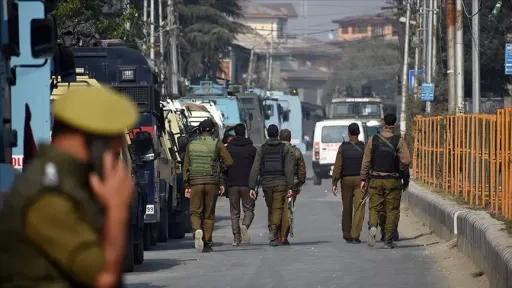
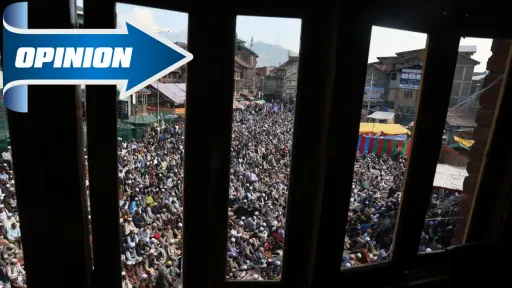
In September 2025, the Jammu and Kashmir Waqf Board installed a plaque bearing India's national emblem inside Srinagar's Hazratbal shrine, which houses a relic revered by Muslims as a hair of the Prophet Muhammad.
Worshippers objected to the installation and removed the plaque. The Waqf Board condemned the action, while police detained dozens of people.
Khan presents the episode as another example of tensions surrounding the relationship between state authority, national symbolism and Muslim religious spaces.
Legal safeguards under pressure
India's Places of Worship Act of 1991 was designed to preserve the religious character of places of worship as they existed at independence, with Ayodhya explicitly excluded from its provisions.
The law was intended to prevent historical disputes over religious sites from becoming a recurring source of litigation.
In late 2024, India's Supreme Court also restricted punitive demolitions and halted the registration of new lawsuits seeking to challenge the religious character of mosques.
Yet challenges to the 1991 law remain pending, while individual disputes continue to reach courts.
A battle over historical memory
Khan's central argument is that the controversy is about more than buildings and land.
In his Daily Sabah analysis, he describes what he calls “Hindutva through memory” — the selective construction of a historical narrative in which present-day Muslims are made responsible for grievances attributed to earlier periods of Muslim rule.
The author argues that such a narrative risks transforming historical disputes into contemporary punishment of people who had no involvement in the events being contested.
The debate therefore extends beyond the fate of individual mosques.
It concerns how India understands its past: as a history marked by centuries of interaction, accommodation and conflict between communities, or primarily through a narrative of religious conquest and historical humiliation.
As disputes continue to move through India's courts and government institutions, the struggle over religious sites is increasingly becoming a struggle over historical memory — and over whether contested interpretations of the past should determine the rights and security of religious communities in the present.
Source: Umair Pervez Khan, Daily Sabah