El Nino could become strongest on record, raising global heat risks

El Nino is rapidly strengthening and could become the most powerful event recorded since 1950, with a 70% chance of surpassing the major 1982-83 episode, according to the US National Oceanic and Atmospheric Administration.
The climate pattern is expected to peak in late autumn or early winter, potentially pushing global temperatures to new highs and increasing the risk of extreme weather.
NOAA’s latest forecast indicates the event could exceed the strength of the 1982-83 “Super El Nino.” Experts warn that its effects could be amplified by ongoing global warming.
Record heat possible
Climate scientist Levent Kurnaz, director of Bogazici University’s Climate Change and Policy Research Center, said the combination of a strengthening El Nino and already elevated global temperatures could produce record-hot months.
“There will be an upward jump in average temperatures worldwide,” Kurnaz said, adding that El Nino’s short-term warming effect is being superimposed on a climate system that is already warming.
He said 2027 could become the hottest year on record, while 2026 could also potentially break the existing record.
Sea temperatures point to strong event
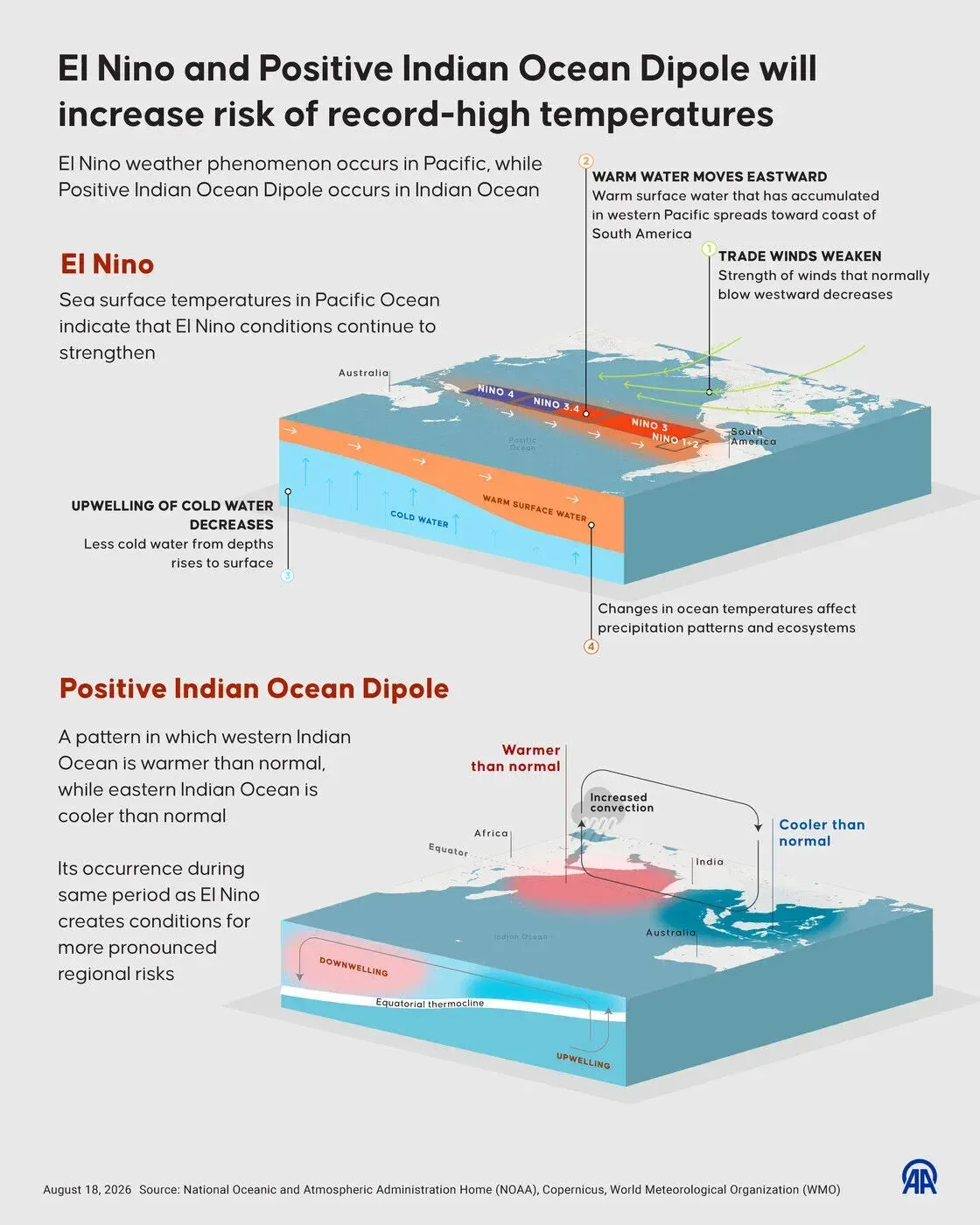
El Nino is characterized by unusually warm ocean temperatures in the tropical Pacific, which can alter weather patterns around the world.
Data from Columbia University’s International Research Institute for Climate and Society showed sea surface temperatures in the Nino 3.4 region, a key monitoring area, were recently 2.1 degrees Celsius above the long-term average.
The anomaly had stood at 0.98 degrees in April-May and 1.55 degrees in June.
Kurnaz said an anomaly of 2 degrees or more is generally considered a very strong El Nino. Forecasts for August through October suggest the event could reach levels comparable with the major 1997-98 and 2015-16 episodes.
The World Meteorological Organization expects El Nino to become a dominant influence on global climate during the August-October period, increasing the likelihood of above-normal temperatures across much of the world and changing rainfall patterns.
Drought and flooding risks rise
The effects of a strong El Nino are expected to vary by region.
Kurnaz said Indonesia, eastern Australia and southern Africa could face greater drought risks, while areas around the eastern Pacific and western South America could experience heavier rainfall and flooding.
El Nino also typically reduces Atlantic hurricane activity.
Indian Ocean pattern could amplify risks
Kurnaz said the simultaneous development of a positive Indian Ocean Dipole could intensify some regional effects.
The pattern occurs when waters in the western Indian Ocean become warmer than normal while waters in the east become cooler.
The overlap of the two climate patterns could make regional weather impacts more severe, Kurnaz said.
He stressed that climate change remains a critical factor because rising global temperatures create a higher baseline from which El Nino-related heat can intensify.
Türkiye faces prolonged heat
For Türkiye, Kurnaz does not expect El Nino to cause major changes in overall rainfall patterns.
However, he said the country could experience continued temperature anomalies and a longer period of elevated wildfire risk, particularly in the Mediterranean region.
El Nino and La Nina are opposite phases of a recurring climate pattern in the Pacific Ocean.
El Nino is associated with unusually warm Pacific waters and generally higher global temperatures, while La Nina is linked to cooler conditions.
Periods between the two phases are considered neutral, when more typical weather patterns prevail.
Source:AA