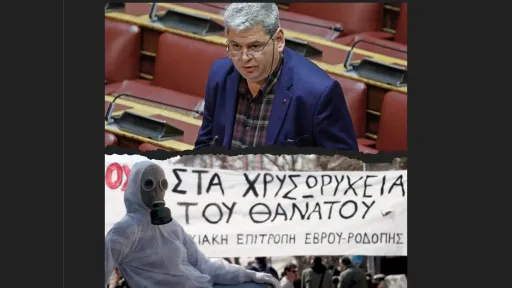
MP Burhan Baran condemns “Kalanda” practice at Dolaphan Middle School: “This is an attempt at assimilation”

The incident has sparked widespread outrage within the Turkish Muslim community of Western Thrace, reigniting concerns over religious freedom, cultural identity, and minority rights in education.
“Unacceptable and Contrary to Universal Education Principles”
In a statement based on images shared on social media and information reported in the press, Baran emphasized that there are no Orthodox Christian students at Dolaphan Middle School. He described it as unacceptable that a religious and cultural practice belonging to Orthodox Christianity was imposed on Muslim children.
Baran stated that the practice clearly contradicts universal principles of education, as well as freedom of religion and conscience, and stands in direct opposition to the beliefs and values of the Muslim minority.
“A Clear and Prohibited Assimilation Policy”
The MP described the official teaching and performance of Christian Kalanda hymns to Muslim students as “a clear attempt at assimilation”, stressing that such practices are prohibited under existing laws.
He warned that imposing religious rituals on children without regard for their faith and identity constitutes a serious violation of their cultural, religious, and personal integrity, and represents a profound lack of respect for the minority community.
Call for Immediate Action and Accountability
Baran underlined that educational environments must be shaped on the basis of respect for students’ religious and cultural identities, adding that ignoring this principle in schools attended by minority students is unacceptable.
He called on relevant authorities, and particularly the administration of Dolaphan Middle School, to issue an immediate explanation, take the necessary steps against those responsible, and implement safeguards to ensure that similar incidents never occur again.
Minority Education Under Scrutiny Once Again
The incident has once again brought to the forefront the longstanding sensitivities faced by the Turkish Muslim Minority of Western Thrace in the field of education. Attention is now focused on how state authorities will respond and whether concrete measures will be taken to address community concerns.