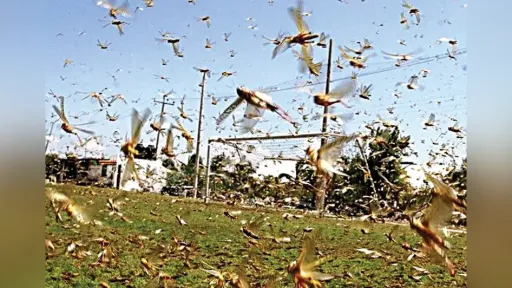
Locusts return to Thrace amid drought: No crop damage reported yet

Farmers, agronomists, and academics in Thrace are expressing concern over the notable resurgence of locusts in the region this year, linked to ongoing drought conditions. Similar locust outbreaks were observed 2-3 years ago along the border areas of the Rodopi and Meriç (Evros) prefectures, largely attributed to vast uncultivated lands.
Triantafyllos Papadakis, President of GEOTEE Thrace (Association of Agricultural Engineers), explains that locusts lay their eggs in undisturbed soil, which favors their reproduction. Conversely, plowing or tilling the soil disrupts the eggs, preventing hatching.
“Locusts are typically solitary insects that find food and live alone. However, when food becomes scarce due to reduced rainfall and subsequent grass shortages, their behavior changes. They may release aggregation pheromones, prompting them to group and swarm,” Papadakis detailed, linking the behavioral shift to drought conditions.
He added that the swarming locusts tend to have large wings and small legs, enabling them to travel greater distances. “If the mother locusts starve, the first generation inherits these characteristics,” he noted, citing past locust invasions on the largely barren island of Agios Efstratios and sightings near a livestock farm north of Alexandroupolis, where locusts were feeding on dry grass.
No Spraying Planned
When asked about control measures, Papadakis stressed that spraying insecticides over such large areas is impractical and potentially harmful. “Using insecticides disrupts ecological balances. Since locusts are much larger than other insects—for example, one locust weighs 20 times more than a ladybug—it would require large quantities of toxic chemicals that could kill many beneficial insects as well,” he warned.
He mentioned ongoing research into bait pesticides as alternatives to potent neurotoxins. In North Africa, where locust swarms are common in barren areas, promising experimental biological controls involve the fungus Metarhizium acridum, which parasitizes young locusts, although this method remains under study.
Birds and small carnivorous mammals are natural predators of locusts, Papadakis added.
To date, locusts have not caused damage to crops, as cereal harvesting has been completed and no locust invasions have been reported in corn or cotton fields. “Cotton fields are regularly plowed, which prevents locust population buildup,” he explained.
Finally, Papadakis called for reforms in the Common Agricultural Policy (CAP), particularly regarding subsidies for leaving land fallow, to help manage the problem more effectively.