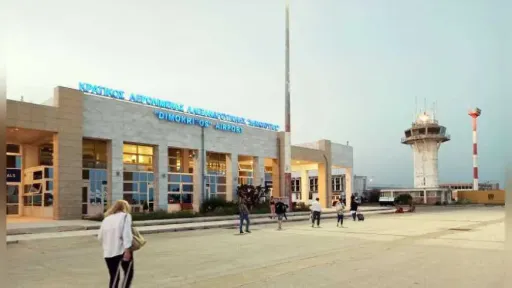
Greece’s €400 million Dedeağaç power plant targets 2028 launch

A €400 million natural gas-fired power plant being developed by Public Power Corporation (PPC) and DEPA Commercial in Dedeağaç (Alexandroupoli) is on track to complete construction by the end of 2027, with electricity generation expected to begin in 2028, according to the project’s current schedule.
The 840-megawatt (MW) facility is designed to strengthen Greece’s electricity supply while creating additional opportunities to export power to Southeast European markets, including Bulgaria and North Macedonia.
Construction is underway at the Alexandroupoli Industrial Area on a 181-stremma site, equivalent to approximately 18.1 hectares. PPC holds a 71% stake in the project, while DEPA Commercial owns the remaining 29%.
The consortium aims to begin testing toward the end of 2027. The plant is expected to contribute to Greece’s electricity system during 2028, provided the construction and commissioning schedule remains on track.
840 MW capacity and 63% efficiency
The combined-cycle gas turbine (CCGT) plant will have an installed capacity of 840 MW, with estimated annual electricity generation of up to 5 terawatt-hours (TWh).
Its technology will use both a gas turbine and a steam turbine to generate electricity, recovering heat from gas combustion to produce additional power and improve overall efficiency.
The planned equipment includes a 571 MW gas turbine supplied by General Electric and a 269 MW steam turbine. The plant’s expected efficiency of approximately 63% would reduce fuel consumption per unit of electricity generated compared with less efficient conventional thermal facilities.
The equipment is also designed to accommodate a fuel blend containing up to 50% hydrogen by volume. This capability could offer greater flexibility as the energy sector evolves, although its practical use will depend on hydrogen availability, fuel supply arrangements and the necessary infrastructure.
Gas infrastructure and regional electricity exports
The plant’s location is strategically significant because Dedeağaç (Alexandroupoli) has become an important hub for natural gas infrastructure and cross-border energy connections.
The facility is expected to receive gas through an underground pipeline connecting it to Greece’s National Natural Gas System in the Anthia area of the Evros region, known in Turkish as Meriç. It is also expected to benefit from liquefied natural gas (LNG) entering the Greek system through Gastrade’s floating storage and regasification unit (FSRU) in Alexandroupoli.
On the electricity side, the plant will connect to the Independent Power Transmission Operator’s (IPTO/ADMIE) ultra-high-voltage substation at Nea Santa. The site is also a key point for cross-border electricity flows, including the second Greece–Bulgaria interconnection linking Nea Santa with Maritsa East.
These connections could enable the facility to supply electricity to neighbouring markets as well as domestic consumers. Potential export destinations include Bulgaria and North Macedonia, with access to Serbia possible through the wider regional transmission network.
Planned improvements to the Greece–Bulgaria interconnection are expected to increase transfer capacity to 1,400 MW from Greece to Bulgaria and 1,700 MW in the opposite direction. Such capacity could create additional opportunities for cross-border electricity trading, although actual exports will depend on market prices, demand, available transmission capacity and the plant’s operating economics.
Supporting renewable energy integration
The project is also intended to complement the growing share of renewable energy in Greece’s electricity mix.
Solar and wind generation fluctuate with weather conditions, creating periods when output may fall below demand. Flexible thermal power plants can help maintain supply during these periods and respond to changes in electricity consumption.
The Alexandroupoli facility is expected to provide additional dispatchable capacity, potentially helping balance variable renewable generation and strengthen the resilience of the electricity system.
However, the plant’s contribution to the energy transition will depend partly on how frequently it operates, the cost and carbon intensity of its fuel, and the pace at which lower-carbon alternatives become available.
A strategic investment for Southeast Europe
With an investment value of €400 million, the Alexandroupoli power plant is positioned as both a domestic electricity-generation project and a potential contributor to regional energy trade.
Although the planned doubling of the Karperi–Komotini natural gas pipeline has reportedly been delayed by a year, the project’s current schedule has not been substantially revised. Nevertheless, the development of gas transmission infrastructure remains important to ensuring that the plant can operate at its intended capacity.
If construction, testing and commissioning proceed as planned, the 840 MW facility could begin contributing to Greece’s electricity supply in 2028, strengthening the country’s generation capacity and expanding its potential role in Southeast Europe’s interconnected energy market.