Minister Zaharaki’s claim does not reflect reality: Nothing has changed, the Minority did not elect the “new muftis”
Presenting an injustice in different packaging does not turn it into a right. Marketing an imposition as democracy does not make that imposition legitimate either.
Greece has introduced a new method in the long-standing muftiate dispute, to which the Muslim Turkish Minority of Western Thrace has been objecting for years. The procedure for appointing muftis was changed through Law No. 4964, adopted in 2022. This time, instead of making direct appointments, the state established a 33-member Advisory Board. At first glance, this was presented as an apparently more participatory and democratic approach. But has the fundamental thinking behind the new procedure actually changed? That is the real question that needs to be examined.
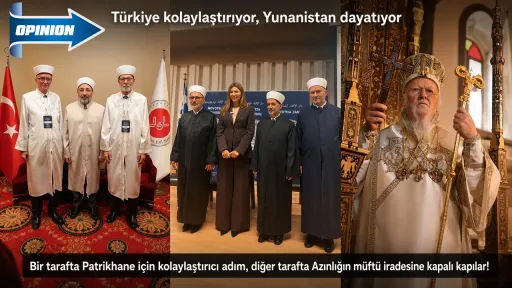
Indeed, the remarks made by Minister of Education and Religious Affairs Sofia Zaharaki at a ceremony held in Komotini on 13 November clearly revealed how the state is marketing this new procedure. Defending the new system, Minister Zaharaki declared: “The new muftis of the Muslim Minority are people chosen by Muslims themselves. That is the reality.” With her statement that “the old days are over; things are different now”, she also sought to convey the message that a new and democratic era had begun in the appointment of muftis.
But have things really changed?
First, let us look at the system introduced by the 2022 law. The 33-member Advisory Board is not composed of representatives elected by the Minority through a ballot. Some of its members are selected by lottery from among certain religious officials and educators, while five members are appointed on the recommendation of the serving mufti. The board expresses its views on the qualifications of candidates. The final decision, however, rests with the Minister of Education and Religious Affairs, while the appointment of the mufti is completed through a presidential decree.
Now let us ask: If Muslims in Western Thrace really elect their mufti, why does the final decision still rest with a government minister? Why is the direct will of the community not sought? Is an advisory board evaluating candidates the same thing as the people choosing their own religious leader?
What is being attempted here is not the abolition of the old system, but its reorganisation under a different appearance. The direct appointment previously made by the state is now carried out with a 33-member board placed in between. The method may have changed; however, the final say over who becomes mufti still belongs to the state. Therefore, presenting this process as the Minority choosing its own mufti is to portray reality differently from what it actually is.
Moreover, the issue is not merely legal and administrative in nature. The way the new procedure is presented to the public is just as thought-provoking as the procedure itself. What is the Minister's declaration that “Muslims chose them themselves” if not an attempt to equate the method preferred by the state with the will of the community? Presenting an administrative process as a democratic election does not automatically make that process democratic.
Then come the ceremonies, official statements, protocol photographs and media reports. The appointed individuals are presented as the religious leaders of the community. Through the titles conferred by the state, the prestige afforded by official institutions and the visibility created by the media, an appearance of social acceptance is sought. In other words, the state's choice is first implemented, and then an attempt is made to create the perception that this choice has been embraced by the community.
Even more troubling is the attempt to portray a practice to which the community has objected for years as a democratic achievement offered to the Muslim Turkish Minority, or even as a gift bestowed by the state. What kind of understanding of democracy is it to disregard a community's will to determine its own religious leader and then present that intervention as a right granted to it?
In my view, the real problem goes beyond the state appointing someone while disregarding the will of the community. It lies in the state's attempt to present its own choice as a decision that has gained social legitimacy. Because acceptance by official authorities and acceptance by the community are not the same thing. The state may declare someone a mufti; however, it cannot decide on its own that this person has been embraced by the community as its religious representative.
We must not forget the legal dimension of this issue either. The provisions of the Treaty of Lausanne concerning the religious rights of minorities, together with the freedom of religion guaranteed by the European Convention on Human Rights, are among the fundamental points of reference in this debate. The European Court of Human Rights' judgments in Ibrahim Serif and Mehmet Emin Ağa v. Greece also serve as a reminder of the limits on state interference in religious communities' autonomy over their own religious affairs. The state's responsibility is not to shape a community's religious representation according to its own preferences, but to safeguard freedom of religion.
The demand of the Muslim Turkish Minority of Western Thrace is neither a request for privilege nor a challenge to the state. The demand is perfectly clear: respect for the community's will and consent when it comes to its own religious leaders.
The Greek state's appointment-based approach of the past is being continued today through a different method and a more elaborate rhetoric of democracy. Placing a board in between, establishing a multi-stage procedure and telling a story of democratic success at official ceremonies do not mean that the will of the community is genuinely being recognised.
Presenting an injustice in different packaging does not turn it into a right. Marketing an imposition as democracy does not make that imposition legitimate either.
The person appointed by the state may be an official mufti. But without the acceptance and trust of the community, the claim that this person is its genuine religious leader cannot be turned into reality through ceremonies, protocol or media campaigns.
Because religious autonomy is not an administrative matter to be shaped through boards established by the state. It belongs to the community, its faith, its conscience and its free will.
Religious autonomy cannot be controlled through imposed muftis.