Papadopoulou says Greece wants Türkiye as a partner, not a dominant regional power

Greek Deputy Foreign Minister Alexandra Papadopoulou has called for cooperation and dialogue with Türkiye, while rejecting any country's ambition to dominate the Eastern Mediterranean. Speaking at the London School of Economics (LSE), she said Greece wanted Türkiye as a partner but would not accept challenges to its sovereignty rights.
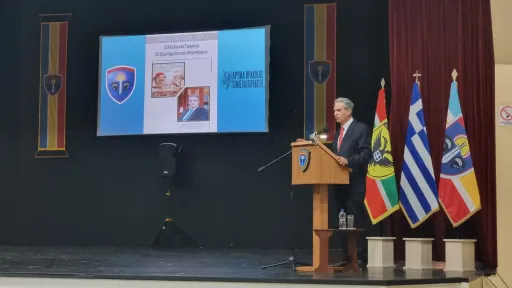
Papadopoulou outlined Athens' foreign policy priorities during an event organised jointly by the LSE European Institute and the Hellenic Observatory in London. In a discussion with academic Jennifer Jackson-Preece, she addressed Greek-Turkish relations, developments in the Eastern Mediterranean and wider regional security issues.
'WE WANT TÜRKİYE AS A PARTNER, BUT NO ONE CAN DOMINATE THE REGION'
Addressing relations between Athens and Ankara, Papadopoulou acknowledged Türkiye's geopolitical importance but stressed that no country should seek a position of dominance in the Eastern Mediterranean.
"We want Türkiye as a partner. But no one wants Türkiye or any other country to become the dominant power in the region. No one can hold a position of supremacy in our region. That would be an invitation to disaster," she said.
She also reiterated that Greece was prepared to engage in dialogue and cooperation with Türkiye, provided that its sovereignty rights were not called into question.
GREECE CRITICISES TÜRKİYE-LIBYA MARITIME AGREEMENT
Papadopoulou also criticised the maritime jurisdiction agreement signed between Türkiye and Libya, arguing that it disregards Greece's rights, particularly those relating to the island of Crete.
"We are not talking about a rock in the Aegean or a small island. We are talking about Crete, a large island. The agreement treats Crete as if it did not exist," she said.
She argued that the agreement was incompatible with international law and the European Union's position, adding that such initiatives did not contribute to improving Greek-Turkish relations or strengthening security in the Mediterranean.
Reiterating Athens' position that maritime jurisdiction delimitation is the only dispute between Greece and Türkiye, Papadopoulou said the issue could be resolved either through direct negotiations or by referring it to an international court.
She also argued that Turkish military aircraft flying over inhabited Greek islands and the concept of the "Blue Homeland" (Mavi Vatan) did not indicate an improvement in bilateral relations and could generate further tensions.
PAPADOPOULOU CALLS FOR A WOMAN TO LEAD THE UNITED NATIONS
Turning to Greece's role on the United Nations Security Council, Papadopoulou said disagreements among the five permanent members increased the importance of elected members.
She added that these divisions made the need for UN reform even more apparent.
Papadopoulou also expressed support for a woman becoming the next UN Secretary-General, arguing that competence and the ability to improve the organisation's effectiveness should be the main criteria in the selection process.
WESTERN BALKANS EU MEMBERSHIP A GREEK STRATEGIC PRIORITY
Papadopoulou also identified EU membership for the Western Balkan countries as a strategic priority for Greece.
She said Athens would seek to advance the European integration prospects of candidate countries during its presidency of the Council of the European Union in the second half of 2027.
However, she stressed that candidate countries must implement the necessary reforms and meet the conditions for EU membership.
AMNA