Greek MP calls for independent foreign policy towards Türkiye
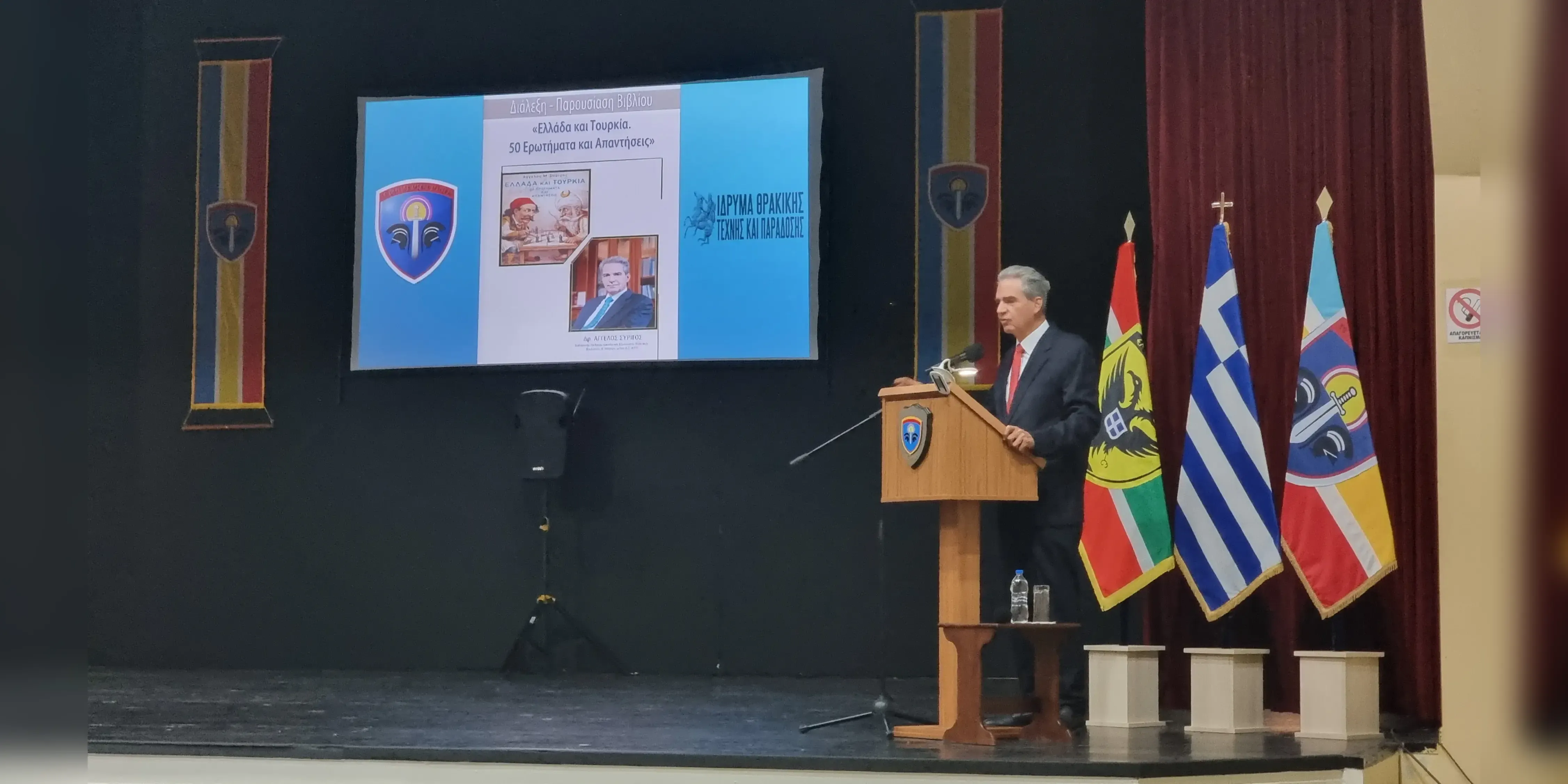
New Democracy MP and Panteion University professor Aggelos Syrigos has called on Greece to move away from a foreign policy shaped primarily by Türkiye’s actions, arguing that Athens should develop an independent geopolitical strategy and strengthen its own defence capabilities.
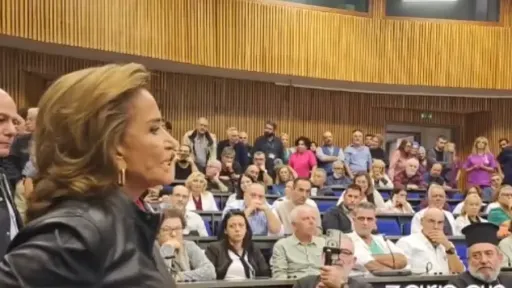
Speaking at a conference in İskeçe (Xanthi) on Friday, 30 October, Syrigos said Greece should become an autonomous geopolitical actor with a more active role in the Aegean, Eastern Mediterranean and Balkans.
The event, titled “Greece and Türkiye: 50 Questions and Answers”, was organised by the Thrace High Military Command (ASDITH) and the Thrace Foundation for Art and Tradition. It was held at the Konstantinos Benis Amphitheatre in the İskeçe Municipal Cultural Centre and also featured discussions on defence policy, international alliances, Cyprus and regional geopolitical developments.
‘GREEK FOREIGN POLICY IS ADAPTED TO TURKISH FOREIGN POLICY’
Syrigos argued that Greece’s approach to Türkiye since 1974 had relied primarily on two pillars: strong defence capabilities and international alliances. However, he questioned whether these remained sufficient under current geopolitical conditions.
Referring to the 2020 Eastern Mediterranean crisis involving the Turkish research vessel Oruç Reis, he said Greece’s allies had not intervened as decisively as Athens might have expected.
“Unfortunately, this is the truth: Greek foreign policy has been adapted to Turkish foreign policy. The Turks do something, and we react; they do something else, and we react again,” Syrigos said.
He argued that Greece needed to “de-Turkify” its foreign policy and establish strategic objectives independent of Ankara’s decisions.
‘OUR ALLIES WILL NOT FIGHT OUR WARS’
A central theme of Syrigos’s speech was the limits of international alliances. He cautioned against assuming that the United States, France or other Western countries would automatically act in Greece’s interests, stressing that states ultimately prioritise their own national interests.
Citing the British statesman Gladstone’s observation that countries have no eternal friends, only eternal interests, Syrigos argued that Greece should not expect foreign soldiers to fight on its behalf in a potential conflict with Türkiye.
He said allies could provide ammunition, military equipment and other resources, but Greece itself would need the personnel and capabilities to use them.
ECONOMIC STRENGTH AND DEFENCE INDUSTRY
Syrigos maintained that military modernisation alone would not provide lasting deterrence without a strong economy.
Referring to Greece’s Rafale fighter jets, upgraded F-16s and Belharra-class frigates, he stressed that maintaining advanced military systems required sustained financial resources.
He also compared the defence industries of the two countries, claiming that seven Turkish defence companies ranked among the world's top 100, while Greece had only two companies placed below the 200th position.
According to Syrigos, Greece could not establish lasting deterrence simply by purchasing weapons from abroad and needed to strengthen domestic production and its defence industry.
CYPRUS IDENTIFIED AS A WEAK POINT
Syrigos identified Thrace, the Aegean islands and Cyprus as three potential fronts in a military confrontation between Greece and Türkiye. He described Cyprus as the weakest of the three in terms of defence capabilities and called for its security capacity to be strengthened.
He said this should not be interpreted as preparation for war, but rather as an effort to establish credible deterrence. He also emphasised that the security of Cyprus was closely linked to Greece’s own security.
EU AND NATO CANNOT BE TAKEN FOR GRANTED
Syrigos also questioned the extent to which Greece could rely on the European Union and NATO for security against Türkiye.
He argued that the EU’s 27 member states had different national priorities and threat perceptions. While Greece and Cyprus viewed Türkiye as a major security concern, he said other European countries prioritised different challenges, including Russia and instability in North Africa.
“The European Union will not enter into a conflict with Türkiye for our sake,” he said, warning against treating European solidarity as an unconditional security guarantee.
TURKISH-LIBYAN MARITIME AGREEMENT UNDER CRITICISM
Addressing the 2019 Türkiye-Libya maritime delimitation memorandum, Syrigos argued that the agreement conflicted with Greece’s interests in the Eastern Mediterranean and what he described as geographical realities.
He said Greece had missed opportunities to conclude maritime negotiations with Libya, which began in 2006 and had advanced before the fall of Muammar Gaddafi in 2011 and the subsequent instability in the country.
Syrigos argued that Türkiye had taken advantage of developments in Libya to advance its regional objectives, adding that Greece needed a more active approach to developments in its neighbourhood.
Dedeağaç proposed as a regional transport hub
One of Syrigos’s proposals concerned the strategic development of Dedeağaç (Alexandroupoli). He suggested that the port could become the centre of a major railway project connecting Greece with Bulgaria, Romania and Ukraine.
The proposed route would link Dedeağaç with the ports of Varna in Bulgaria, Constanța in Romania and Odesa in Ukraine, potentially creating a new transport corridor between the Black Sea and Europe.
Syrigos said such a railway connection could allow goods to travel through the route in approximately 10 to 12 hours, compared with at least three days for maritime transport through the Turkish Straits.
He cited the EU-backed Rail Baltica project as an example of the scale of infrastructure initiative that could be pursued.
SAFE PROGRAMME AND GREECE'S DEFENCE PARTNERSHIPS
During the question-and-answer session, Syrigos discussed the EU's €150 billion Security Action for Europe (SAFE) defence financing programme.
He said Italy, Spain and Germany had made efforts to include Türkiye in the programme, while Greece and Cyprus had opposed those initiatives. He presented this as an example of the diplomatic negotiations taking place within the EU over defence cooperation.
He also highlighted France's role in regional military and defence partnerships, arguing that Greece should focus on developing concrete shared interests with international partners.
NAVAL CAPABILITIES AND MARITIME CLAIMS
Asked why Greece had not expanded its maritime jurisdiction or concluded an exclusive economic zone delimitation agreement with Cyprus, Syrigos argued that legal rights alone were not enough to make such decisions viable.
He said Greece would need sufficient military capacity to defend any agreement in practice, particularly in the event of a Turkish response involving research vessels in disputed waters.
Syrigos described the age of some Greek naval assets, estimated at 30 to 50 years, as a limitation. He suggested that the introduction of new vessels, including Belharra-class frigates and Italian Bergamini-class ships, could strengthen Greece’s capabilities.
ISRAEL PARTNERSHIP AND REGIONAL COOPERATION
Syrigos also underlined the importance of long-term cooperation between Greece and Israel, pointing to projects such as the aviation training centre in Kalamata, a proposed Greece-Cyprus-Israel radar system and electricity interconnection initiatives.
He argued that practical projects creating shared interests could help ensure that cooperation continued even if political relations changed.
The conference concluded with further discussion of Greece’s strategic position, democratic decision-making and the need for more ambitious regional initiatives. Syrigos reiterated that the proposed railway corridor centred on Dedeağaç could serve as an example of Greece taking a more proactive role in regional geopolitics.
The views and assessments in this report are attributed to Syrigos and reflect his statements at the conference.