Mitsotakis: ‘We cannot change geography, living side by side is our fate’
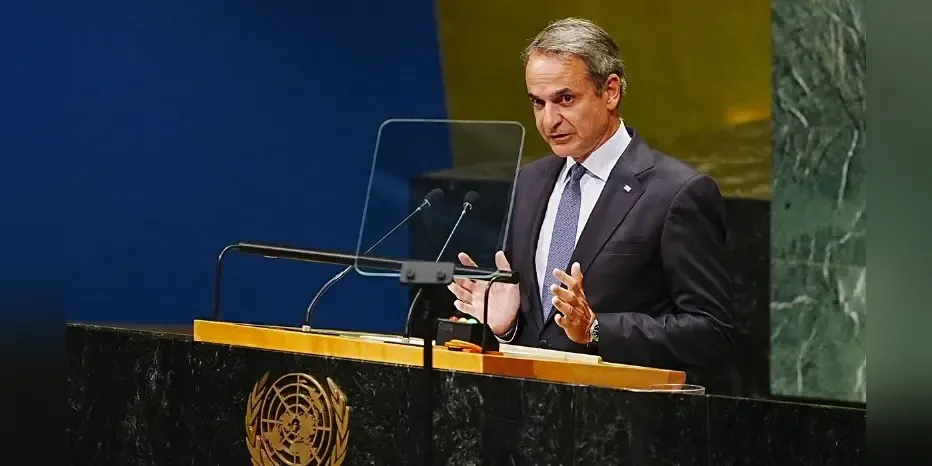
Greek Prime Minister Kyriakos Mitsotakis said Greece and Türkiye are destined to live side by side, calling for continued dialogue and respect for international law in relations between the two countries.
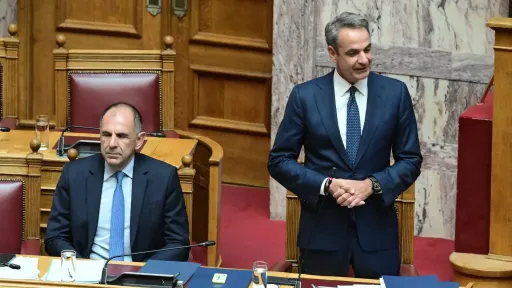
Speaking during the 81st United Nations General Assembly in New York, Mitsotakis said Greece had spent the past three years working to improve bilateral relations, build trust and keep channels of communication open in order to prevent tensions from escalating into unwanted crises.
“History weighs heavily on our sensitive relationship,” Mitsotakis said, arguing that Greece and Türkiye urgently need a shared understanding of how to move forward amid wider regional and international developments.
He said such an understanding should be based on respect for international law and good-neighborly relations.
“As I have said many times, we cannot change geography; living side by side is our fate,” Mitsotakis said.
MARITIME DISPUTE AND INTERNATIONAL LAW
Mitsotakis said Greece considers the delimitation of maritime zones — specifically the exclusive economic zone (EEZ) and continental shelf — to be the central bilateral dispute with Türkiye. He argued that the United Nations Convention on the Law of the Sea (UNCLOS) provides the institutional legal framework for addressing the issue.
His position is consistent with previous statements in which he has described the delimitation of maritime zones in the Aegean and Eastern Mediterranean as the main dispute between the two countries. In a June 2026 interview, Mitsotakis similarly said Greece and Türkiye were “destined by our geography to live side by side” while emphasizing Athens’ position on maritime rights and international law.
Mitsotakis also addressed the Cyprus issue, describing it as a test of the United Nations’ ability to implement its own resolutions. He said Greece supports UN Secretary-General António Guterres’ efforts to facilitate a return to negotiations.
GLOBAL CONFLICTS AND MARITIME SECURITY
Turning to wider international issues, Mitsotakis said the world was going through a dangerous period marked by growing conflict and tensions and argued that the international community needs stronger multilateral cooperation.
He highlighted the growing geopolitical importance of major maritime routes, including the Strait of Hormuz, the Red Sea and the Indo-Pacific, warning that attacks on commercial vessels and the use of trade routes as instruments of pressure could have consequences for supply chains, energy markets and global food security.
Mitsotakis said protecting maritime commerce was a shared responsibility.
His comments came during the high-level week of the UN General Assembly, whose 81st session is being held from September 22 to 28 under the theme “Restoring trust, managing transformation: a United Nations that delivers for all.”
GAZA AND THE WEST BANK
Mitsotakis also addressed the war in Gaza and said the peace plan adopted last year should be implemented. He said reconstruction should proceed in a way that enables Palestinians to determine their own future.
While reaffirming Greece’s strategic partnership with Israel, he said developments in the West Bank remained a source of deep concern. Mitsotakis argued that actions he considers contrary to international law and detrimental to the prospects of a future Palestinian state should not be allowed.
He also said Lebanon has an opportunity for lasting peace and reaffirmed Greece’s support for a sovereign and unified Lebanon.
AI REGULATION
Artificial intelligence was another issue raised by the Greek prime minister. Mitsotakis said that, despite its potential benefits, AI requires regulation.
He called for AI companies to operate under requirements related to human values, transparency and safety. He also expressed support for proposals for a voluntary, temporary pause in the development of AI models until appropriate regulatory frameworks are established.
AI governance was also a major theme at the opening of the 81st UN General Assembly, with Secretary-General António Guterres calling for binding international cooperation on AI governance and warning against handing life-and-death decisions to machines.