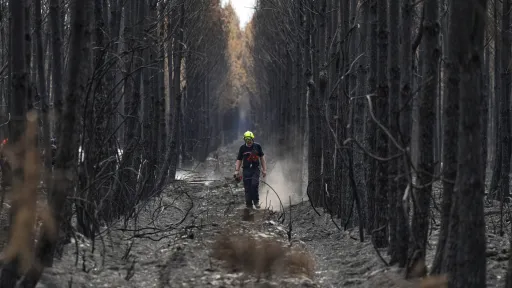
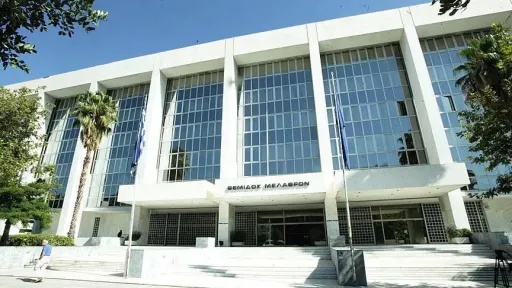
Greece reports more than 400 wildfires in 10 days as authorities warn of extreme conditions

Speaking to Greek broadcaster SKAI on Sunday, Tournas said the country’s civil protection mechanism had faced an exceptionally difficult period marked by strong winds, high temperatures and large amounts of dry vegetation.
“We went through a difficult 10-day period … during which we dealt with more than 400 fires,” Tournas said, adding that some fires were still requiring the attention of firefighting forces.
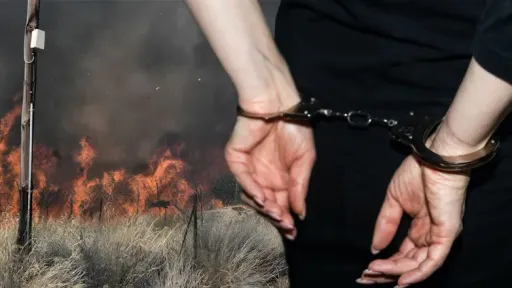
According to the minister, authorities have so far issued 680 fines and made more than 274 arrests under the fast-track procedure in connection with wildfire-related offences. He said approximately 90% of the cases involved fires caused by negligence, while around 10% were considered intentional.
“Whether intentional or caused by negligence, they cause the same damage,” Tournas warned, urging citizens to avoid any activity that could potentially start a fire.
Strong winds complicate aerial firefighting
The minister said extreme weather conditions had significantly restricted the use of firefighting aircraft and helicopters during several major fires.
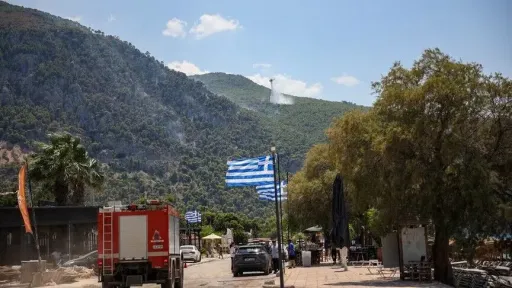
In Rethymno, Crete, aerial firefighting aircraft repeatedly attempted to assist operations, while Canadair aircraft were deployed from Elefsina but were unable to conduct water drops because of the severe weather conditions.
Similar difficulties were reported during the major Attica-Boeotia wildfire. Tournas said aircraft and helicopters were ordered to the area shortly after the fire broke out near Agios Vasilios, but were unable to carry out water drops or even collect water.
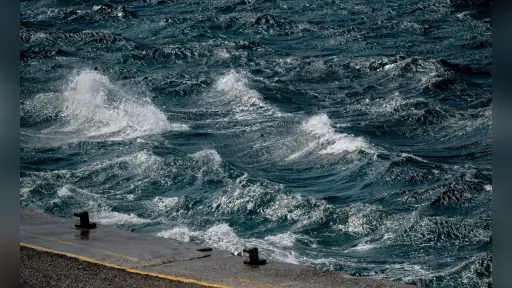
According to wind data cited by the minister from the National Observatory of Athens, wind speeds reached up to 150 kilometers per hour in some areas. Severe turbulence also prevented aircraft from safely descending below approximately 3,000 feet.
Tournas said the country had faced an unusual threat this year, with powerful northeasterly winds producing strong downslope winds and extreme turbulence in areas sheltered by mountainous terrain.
Ground forces and AntiNero measures help contain fires
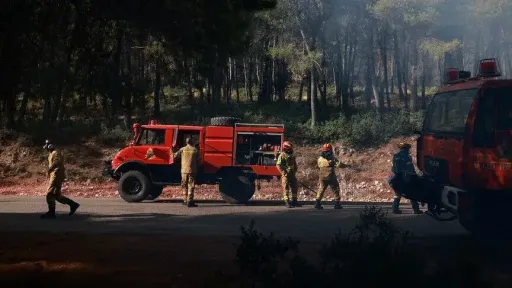
With aerial firefighting operations severely restricted, authorities shifted to a ground-based strategy in parts of Attica and Boeotia.
Firefighters, specialized forest firefighting units and volunteers established defensive lines, while 14 pieces of heavy machinery were deployed to prevent the fire from spreading toward Vilia and the Megara plain.
Tournas also highlighted the role of the AntiNero wildfire prevention programme, particularly around Psatha, saying previous vegetation management and access works helped firefighters reach higher ground and prevent the fire from advancing further.
The minister also described the evacuation of around 254 holidaymakers and swimmers from Agios Vasilios, where the local geography and enclosed coastline made an early evacuation necessary.
The operation involved a Fire Service vessel, the Mouzakitis ship and five private boats requisitioned by the Hellenic Coast Guard. All 254 people were safely evacuated by sea.
Tournas urged residents and visitors to follow instructions from the authorities and respond immediately to 112 emergency alerts, stressing that timely evacuation can save lives while allowing firefighting forces to focus on containing the blaze.
Greece to strengthen aerial firefighting fleet
Greece is also preparing to expand its aerial firefighting capabilities.
Tournas said the country will begin receiving eight Super Puma firefighting helicopters, with the first two expected in autumn.
From 2028, Greece is expected to begin receiving new Canadair CL-515 aircraft. Seven new aircraft are planned, with two financed through the European Civil Protection mechanism and five through European funding.
The country is also planning to upgrade seven existing CL-415 aircraft to the CL-515 standard.
According to Tournas, Greece will ultimately have 14 aircraft of this type, significantly strengthening its aerial firefighting fleet. The new CL-515 aircraft will be capable of carrying up to seven tonnes of water and will offer improved operational capabilities in challenging weather conditions.
The minister nevertheless stressed that even an expanded fleet cannot overcome every extreme weather scenario, making prevention and alternative operational planning essential.
He called for the continuation and expansion of the AntiNero programme, describing prevention as a central component of Greece’s wildfire strategy.
Red Code alert issued for six regions
Sunday and particularly Monday are expected to pose the greatest fire-weather challenge as high temperatures combine with strong winds.
Strong northerly winds are forecast to affect the Aegean and eastern parts of Greece, while authorities are also closely monitoring conditions in Crete, where winds are expected to strengthen.
A Red Code operational readiness alert has been issued for Attica, the Peloponnese, Central Greece, the North Aegean, the South Aegean and Crete.
The Red Code areas include:
Attica, including Kythira
Peloponnese: Corinthia, Argolis, Arcadia and Laconia
Central Greece: Boeotia, Phthiotis and Euboea
North Aegean: Lesbos, Chios, Samos and Ikaria
South Aegean: all Cyclades islands
Crete is also classified at Fire Risk Category 4, indicating very high fire danger.
A Red Code designation means authorities are required to operate at an increased level of readiness. Municipalities and regional authorities are expected to activate coordination mechanisms and implement the necessary preventive measures.