Government avoids clash with former PM Samaras

Government is seeking to avoid a direct confrontation with former Prime Minister Antonis Samaras as he steps up criticism of its economic and foreign policy, amid expectations that he could launch a new party ahead of next summer’s elections, Kathimerini reported.
Athens opts for a cautious response
The government is keen to avoid a repeat of the public dispute that followed the Thessaloniki International Fair in September, when officials from the ruling New Democracy party engaged in a war of words with Samaras. The confrontation lasted around 10 days.
Instead, the government has adopted a strategy of addressing the substance of his criticism without turning the disagreement into a personal dispute.
Government spokesman Pavlos Marinakis set the tone on Tuesday when asked about Samaras’ criticism of taxation and value-added tax (VAT), as well as his call for a change in economic policy.
“Mr Samaras is very experienced, and that is why I do not want to engage in a confrontation with him,” Marinakis said.
He argued that funds allocated to loan repayments could not be redirected toward additional spending because of European fiscal rules. He also noted that the government had reduced 25 indirect and other taxes, adding that further cuts could be considered if sufficient fiscal room became available.
New Democracy spokeswoman Alexandra Sdoukou adopted a similar approach, saying Samaras’ criticism was no different from that voiced by center-left opposition parties.
Government wary of boosting Samaras
According to Kathimerini, the government believes that engaging Samaras in a prolonged public dispute could increase his visibility and strengthen his support among center-right voters.
“The more visibility the government gives him, the more likely he is to increase his support,” a source familiar with the government’s thinking said.
However, maintaining that strategy could become more difficult if the former prime minister intensifies his criticism on issues requiring an official response.
Libya dispute puts foreign policy in focus
Samaras renewed his criticism of the government on Tuesday over developments in Libya, calling on Prime Minister Kyriakos Mitsotakis to dismiss Foreign Minister George Gerapetritis.
His demand followed the decision by Libya’s eastern-based parliament to approve the 2019 maritime memorandum with Türkiye, reversing its previous rejection of the agreement.
“The dramatic events in Libya irreparably expose Mr Gerapetritis, who recently assured us of precisely the opposite,” Samaras said.
The government again refrained from engaging in a direct public exchange with the former prime minister.
The dispute adds to tensions over Greece’s foreign policy and the maritime agreement between Türkiye and Libya, which Athens considers contrary to international law and its sovereign rights in the Eastern Mediterranean.
Poll shows limited support for potential new party
Samaras was expelled from New Democracy two years ago after repeatedly criticizing the government over ideological and foreign policy issues.
His possible return to electoral politics remains a concern for the ruling party as it prepares for the next national elections.
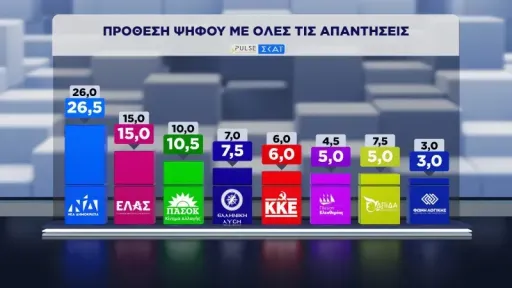
A recent poll by Alco found that 10% of respondents said they would be fairly or very likely to vote for a party led by Samaras. The figure was down one percentage point from the company’s previous poll in June.
Meanwhile, 74% of respondents said they would not vote for such a party at all.
The findings suggest that a potential political move by Samaras could create additional pressure on New Democracy, although the current polling figures indicate that most respondents remain unwilling to support a party under his leadership.