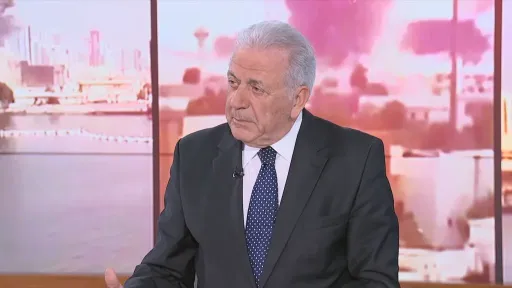
Former Greek MEP warns Athens not to clash with Türkiye over Israel

Speaking to Türkiye's state-run Anadolu Agency (AA), he called Israeli Prime Minister Benjamin Netanyahu's policies "a source of regional instability" and urged Prime Minister Kyriakos Mitsotakis to put distance between Athens and Tel Aviv.
"Having our own disagreements is one thing; coming into conflict with each other because of Israel is something else entirely," Kyrtsos said, drawing a direct line between Israel's anti-Türkiye strategy and the dangers it poses for Greek foreign policy.
"Israel has an anti-Türkiye strategy, and that is a danger sign for Greece. We have bilateral problems with Türkiye, we have a need to reach agreements as neighboring countries, but dragging Greece into a potential Israel-Türkiye antagonism is a separate matter altogether," he said.
'Mitsotakis is dependent on Netanyahu'
Kyrtsos was sharply critical of what he described as the current Greek government's excessive closeness to Israeli leadership.
"A relationship has formed in which Mitsotakis is dependent on Netanyahu. Mitsotakis calls Netanyahu 'my friend Bibi,'" he said.
He observed that Netanyahu is currently entangled in two major legal battles: war crimes charges sought by the International Criminal Court and an ongoing trial in the Israeli Supreme Court. He added that publicly advertising a close relationship with a leader in such a position was "interesting," to say the least.
On Netanyahu's motivations, Kyrtsos said the Israeli premier "wants constant conflict both to expand Israeli territory and to protect himself."
Greek public opinion diverging from government
Kyrtsos cited polling data suggesting that public opinion in Greece does not align with the government's pro-Israel stance.
He said surveys indicate that approximately 75% of Greeks view the stance of Israel and the United States toward Iran as aggressive, while those who agree with Washington and Tel Aviv represent around 20%.
He also noted that support for Israel in the United States itself had fallen to approximately 37% in recent polls.
'Neighbors who need each other'
On the Greece-Türkiye dimension, Kyrtsos rejected the theory that Israel's regional containment strategy could be leveraged against Türkiye, particularly over Syria. He said such ideas were being promoted by the pro-government media.
"Greece and Türkiye have a difficult history and a shared past. There are different problems between them, but they are also neighboring countries that benefit from solving practical problems and moving forward together," he said.
He said Greece should not find itself caught between Israel and Türkiye.
"Bilateral problems with Türkiye are one matter. The need to reach agreements as neighbors is another. Dragging Greece into a possible Israel-Türkiye confrontation is something else entirely," Kyrtsos noted.
Israel not a natural Greek ally
Kyrtsos argued that Greece has no strategic necessity to align with Israel and drew a contrast with France and other EU partners.
"We have no obligation to ally with Israel. Israel's approach is not like Europe's. It is a state that does not respect U.N. resolutions and does not act in accordance with international law and international legitimacy, the very things that Greek foreign policy constantly refers to. So what business do we have with Israel?" he said.
"We should keep our distance from Israel because it is an aggressive, extremely Zionist state that constantly seeks adversaries and creates problems. I believe Greece and the Greek government should put distance between themselves and Netanyahu's policies," Kyrtsos concluded.
AA