Which countries have the highest and lowest minimum wages in Europe?

Minimum wages vary widely across Europe, shaping living standards for millions. While the nominal amount in euros gives part of the picture, the real value depends heavily on each country’s cost of living and purchasing power.
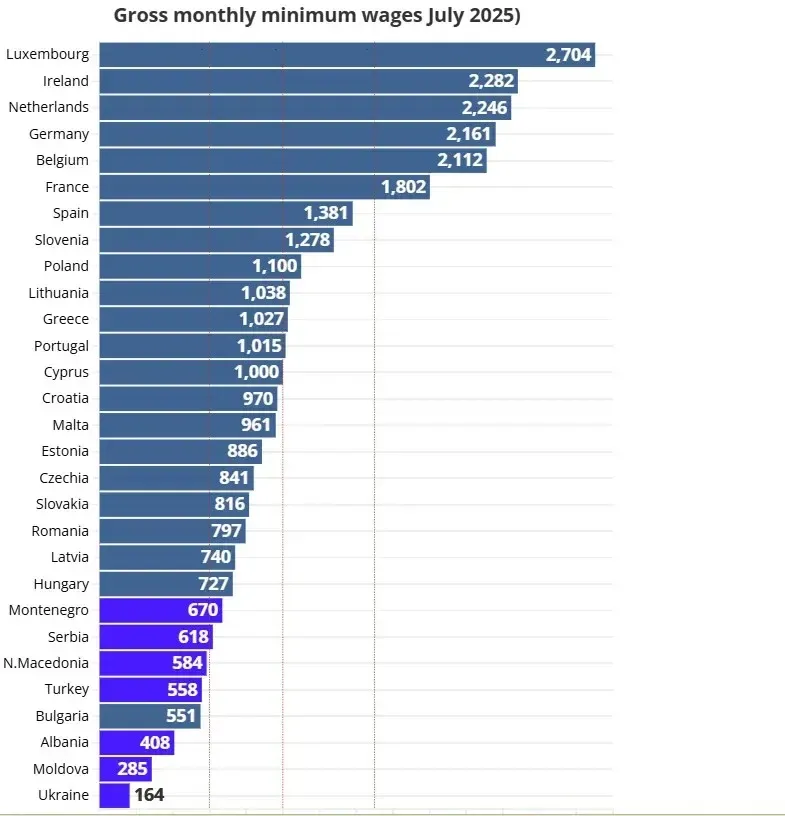
According to Eurostat data for July 2025, monthly gross minimum wages in the EU range from €551 in Bulgaria to €2,704 in Luxembourg. Including EU candidate countries, Ukraine has the lowest minimum wage at just €164 per month.
Five EU countries — Italy, Denmark, Sweden, Austria, and Finland — do not have a statutory national minimum wage.
Minimum Wage Groups in Europe
Highest Group: Over €1,500
Luxembourg: €2,704
Ireland: €2,282
Netherlands: €2,246
Germany: €2,161
Belgium: €2,112
France: €1,802
Middle Group: €1,000 – €1,500
Spain: €1,381
Slovenia: €1,278
Poland: €1,100
Lithuania: €1,038
Greece: €1,027
Portugal: €1,015
Cyprus: €1,000
Lower Group: €600 – €999
Croatia: €970
Malta: €961
Estonia: €886
Czechia: €841
Slovakia: €816
Romania: €797
Latvia: €740
Hungary: €727
Montenegro: €670
Serbia: €618
Very Low Group: Under €600
North Macedonia: €584
Turkiye: €558
Bulgaria: €551 (EU member)
Albania: €408
Moldova: €285
Ukraine: €164
Purchasing Power Adjustments
When adjusted for purchasing power, the gap between the highest and lowest wages narrows considerably. However, Luxembourg still ranks first, while Eastern and Southeastern European countries tend to climb the rankings due to lower living costs.