Next milestones for the vertical gas corridor and benefits for Greece

Key developments in the Vertical Gas Corridor are being driven by a commercial agreement signed by the ATLANTIC SEE LNG TRADE consortium, accelerating the implementation of the project and enabling the supply of U.S. liquefied natural gas (LNG) as early as 2026.
The consortium — comprising AKTOR Group (60%) and DEPA Commerce (40%) — has signed its first LNG sales agreement with Ukraine, with BP as supplier and Naftogaz as buyer. The first LNG cargo is expected to arrive at the Revithoussa terminal in March and will be transported to Ukraine via Route 1 of the corridor.
Further progress is anticipated following a high-level meeting at the White House on February 24, to be attended by Greece’s Minister of Environment and Energy, Stavros Papastavrou.
According to officials, the Vertical Corridor refers to a broader energy flow axis rather than a single pipeline route. Historically, this corridor carried Russian gas from north to south, but flows shifted after the launch of TurkStream in 2020, redirecting Russian gas through Türkiye and leaving older pipelines largely underutilized.
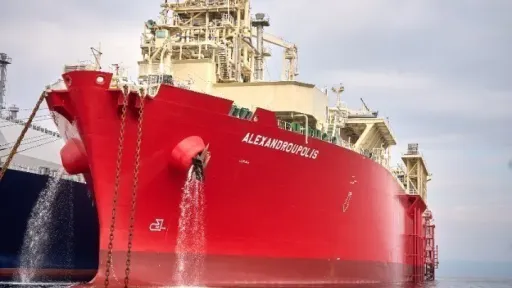
Since 2021, new sources and infrastructure have reshaped the regional energy map, including gas supplies from Azerbaijan via the TAP pipeline, the commissioning of the Greece–Bulgaria interconnector (IGB) in 2022, and the launch of the Alexandroupolis FSRU in 2024. As a result, Greece now has the capacity to channel gas northward and has been exporting natural gas to neighboring countries since 2022.
However, the system has not yet reached full potential due to continued Russian gas dominance in the region, with flows via Türkiye increasing by around 60% between 2021 and 2025. Recent EU measures targeting volumes transiting through TurkStream are expected to significantly strengthen Greece’s position, enhancing its role as a key energy hub and alternative supply gateway for Southeastern and Eastern Europe.