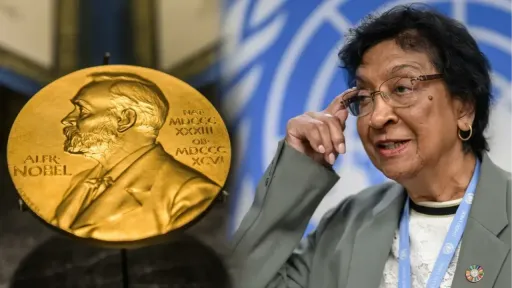
Navi Pillay wins Nobel Peace Prize for work on international law and human rights

South African jurist Navanethem “Navi” Pillay has been awarded the 2026 Nobel Peace Prize for her efforts to promote peace and international law, recognising a career spanning human rights advocacy, international criminal justice and the fight against apartheid.
The Norwegian Nobel Committee announced the award on October 9, highlighting Pillay’s contribution to strengthening international legal accountability for war crimes, crimes against humanity and genocide.
Pillay, 85, previously served as United Nations High Commissioner for Human Rights from 2008 to 2014 and held senior judicial positions at international tribunals. Her selection has also drawn attention to her work on alleged international crimes in Gaza and the broader debate over the enforcement of international law.
A CAREER IN HUMAN RIGHTS AND INTERNATIONAL JUSTICE
Born in Durban, South Africa, in 1941 to a family of Indian Tamil origin, Pillay built her legal career during the apartheid era, when racial discrimination shaped the country's political and judicial systems.
She later became the first non-white woman appointed to South Africa’s High Court. Her international judicial career included serving as a judge and president of the International Criminal Tribunal for Rwanda, as well as a judge at the International Criminal Court (ICC).
As a judge in Rwanda-related proceedings, Pillay contributed to landmark legal developments establishing that sexual violence could constitute a crime against humanity and, under the relevant circumstances, an act of genocide. She subsequently led the UN human rights office for six years.
GAZA IN THE SPOTLIGHT
Pillay also chaired the UN Independent International Commission of Inquiry on the Occupied Palestinian Territory, including East Jerusalem, and Israel from 2021 to 2025.
In September 2025, the commission concluded that Israel had committed genocide against Palestinians in the Gaza Strip. The findings intensified international debate over accountability and the application of international humanitarian law. Israel has rejected allegations of genocide, and the commission’s conclusions should be distinguished from a final judgment by an international court.
The Nobel Committee said Pillay’s work demonstrated the importance of holding individuals and states accountable under international law. Her award comes amid wider disputes over the authority of international judicial institutions and their ability to investigate alleged crimes committed during armed conflicts.
GREEK COMMENTARY RAISES FRANCESCA ALBANESE’S NAME
A commentary published by the Greek newspaper EfSyn on October 10 argued that the Nobel Committee could also have recognised Francesca Albanese, the UN special rapporteur on the situation of human rights in the Palestinian territories occupied since 1967.
The article's author, Korina Vasilopoulou, criticised the committee’s choice in a strongly worded opinion piece while acknowledging Pillay’s extensive record in human rights and international justice.
Albanese has become a prominent figure in international discussions of Palestinian rights. However, Nobel Peace Prize nominations are not publicly disclosed by the committee for 50 years, meaning claims about specific nominees cannot ordinarily be independently verified through official nomination records.
A PRIZE FOR INTERNATIONAL LAW
The award has been welcomed by international figures who view the defence of international law as essential to peace and accountability.
The United Nations described Pillay as a longstanding advocate for human rights and international justice, while the Nobel Committee emphasised the importance of strengthening the global rule of law at a time of growing pressure on international institutions.
Pillay also responded to the announcement with humour. During applause following the award, she joked that if the audience continued clapping, she might share the prize with US President Donald Trump, according to reporting by AFP.
Her selection places international law and the accountability of states and individuals at the centre of this year’s Nobel Peace Prize, while the debate surrounding the award reflects continuing disagreements over how those principles should be applied in conflicts around the world.