26 years since Al-Aqsa Intifada: Key events in 5 years of bloodshed

Intifada effectively ended following Sharm el-Sheikh summit in 2005.
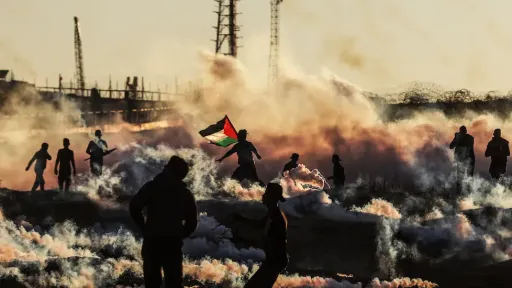
Twenty-six years after it erupted, the Al-Aqsa Intifada remains one of the bloodiest chapters of the Palestinian-Israeli conflict, marked by deadly Israeli raids into Palestinian cities, assassinations and attacks.
The uprising, the second after the First Intifada, also known as the “Stone Intifada”, began on Sept. 28, 2000, after then-Israeli opposition leader Ariel Sharon stormed Al-Aqsa Mosque in occupied East Jerusalem.
Monday marks the 26th anniversary of the uprising, which gradually subsided before the February 2005 Sharm el-Sheikh summit in Egypt effectively brought it to an end.
According to official figures, 4,412 Palestinians were killed and 48,322 others injured during the uprising.
The First Palestinian Intifada began on Dec. 9, 1987, after four Palestinian workers were killed when they were run over by an Israeli truck. It started in the Jabalia refugee camp and spread across the Gaza Strip and the occupied West Bank, lasting around six years.
Spark of uprising
The Al-Aqsa Intifada erupted as the Palestinian-Israeli peace process had reached an impasse following the failure of the US-sponsored Camp David summit in July 2000 to reach an agreement on final-status issues, including Jerusalem, borders, refugees and illegal settlements.
On Sept. 28 that year, Sharon stormed Al-Aqsa Mosque in occupied East Jerusalem accompanied by a large number of Israeli police and security personnel.
The incursion triggered Palestinian protests and clashes around the mosque that quickly spread to East Jerusalem, the West Bank and Gaza Strip, developing within days into widespread confrontations.
The UN has identified Sharon’s visit as the immediate trigger for the uprising, while the stalled peace process and diminishing prospects for a political settlement were among the factors that contributed to the escalation.
The following day, Israeli forces stormed the Al-Aqsa Mosque compound and used live fire and other means against worshippers and protesters, leaving Palestinians killed and wounded before clashes spread elsewhere.
As the violence escalated, images of Palestinians killed by Israeli forces fueled public anger and widened the protests.
Among the most prominent was the killing of 11-year-old Muhammad al-Durrah in Gaza by Israeli gunfire as he sheltered beside his father, an image that later became one of the symbols of the uprising.
Assassinations
As Israeli attacks intensified, the uprising gradually shifted from popular protests and street clashes to armed confrontations between Palestinians and the Israeli army.
Israel escalated military operations in the occupied West Bank and Gaza Strip, carrying out assassinations targeting Palestinian political and military figures, alongside mass arrests, shelling and incursions into cities and refugee camps.
On Dec. 3, 2001, the Israeli government imposed a siege on former Palestinian President Yasser Arafat at his presidential headquarters in Ramallah that continued until he died.
During the siege, Israeli forces destroyed large parts of the presidential compound and repeatedly shelled the building, where Arafat was staying with aides and associates, using tanks and aircraft.
Israeli forces also struck presidential facilities in Gaza and the occupied West Bank and destroyed Gaza International Airport and Palestinian presidential helicopters, preventing Arafat from traveling, according to the official news agency Wafa.
Arafat died in Paris on Nov. 11, 2004, after his health deteriorated, amid Palestinian suspicions that he may have been poisoned, an issue that remained subject to controversy and subsequent investigations without a definitive judicial finding.
In March 2004, Israel assassinated Hamas founder Ahmed Yassin and Abdul Aziz al-Rantisi, who succeeded him as the movement’s leader, the following month. It also killed senior Hamas figures Salah Shehadeh and Ismail Abu Shanab.
In August 2001, Israel killed Secretary General of the Popular Front for the Liberation of Palestine (PFLP) Abu Ali Mustafa in an airstrike on his office in the West Bank city of Al-Bireh.
Reoccupation of West Bank cities
The uprising entered one of its bloodiest periods in 2002 when Israel launched a major offensive code-named “Operation Defensive Shield”, involving large-scale incursions into cities, towns and refugee camps across the occupied West Bank.
During the operation, the Israeli army redeployed inside Palestinian city centers after having partially withdrawn under arrangements stemming from the 1993 Oslo Accords between Israel and the Palestine Liberation Organization (PLO).
Several Palestinian cities and refugee camps witnessed major military operations, including the Jenin refugee camp in the northern West Bank. Palestinian areas also saw widespread home demolitions, the bulldozing of agricultural land and extensive damage to infrastructure.
The UN documented the return of Israeli forces during the uprising to parts of the Palestinian territories where they had not been deployed for years, including populated areas classified as Area A.
Under the 1995 Oslo II Accord, which was intended as an interim arrangement, the West Bank was divided into Areas A, B and C.
Area A was placed under full Palestinian control, Area B under Palestinian civilian control and Israeli security control, while Area C remained under full Israeli control and accounts for around 60% of the West Bank.
Israeli siege
During the years of the uprising, Palestinian factions carried out attacks inside Israel that killed and wounded Israelis.
In October 2001, PFLP members assassinated Israeli Tourism Minister Rehavam Ze’evi at a hotel in Jerusalem.
The uprising also saw a development in the military capabilities of Palestinian factions compared with the First Intifada, which had been primarily associated with demonstrations, strikes and the throwing of stones and Molotov cocktails.
Palestinian factions, particularly Hamas’ armed wing, the Qassam Brigades, began firing locally manufactured rockets toward Israeli towns, marking a military development that later became one of the defining features of confrontations between the two sides.
Around 1,069 Israelis were killed and 4,500 others injured in Palestinian attacks during the uprising, according to Israeli figures.
On Feb. 8, 2005, Palestinian President Mahmoud Abbas, then-Israeli Prime Minister Ariel Sharon, former Egyptian President Hosni Mubarak and Jordan’s King Abdullah II met in Egypt’s resort city of Sharm el-Sheikh to discuss ways to end the crisis that began with the Al-Aqsa Intifada.
Abbas and Sharon agreed, according to statements issued at the time, to halt “acts of violence.”
The summit is widely regarded as the point at which the Al-Aqsa Intifada effectively ended, nearly five years after it began.
Months later, Israel implemented its unilateral “disengagement” plan in September 2005, evacuating illegal settlements and withdrawing forces from the Gaza Strip. The withdrawal, however, did not end Israeli control over the enclave, as Israel continued to control its borders, airspace, and territorial waters.
Israel imposed a blockade on Gaza from mid-2006, and subsequently launched several wars on the enclave, most recently its genocidal war that began in October 2023 and has killed more than 74,000 Palestinians and wounded over 175,000 others.
The period has also been accompanied by escalating Israeli military operations in the occupied West Bank, including killings, home demolitions, displacement of Palestinians and settlement expansion.
AA