Eastern Macedonia and Thrace strengthens social inclusion coordination

Regional authorities bring municipalities, social services and organisations together to improve support for vulnerable groups.
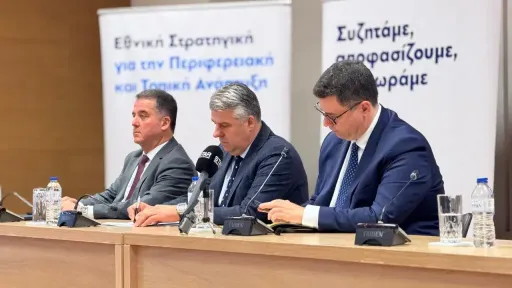
The Regional Observatory for Social Inclusion of Eastern Macedonia and Thrace (EMTH) is beginning to establish a stronger role in coordinating social policies and interventions across the region, following its first open conference held on Wednesday, November 25, at the Komotini Concert Hall.
The event, titled "The Observatory as a monitoring body for social inclusion interventions in the Region of Eastern Macedonia and Thrace", brought together representatives of local authorities, social services, Community Centres, scientific institutions and civil society organisations.
Participants were presented with the Observatory's work, ongoing research, its online portal and digital data repository. A workshop involving municipalities and Community Centres followed, focusing on strengthening cooperation and coordination among organisations working with vulnerable communities.
Social policy a regional priority
Opening the conference, Regional Governor Christodoulos Topsidis stressed that social policy is a central priority and an integral part of the region's development strategy.
He said the regional administration had moved to establish and activate the Observatory from the beginning of its term, creating an organised mechanism to record social needs, map poverty and social exclusion, and evaluate the effectiveness of social interventions.
The initiative also addresses a delay dating back to 2016, when the creation and operation of such an observatory had originally been envisaged.
"The Observatory is not being created simply to produce studies, reports and statistics. It is being created to transform knowledge into political action and data into effective interventions for the benefit of citizens," Topsidis said.
He stressed that identifying social problems was only the first step, adding that the region also aimed to develop practical solutions through available funding instruments, including European Union programmes.
The governor highlighted the importance of stronger cooperation and inclusion to address social challenges that have intensified in recent years, particularly following the economic crisis and the COVID-19 pandemic.
He also underlined the need for equal opportunities for vulnerable groups in areas such as accessibility, employment and access to essential services.
Among the region's existing initiatives, he highlighted support for Community Centres, food assistance and elderly care structures, as well as services for people with disabilities.
Particular emphasis was placed on ensuring that residents of remote and hard-to-reach areas have equal access to social support.
Observatory already supporting new programmes
The practical results achieved so far were presented by Angelos Antoniadis, Director General of Public Health and Social Welfare of the Region.
He described the Observatory as an important tool for designing targeted social policies and protection measures based on an accurate assessment of local needs.
According to Antoniadis, the institution is creating a region-wide network that connects social organisations and public services in a more systematic way.
Although cooperation previously existed at local level, communication between different organisations was often limited. The Observatory aims to bridge these gaps by collecting and coordinating information from public institutions, non-governmental organisations, associations and other active social organisations.
The information gathered is already being used to develop several initiatives.
These include a telecare programme for elderly people and individuals with disabilities, particularly those living in remote and inaccessible areas.
Other initiatives include the development of a programme to combat child and intergenerational poverty, as well as a project to assess the vulnerability of people aged over 65 using real population data.
Demographic monitoring and public health initiatives
Antoniadis also highlighted the operation of the Regional Demographic Observatory, which focuses on analysing demographic developments and supporting the development of relevant policies.
Additional measures and interventions linked to public health are also being examined as part of the region's broader social planning.
The conference concluded with a presentation by Christos Bachos, Head of the Regional Social Inclusion Observatory Department, who outlined its responsibilities, operational structure and role in monitoring social interventions.
He emphasised the importance of systematically collecting and using data, evaluating the effectiveness of social programmes and maintaining close cooperation with all relevant organisations.
The first open conference marked an important step towards establishing a common framework for social policy across Eastern Macedonia and Thrace, with the aim of turning better coordination and reliable information into more effective support for the region's most vulnerable residents.