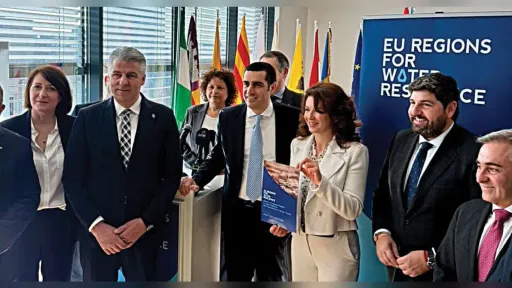
Eastern Macedonia and Thrace joins European alliance for water resilience

The Region of Eastern Macedonia and Thrace is strengthening its role in the European debate on water security and climate adaptation through its participation in the Alliance of European Regions on Water Resilience and Preparedness for Climate Change.
Regional Governor Christodoulos Topsidis took part in the alliance’s first annual meeting in Bologna, Italy, on September 16 and 17, where European regional and local authorities, EU institutions, policymakers and researchers discussed strategies for water resilience, climate adaptation and risk prevention.
The alliance, promoted by the Emilia-Romagna Region, currently brings together 29 regions from 10 European countries. Its first annual forum, titled “Water Resilience in a Changing Climate,” focused on strengthening regional cooperation in response to drought, flooding, water scarcity and other climate-related risks.
Eastern Macedonia and Thrace joined the initiative at its launch in Brussels in March 2026. Topsidis signed the declaration establishing the alliance alongside representatives of other European regions, with the initiative designed to strengthen the role of regional authorities in EU water and climate policies.
Topsidis highlights cross-border water challenges
Speaking at the Bologna conference, Topsidis described water resilience as an issue extending beyond environmental policy.
“Water resilience is no longer only an environmental issue. It is an issue of the economy, agricultural production, energy, civil protection and, ultimately, the security and sustainability of our societies,” he said, according to the regional administration.
He highlighted the cross-border character of several major rivers in Eastern Macedonia and Thrace, including the Nestos, Meriç (Evros), Ardas and Erythropotamos, arguing that their management requires sustained cooperation between neighbouring regions and countries.
Topsidis also called for a shift from crisis management toward prevention and resilience, emphasizing shared knowledge, early-warning systems, coordination and permanent cooperation.
From regional experience to joint European projects
The regional governor pointed to existing cooperation initiatives involving Eastern Macedonia and Thrace, including Greek-Bulgarian cooperation concerning the Ardas River and European Nexus approaches in the Nestos basin.
He argued that the next step should be to transform this experience into permanent institutional cooperation and joint projects.
The approach is consistent with the alliance’s broader objectives. According to its concept note, the network aims to strengthen the role of regions in EU policies on water security, climate adaptation and preparedness, increase investment in territorial resilience and create a platform for sharing practices on issues including drought, floods, early-warning systems, emergency management and digital technologies.
Focus on EU funding and the 2028–2034 period
Financing is also expected to be a central part of the alliance’s work as discussions advance toward the EU’s 2028–2034 financial period.
The alliance’s action plan includes mapping available funding instruments, developing joint projects and engaging with the European Investment Bank. Its broader objectives include increasing EU investment in climate resilience, supporting flood and drought prevention and strengthening financing mechanisms for vulnerable territories.
The Emilia-Romagna government has similarly identified increased European investment in water security and territorial resilience as a key objective of the alliance. The network was established in Brussels in March and has since expanded to 29 territories across 10 EU countries.
Eastern Macedonia and Thrace seeks stronger European role
Topsidis said Eastern Macedonia and Thrace intends to contribute to the alliance not only by presenting the challenges facing the region but also by sharing its experience and developing practical solutions.
“The future of water must also be designed within the regions,” he said.
The Region’s participation gives Eastern Macedonia and Thrace a formal platform within a growing European network focused on water security, climate adaptation, disaster prevention and regional resilience. The initiative also provides a framework for regions facing different but interconnected challenges, from prolonged drought and water scarcity to extreme rainfall and flooding.