Türkiye criticizes Greek maritime map as lacking legal basis

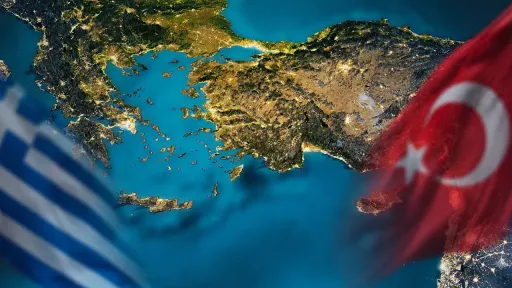
A recently released maritime spatial planning (MSP) map by Greece has drawn criticism from Turkish legal experts, who argue that the map lacks any legal foundation and aims to unjustly confine Turkey's maritime jurisdiction in the Aegean Sea.
UNFOUNDED CLAIMS, DISPUTED WATERS
Dr. Mustafa Başkara, Director of the National Center for Maritime Law Research (DEHUKAM) at Ankara University, strongly criticized the Greek MSP map, which was published on Wednesday. Speaking to Anadolu Agency, Başkara stated, “Greece has published a map that has no legal basis and completely disregards Türkiye’s rights, interests, and jurisdiction in the Aegean Sea. It is an absurd attempt to lock us into our territorial waters.”
He emphasized that while Greece claims its map aligns with European Union directives, it overlaps with areas included in Türkiye’s academic MSP efforts, particularly in the Aegean Sea. According to Başkara, this indicates a clear violation of Türkiye’s maritime rights.
OFFICIAL RESPONSE AND LEGAL FRAMEWORK
The Turkish Ministry of Foreign Affairs also released a statement reminding Greece that unilateral actions in the Aegean and Mediterranean seas should be avoided and that international maritime law encourages cooperation among coastal states.
Başkara reiterated that Türkiye’s MSP map follows the principle of equidistance between mainland coasts — a method supported by decades of legal precedent and international norms. “The map Greece has put forward is not recognized by Türkiye and holds no legal value. The legally appropriate method is the equidistance line between mainlands, as we have long advocated,” he said.
NO MARITIME JURISDICTION ESTABLISHED
Clarifying the nature of maritime spatial planning, Başkara noted that the Greek MSP map does not constitute an actual delineation of maritime jurisdiction. “This is not a legal maritime boundary. Similarly, our own MSP map, although science-based and prepared with interministerial coordination, does not claim jurisdiction but reflects long-standing legal positions,” he explained.
DEHUKAM, which has specialized in maritime law for over a decade, collaborated with experts and drew from publicly available data and previous state projects to create Türkiye’s MSP map. Başkara highlighted that the map was based on objective, scientific principles and was widely accepted by Turkish authorities.
He concluded that the Foreign Ministry’s plan to submit the map to the United Nations, in coordination with UNESCO and other relevant international bodies, further confirms Türkiye’s commitment to international law and cooperation.