Mehmet Metiner: From Gümülcine to Kırcaali... Who can draw borders in our Heart’s Geography?

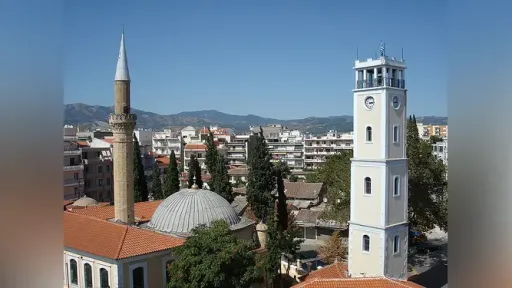
We crossed the border from Edirne/İpsala into Greece. Upon arriving in Gümülcine, the call to prayer was echoing. Our esteemed Consul General, Aykut Ünal, awaited us at the mosque. We arrived just in time to catch the conclusion of the sermon delivered by the wise Mufti of Western Thrace, İbrahim Şerif. Graciously, he requested a brief address from us. We conveyed the greetings we had brought from our homeland to our Muslim Turkish brothers there.
“Türkiye is your homeland, but this is also your land,” we said.
“Wherever you are, we are there too. We are siblings. Your rights are our rights. Your joy is our joy; your pain is our pain. We are different limbs of a single body. Boundaries may have arisen between us, but our heart’s geography is one. No one can draw borders in our heart’s geography.”
We performed Friday prayers together, facing the same Qibla, reciting the same prayers, shoulder to shoulder. It wasn’t just our shoulders and hands that touched; our hearts united in the same faith.
The theme of the sermon was about the boundless brotherhood of Islam. A fraternity that transcends race, geography, color, or sect, based solely on the foundation of faith. Thus, Gaza belongs to us. The brave brothers of Abu Ubaidah are our gallant brethren. Those killed in Lebanon are our brothers. The sermon beautifully and meaningfully addressed a sensitivity towards Gaza and Palestine, rooted in this sense of brotherhood.
Visiting from Turkey holds great significance for our Turkish brothers. It is equally exciting. After the prayer, we embraced warmly with our open hearts.
The cheerful voices of children were especially delightful. In the mosque courtyard, our children, holding copies of the Quran, showcased the genuine identity of the Turkish community in Western Thrace. When one thinks of Turks, it’s no coincidence that Islam comes to mind, just as thinking of Islam conjures the Turkish identity.
Once again, I understood that the spirit of Turkishness holding the Balkans is intertwined with Islam.
The selected mufti of the Turkish minority, the esteemed scholar İbrahim Şerif, is a legendary figure. Despite his advancing years, he remains spiritually vibrant. I was captivated by his fighting spirit and enthusiasm. Meeting him was certainly a great honor for me, as he symbolizes the noble struggle for Turkishness and Islam.
After Friday prayers, alongside our esteemed Consul General Aykut Ünal, we engaged in lengthy discussions over lunch with the influential leaders of Gümülcine.
We had productive conversations with Ms. Çiğdem Asafoğlu, President of the Friendship Equality Peace Party (DEB), Mr. Aydın Ahmet, President of the Western Thrace Turkish Teachers' Union, and Mr. Sedat Ayhan, President of the Gümülcine Turkish Youth Union.
I thank them all.
They should know that we left Gümülcine with our hearts there, having embraced their hearts within ours. We departed with a promise to return. We pledged to visit not only Gümülcine but also İskeçe and other cities.
Our word is our bond.
Gümülcine is only an hour and a half away from Kırcaali.
The two cities are like siblings, leaning on one another.
Once two cities of the Ottoman Empire for centuries, Gümülcine and Kırcaali are now situated within the borders of two separate states.
Gümülcine is a city of Greece, while Kırcaali is in Bulgaria. Yet, both exhibit a distinct Turkish and Muslim identity.
In Kırcaali, remnants of the Ottoman Empire are omnipresent.
Just like in present-day Plovdiv, known as Polovniv.
Turkishness and Ottomanism, that is, Islam, are integral to Bulgaria’s long historical narrative.
In the Ardino district of Kırcaali, amidst wooded mountains, an Ottoman-built bridge stands as a monumental testament worth visiting. This grand bridge, connecting Edirne to the city of Plovdiv in Greece, still stands tall with its magnificent spirit.
Ardino is the birthplace of our famous writer and intellectual, Sabahattin Ali, who was born in 1907.
We visited the former Ottoman barracks and powder magazine, now a museum.
While touring the museum, which houses the bust of Sabahattin Ali—who spent his life in dungeons during the one-party period and was brutally killed while attempting to escape to Bulgaria—I found an opportunity to reflect on the greatness of our history and the profound meaning of our heart’s geography.
Once again, I realized that what we have lost today is that very spirit that defines us.
I lamented that we remain oblivious to how, with the loss of our spirit, we have been reduced to mere shells.
It is abundantly clear that within the narrow confines they have trapped us in, they are attempting to extinguish our spirit and heart.
Yet, witnessing our spirit’s resistance against those who seek to reduce us to mere lifeless bodies brings immense joy.
I saw us there.
I saw our resisting spirit.
I saw our spirit embodied in figures like İbrahim Şerif.
I witnessed the close interest and helping hand of Turkey, embodied in the leadership of Erdoğan.
Turkey is perceived as the owner and protector of that spirit.
It is viewed as the strong motherland of hope and trust.
THE ISSUES OF THE MUSLIM TURKISH MINORITY IN WESTERN THRACE MUST BE RESOLVED
The Muslim Turkish minority living in Greece faces serious problems.
The selection of the chief mufti and muftis has turned into a chronic issue.
On one side are muftis chosen freely by the minority, and on the other are muftis appointed by the Greek government who are not accepted by the minority.
This issue creates a significant conflict.
The treaties of the past (the 1913 Athens Treaty and the 1923 Lausanne Treaty) are fraught with legal ambiguities. The Greek government can arbitrarily restrict the rights of the Muslim Turkish minority in matters lacking legal clarity, such as the appointment of muftis. This includes declaring elected muftis illegal and subjecting them to prosecution, as well as reducing the number of minority schools and intervening in the education of minority children.
The failure of the European Court of Human Rights to implement decisions in favor of the Turkish minority for years has also created a serious area of concern.
The matters concerning the selection of the chief mufti and muftis, as stipulated in the 1913 Treaty between the Ottoman Empire and the Kingdom of Bulgaria, have been suspended on the grounds that they were not mentioned in Lausanne. Unfortunately, the lack of explicit mention of this matter within the provisions of the Lausanne Treaty has allowed Greece to act arbitrarily.
The personal rights of the minority (marriage, divorce, inheritance, etc.) that were granted to the minority until 1995 have been gradually taken away by laws enacted after that date.
The property of the Turkish minority’s foundations has also not been granted to them, nor is it managed by them.
Until 1985, the names determined and declared by the Turkish minority were accepted as muftis, but this practice was abandoned after 1985. Instead, muftis have been appointed by the central government from graduates not of Turkey but particularly of Saudi Arabia.
The chief mufti system mentioned in the 1913 Treaty has been completely abolished.
In contrast, the Patriarchate in Turkey, chosen by the Greek minority, is recognized by the government.
The properties of minority foundations have been entrusted to them in Turkey.
Minority schools in Turkey are also free and widespread, incomparable to those in Greece.
THE PRINCIPLE OF RECIPROCITY MUST BE APPLIED
As the issue of opening the Heybeliada Greek Seminary comes to the fore, I have a few words to say.
As a principle, I am a staunch advocate of freedom of religion and belief. In this context, I see no objection to the opening of the seminary.
However, since this matter is framed within the context of minorities in Lausanne, I consider it essential that the principle of reciprocity be sought.
I advocate for the principle of reciprocity to be strictly applied not only for the seminary but also for other minority schools.
Whatever application exists for Turkish minority schools in Greece, the same should apply in Turkey. I recommend that the relevant school regulations from Greece be translated and sent to minority schools in Turkey, meaning the strict application of the principle of reciprocity is vital for resolving these issues.
Otherwise, we risk bearing the guilt of leaving our Turkish brothers, whom we are abandoning there, to lose their Turkishness and their Islam over time.