Venice Commission to examine Greece's regulations on civil society organizations

The Venice Commission of the Council of Europe is preparing an urgent opinion on Greece's regulations governing the registration and activities of civil society organizations (CSOs) operating in the fields of migration and asylum.
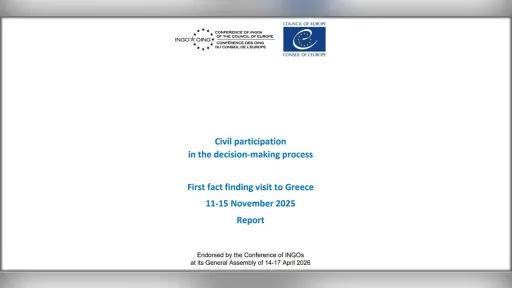
The review was requested by the Monitoring Committee of the Parliamentary Assembly of the Council of Europe (PACE) as part of its ongoing monitoring process concerning Greece.
The European Commission for Democracy through Law, commonly known as the Venice Commission, is expected to examine provisions concerning the registration of NGOs under Greece's asylum legislation, as well as provisions related to the potential criminal liability of NGO members.
Focus on registration and criminal liability
The review is expected to address the conditions under which NGOs working in migration and asylum can register and operate, as well as potential criminal sanctions affecting their employees and members.
The PACE Monitoring Committee reportedly requested an examination of provisions in Law 4939/2022, concerning the NGO registry, and Law 5275/2026, concerning the criminal liability of NGO members.
The Venice Commission's urgent opinion is expected to be submitted for approval by the Commission's plenary session in October 2026.
Previous criticism of Greece's NGO regulations
The Council of Europe's Expert Council on NGO Law has previously assessed aspects of the regulations and raised concerns that certain provisions could significantly restrict the operating environment for civil society organizations.
The forthcoming Venice Commission review is therefore expected to provide a broader assessment of whether Greece's regulatory framework is consistent with European standards concerning freedom of association, civil society activity and the rule of law.
Western Thrace Turkish community raises concerns
Halit Habipoğlu, president of the Federation of Western Thrace Turks in Europe (ABTTF), welcomed the review while describing it as another indication of what he considers structural problems concerning human rights and the rule of law in Greece.
Habipoğlu argued that the regulations affecting civil society organizations should be viewed alongside longstanding disputes involving the Western Thrace Turkish community.
He specifically referred to issues surrounding the recognition of Turkish identity, rights associated with the Treaty of Lausanne and freedom of association.
He also highlighted the implementation of European Court of Human Rights judgments concerning freedom of association, including cases covered by the Bekir Usta group of cases, which involves associations representing Western Thrace Turks.
Habipoğlu argued that human rights cannot be applied selectively and called on Greece to address what he described as a gap between the country's international image regarding democracy and the rule of law and practices inside the country.
The Venice Commission's forthcoming opinion could therefore become an important reference point in the broader European debate over Greece's NGO regulations, freedom of association and the protection of civil society.