UN review puts Greece’s minority and human rights record under scrutiny
Greece’s minority rights, language policies, migration practices, religious freedom and rule of law are among the issues raised in submissions prepared for the United Nations’ Universal Periodic Review (UPR) of the country.
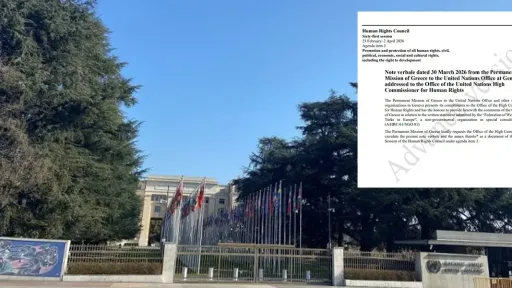
Greece is scheduled to undergo its fourth UPR examination in the UN Human Rights Council’s Working Group 53 in October–November 2026. The UPR process incorporates information from the state under review, UN bodies and other stakeholders, including civil society organizations.
The submissions concerning Greece cover a broad range of issues, including minority rights, linguistic diversity, migration and border practices, freedom of religion, racism and discrimination, prison conditions, human trafficking and the rule of law.
MINORITY AND LANGUAGE RIGHTS
One of the issues highlighted in the submissions is Greece’s position on regional and minority languages. ELEN, the European Language Equality Network, called on Greece to ratify the Council of Europe’s European Charter for Regional or Minority Languages and apply its provisions to linguistic minorities in the country.
ELEN also raised issues concerning the Turkish community in Western Thrace, including education and the operation of minority schools. According to the organization, the number of Turkish primary schools in Western Thrace fell from 188 in 2011 to 83 during the 2025–26 school year. These figures and the related assessments are claims made in ELEN’s submission to the UPR process.
The question of minority recognition has also been a recurring issue in previous UPR cycles. In its earlier UPR recommendations, the UN process recorded calls for Greece to consider accession to the European Charter for Regional or Minority Languages and to ratify the Council of Europe Framework Convention for the Protection of National Minorities. Greece did not accept those recommendations at the time.
The Greek authorities maintain that the Muslim minority in Western Thrace is the minority recognized under the Treaty of Lausanne and do not recognize additional “national minorities” on the basis of ethnic identity.
MIGRATION AND BORDER POLICIES
Migration and border management also feature prominently in the material submitted for the review.
Some civil society organizations have called for safeguards against collective expulsions and stronger protection of the rights of migrants and asylum seekers. The UN human rights system has separately received information in 2026 concerning alleged restrictions on civic space and the environment for defending the rights of refugees, migrants and asylum seekers in Greece.
Greek authorities, meanwhile, emphasize the country’s right and obligation to protect its national and European borders.
RELIGIOUS FREEDOM AND RULE OF LAW
Freedom of religion is another issue addressed in the submissions. Some organizations have called for changes to legal restrictions concerning activities aimed at religious conversion, while the Greek side has argued that such proposals are incompatible with relevant constitutional provisions.
The rule of law, racism, intolerance and the functioning of the justice system are also included among the issues raised in international human rights assessments concerning Greece. OHCHR’s 2026 rule-of-law contribution on Greece examines, among other issues, judicial independence, access to justice and the protection of human rights.
The OSCE Office for Democratic Institutions and Human Rights has also contributed information to the UPR process in previous cycles, including material concerning racism and intolerance. The Council of Europe’s Committee for the Prevention of Torture has likewise provided information concerning detention conditions in Greece.
Greek authorities have responded to criticism in the broader UPR process by pointing to legislative changes and reforms introduced in recent years, arguing that these measures have strengthened the country’s legal and institutional mechanisms.
The forthcoming UPR examination will provide an opportunity for UN member states to question Greece and issue recommendations on the human rights issues identified during the review.