Three Greek polls show New Democracy leading as PASOK gains ground

Three opinion polls published in Greece in the week leading up to October 24, 2026, show the ruling New Democracy (ND) maintaining a lead in voting-intention estimates, while PASOK remains in contention for second place amid a fragmented opposition landscape.
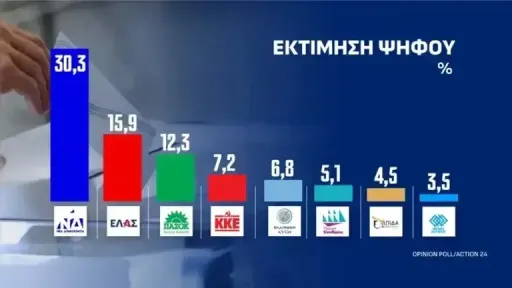
The surveys, conducted by GPO for Iefimerida, Pulse for Skai and Metron Analysis for Mega, put New Democracy at around 29.4% to 30%. PASOK registers approximately 13% across all three polls, while the party identified in the source report as ELAS ranks second, with support ranging from 15% to 16.5%.
The findings also highlight uncertainty over which smaller parties would cross Greece’s 3% parliamentary threshold. Depending on the poll, the estimates suggest that between seven and ten parties could enter Parliament.
New Democracy leads, while PASOK holds third place
New Democracy records the strongest result in all three voting estimates, but the figures remain below the level that would automatically guarantee a parliamentary majority under the electoral rules applicable to the next election.
PASOK polls at 13.0% to 13.1% across the three surveys, while the party listed as ELAS records between 15% and 16.5%. The figures indicate a competitive contest for second place, although the surveys do not point to a change in the ranking.
The Communist Party of Greece (KKE), Greek Solution and Course of Freedom (Plefsi Eleftherias) also feature among the parties with significant support, though their relative positions vary between pollsters.
The differences between the surveys are particularly notable among smaller parties. Hope for Democracy and Alliance of Greeks both fall below the 3% threshold in the GPO poll but exceed it in the Pulse and Metron Analysis estimates. MeRA25 is below the threshold in the GPO survey and reaches 3% in the other two.
Voice of Reason exceeds 3% in all three polls, according to the reported estimates. SYRIZA, meanwhile, is described in the source report as falling outside Parliament in all three surveys, although no specific figures for the party are provided in the supplied text.
These estimates are not election results. Actual parliamentary representation would depend on the vote at the next election and the applicable electoral rules.
Voters divided over single-party and coalition governments
The surveys also indicate differing preferences regarding the form of the next government.
In the GPO poll, 52.7% of respondents favour a single-party government, compared with 43.8% who prefer a coalition. A further 4.5% say they do not know or decline to answer.
In the Pulse survey, 43% prefer a single-party administration, while 36% favour a coalition government. Another 13% express no particular preference, and 8% are undecided or do not respond.
The Metron Analysis survey points to uncertainty about whether a government could be formed after the next election. According to the report, 69% of respondents believe another election would be necessary.
The figures suggest that preferences for a single-party government do not necessarily translate into confidence that one can be formed. However, the questions differ across the three surveys, so the results should not be treated as directly equivalent.
A fragmented opposition and an uncertain parliamentary landscape
Taken together, the three polls depict a political landscape in which New Democracy maintains a clear lead in voting estimates, while PASOK remains at around 13% and smaller parties compete for parliamentary representation.
The variation in support for parties near the 3% threshold makes the potential composition of the next Parliament particularly uncertain. The reported estimates suggest that the number of parliamentary parties could vary considerably depending on which poll more closely reflects the eventual vote.
The surveys provide a snapshot of voter preferences in late October 2026, rather than a definitive forecast of the next election outcome.
Source: Thraki.com.gr, October 24, 2026. Poll figures and descriptions are reproduced from the supplied report; the identity of “ELAS” requires confirmation.