Thousands gather at Athens Polytechnic for 53rd anniversary uprising

Political events, discussions and memorial activities highlight calls for continued democratic struggles.
Major anti-imperialist march to US embassy scheduled for November 17.
Thousands of people gathered at Athens Polytechnic on Sunday to mark the 53rd anniversary of the November 17, 1973 student uprising, challenging restrictions imposed on this year's commemorations by the university administration.
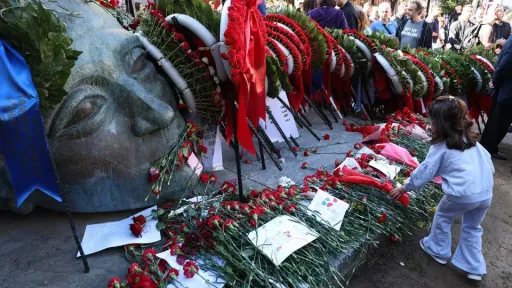
People of all ages, including students, trade unions, political organisations, resistance groups and members of the public, visited the historic campus to lay wreaths and flowers in memory of those who fought against Greece's military dictatorship.
According to a report by efsyn.gr, the large turnout effectively challenged the university administration's decision to limit the celebrations through restricted opening hours and the closure of rooms traditionally used for exhibitions and political events.
The strong public participation demonstrated that, more than five decades after the uprising, the Polytechnic remains an important symbol of democratic resistance and social and political struggles in Greece.
The majority of visitors left the campus in an organised manner after 6:30 p.m., while the main gates remained open into the evening.
Events link the 1973 uprising with today's struggles
The commemorations included political discussions, exhibitions and cultural activities organised by student groups and left-wing organisations.
The Communist Youth of Greece (KNE) also organised a memorial gathering and concert in the university courtyard.
Several resistance figures took part in an event highlighting the historical significance of the uprising and the importance of collective resistance. Among those attending were Association of Imprisoned and Exiled Resistance Fighters (SFEA) president Vangelis Gkiougkis, former minister Nadia Valavani and architect Antonis Maounis.
Speakers stressed that the sacrifices, imprisonments and exiles associated with the November 1973 uprising should not be treated simply as historical memories, but as a legacy of responsibility for younger generations.
Their central message was that the spirit of the November uprising continues through contemporary struggles.
Representatives of student associations also described the large turnout as a response to attempts to restrict the anniversary celebrations and undermine their historical significance.
Maria Karystianou, head of the political movement Elpida gia ti Dimokratia (Hope for Democracy), also visited the Polytechnic on Sunday, laying a wreath alongside young members of her movement.
KNE calls for greater public mobilisation
Speaking during the commemorations, KNE Central Council secretary Theodoros Kotsantis highlighted the wave of demonstrations and social mobilisation across Europe.
He referred to protests in France, Spain, Portugal, Italy, Germany, Belgium and Albania, describing the large gatherings as a sign of hope and evidence that social struggles remain alive.
Kotsantis argued that workers and young people continue to challenge policies they consider unjust, despite efforts to discourage collective mobilisation.
He also criticised those who, according to him, had previously dismissed the possibility of widespread social protests but were now expressing concern over the prospect of further unrest.
Major security operation expected on November 17
Security measures across central Athens are expected to be particularly extensive during Tuesday's anniversary march.
According to the report, police authorities are planning to deploy approximately 5,000 officers to oversee public order and security.
A significant police presence was already visible around the Polytechnic on Sunday, with heavily equipped officers positioned in the surrounding area.
The anniversary programme continues on Monday, with the university scheduled to remain open from 8:30 a.m. until the afternoon, despite the administration's announced restrictions.
On Tuesday, November 17, the campus will open from 9 a.m. until 1 p.m., followed by the traditional anti-imperialist march towards the US Embassy in Athens.
Calls for an open and democratic commemoration
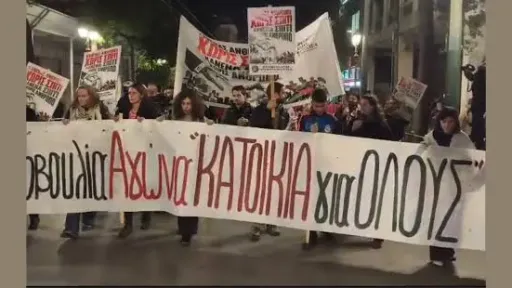
Political organisations and collectives from the extra-parliamentary left also criticised the university administration's restrictions, describing them as an attempt to limit the public character of the anniversary.
In a joint statement, they called for an open, democratic and mass commemoration, rejecting what they described as authoritarian restrictions imposed by the university administration and the government.
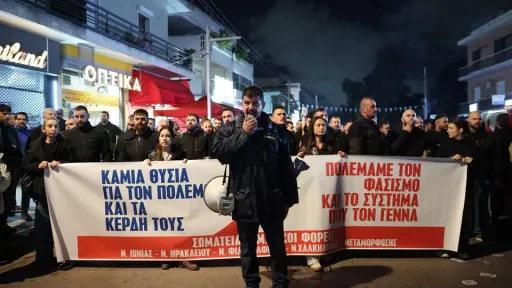
They also urged citizens to participate in Tuesday's anti-imperialist and anti-war demonstration towards the US Embassy.
More than half a century after the events of November 1973, the anniversary continues to attract thousands of participants, bringing together historical remembrance, political debate and contemporary demands for democracy and social rights.
Source: efsyn.gr