Mental health at work: High levels of stress, anxiety and depression among Greek workers

Work is taking a toll on the mental health of millions of employees across Europe, with Greece recording higher-than-average figures on several key indicators. The findings come from the OSH Pulse 2025 survey by the European Agency for Safety and Health at Work (EU-OSHA).
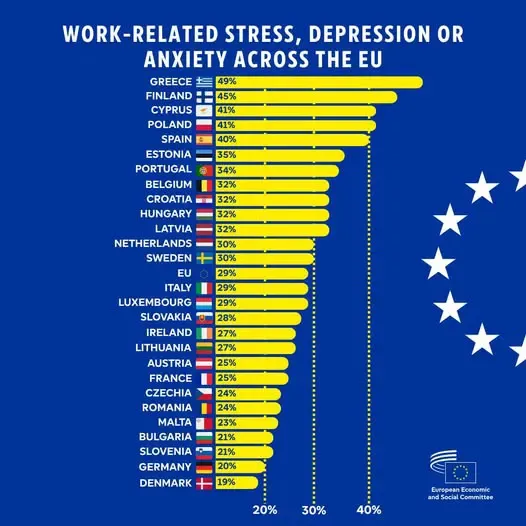
In Greece, 49% of workers say they have experienced stress, depression or anxiety over the past 12 months that was caused or worsened by their work. The corresponding figure across the European Union is 29%.
A similar pattern can be seen in other forms of physical and mental strain. 44% of workers in Greece say their job has caused or worsened overall fatigue, compared with 37% in the EU. Meanwhile, 43% report headaches or eye strain, compared with 35% across the EU.
Intense pressure and heavy workloads
The pressure is also reflected in working conditions. 57% of workers in Greece say they are exposed to intense time pressure or excessive workloads, compared with a European average of 44%.
At the same time, 44% report a lack of rewards, including adequate pay, career development opportunities or recognition for their efforts, compared with 34% in the EU.
Problems with communication or cooperation within the workplace are reported by 30% of Greek workers, compared with 29% across the EU. Meanwhile, 23% say they have limited autonomy or influence over the pace and way in which they perform their work, compared with 21% in the EU.
The figures on violence and harassment are also concerning. 20% of workers in Greece report incidents of violence or verbal abuse from customers, patients, students or other people, compared with 16% in the EU. In addition, 11% say they are exposed to harassment or bullying, compared with 8% across the EU.
Reluctance to talk about mental health
At the same time, workers in Greece appear less comfortable discussing mental health issues in the workplace.
Only 44% say they would feel comfortable talking to their supervisor or employer about their mental health, compared with 53% in the EU.
Even more significantly, 23% of workers in Greece believe that disclosing a mental health problem could have a negative impact on their career. The corresponding figure in the EU is 19%.
Limited workplace prevention and support
Meanwhile, prevention and support initiatives available in Greek workplaces appear to remain limited.
Just 28% of workers in Greece say their workplace offers information, awareness or training initiatives related to wellbeing and stress management, compared with 53% across the EU.
Only 26% report having access to counselling or psychological support, compared with 40% in the EU.
At the same time, 43% say that other measures are in place to address work-related stress, such as changes to work organisation, setting priorities or improving communication. The corresponding figure across the EU is 35%.
Mental health as a workplace safety issue
The findings help explain why mental health in the workplace has moved high up the European policy agenda.
The European Economic and Social Committee (EESC) has stressed that mental health at work should be treated with the same level of seriousness as physical safety. Meanwhile, the European Parliament has called for new EU legislation addressing psychosocial risks in the workplace.
Key areas of concern include regular assessments of psychosocial risks, excessive workloads, harassment and bullying, as well as new pressures arising from digitalisation and algorithmic management.
The European figures show that the issue is not simply about the individual mental health of employees, but also about the conditions in which they work. In Greece, several of the key indicators are above the EU average, highlighting the need for greater emphasis on prevention, support and improvements to working conditions.
The emerging European approach is therefore shifting the focus away from treating mental health as an individual responsibility and towards a broader responsibility to create safe and healthy workplaces.
Source:efsyn.gr