KEDE congress ends in Kalamata with three resolutions and fierce political confrontation

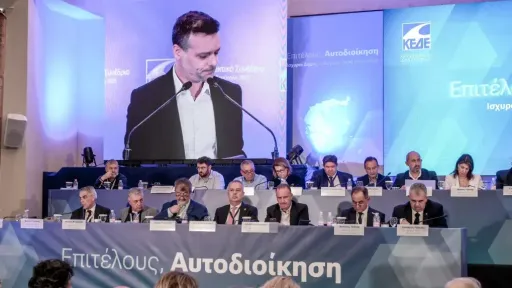
The annual congress of the Central Union of Municipalities of Greece (KEDE) concluded in Kalamata on Saturday with three separate resolutions, amid heated exchanges, political accusations and controversy over the voting procedure.
The congress, held from November 5 to 7, failed to produce a unified position among municipal representatives, with disagreements escalating during the final vote.
A total of 338 delegates participated. The resolution submitted by the "Modern Strong Municipalities" faction, led by KEDE President Lazaros Kyrizoglou, secured 213 votes, representing 63% of the total.
The proposal backed by Athens Mayor Haris Doukas received 111 votes, while the "People's Rally" faction, led by Kostas Peletidis, secured 14 votes.
Doukas challenges voting procedure
The voting process became increasingly tense after Doukas questioned the counting procedure and raised allegations of irregularities.
The Athens mayor repeatedly requested a roll-call vote to ensure that each delegate's choice was clearly recorded. However, the congress presidium rejected his request.
The vote proceeded through a show of hands, with Doukas insisting that discrepancies existed in the number of votes being counted.
Tensions escalated further when KEDE Secretary-General Dimitris Kafantaris intervened in a heated exchange, telling the Athens mayor that he should be ashamed.
Despite the objections, the voting continued and the results were announced without a roll-call procedure.
Kyrizoglou rejects allegations of fraud
KEDE President Lazaros Kyrizoglou strongly rejected Doukas' accusations, describing the voting process as open and transparent.
He argued that all political factions were represented during the procedure and that the vote was conducted publicly, with the counting taking place in their presence. The proceedings were also broadcast live on KEDE's YouTube channel.
Kyrizoglou said the administration's proposal had received 213 votes against 111 for Doukas' proposal, describing the result as a major political defeat for the Athens mayor.
"With a score of 213-111, you cannot speak of fraud, Mr Doukas, but of defeat," Kyrizoglou said, accusing him of attempting to undermine the institution of local government.
He also argued that the administration's resolution focused on the actual problems facing municipalities, while Doukas had sought a political condemnation of the government and Prime Minister.
Doukas' faction accuses KEDE leadership of serving government interests
The confrontation continued after the congress, with Doukas' faction issuing a statement accusing KEDE's leadership of acting as an extension of government policy.
The faction criticised what it described as unacceptable manoeuvres and the refusal to guarantee the integrity of the voting process.
It also alleged that members of the KEDE majority had engaged in aggressive and intimidating behaviour towards Doukas and members of his political group.
The faction maintained that the leadership had failed to represent the independence of local government and accused it of contributing to the problems facing municipalities.
Kyrizoglou responded with another statement, accusing Doukas of using the local government institution as a platform for national political ambitions.
He said KEDE would not allow the confrontation to import the divisions of national politics into the organisation.
PASOK condemns voting arrangements
PASOK also criticised the handling of the vote, expressing support for Doukas' objections.
In a statement, the party condemned what it described as attempts by the KEDE presidium to undermine the integrity of the voting process.
It also criticised alleged attacks against Doukas and members of his faction.
PASOK argued that political manipulation of majorities was incompatible with the constitutional role of local government and undermined the concerns of mayors, municipal representatives and citizens.
Municipalities demand more funding and 35,000 new employees
Beyond the political confrontation, the congress addressed major financial and administrative challenges facing Greece's municipalities.
Among the key demands were increased state funding to cover rising operating costs, the recruitment of 35,000 additional municipal employees, greater energy independence and a dedicated development plan for mountainous regions.
However, disagreements between the different factions prevented the adoption of a single common resolution.
The congress therefore concluded with three separate texts, reflecting the divisions within the country's municipal leadership.
Source: ERTnews.