Greece plans major changes to driving tests and traffic rules
Greece is preparing significant changes to its Road Traffic Code, introducing new rules for driving examinations, young drivers, high-powered cars, illegal parking and traffic violations.
The proposed measures are included in a bill submitted by the Ministry of Infrastructure and Transport for public consultation last Saturday. The reforms aim to improve road safety, strengthen enforcement and introduce a more proportionate system of penalties.
Cameras and digital controls in driving examinations
Practical driving tests for car licences will be subject to mandatory audiovisual recording using the examiner's tablet and a portable 360-degree camera focused on the pedals and the instructor's position.
The proposed system will also introduce electronic identification and authentication through QR codes for the examiner, the vehicle and the candidate's training and examination record.
Artificial intelligence will be used to automatically verify that the cameras are correctly positioned and operating.
The bill also provides for procedures to review recorded examinations, with audiovisual material retained for a maximum of six months.
Penalties will become stricter in cases involving identity fraud or attempts to impersonate driving licence candidates. An electronic register of driving school training vehicles will also be established.
New restrictions for young drivers and supercars
New drivers will be required to display a special identification sign on their vehicles for one year after obtaining their driving licence.
Additional restrictions will apply to high-powered cars.
Drivers will have to be at least 22 years old and have held the relevant driving licence for at least three years before they can drive a vehicle with an engine output exceeding 340 horsepower.
Driving without the correct licence category
The proposed legislation revises penalties for drivers operating vehicles without holding the required licence category.
The existing administrative fines, which vary depending on the type of vehicle, will remain in place. However, the driving licence suspension will be reduced from one year to 30 days, provided the driver obtains the necessary licence extension.
After the first 30 days, the driver will be able to apply for the additional licence category.
Following successful completion of the required theoretical examination, where applicable, and the practical driving test, the remaining suspension will automatically end and the licence will be returned.
The provision will also apply retrospectively to drivers whose first 30 days of suspension have already elapsed.
Parking fines doubled for certain violations
The bill also revises penalties for specific, less serious parking offences classified under category E1-B.
The fine will double to €60, while the existing 10-day temporary driving licence suspension will be abolished.
The changes concern violations such as parking on traffic islands, central dividing islands, electric vehicle charging spaces and areas where stopping and parking are prohibited by regulatory signs.
However, strict penalties will remain in place for serious and obstructive parking violations, including parking on pavements, pedestrian crossings, disabled access ramps and bus lanes.
Where several parking violations occur simultaneously, only the offence carrying the most severe administrative measure or the highest fine will normally be recorded.
If the illegal parking continues for more than three hours, however, a new violation may be issued.
€2,000 fine for unreadable number plates
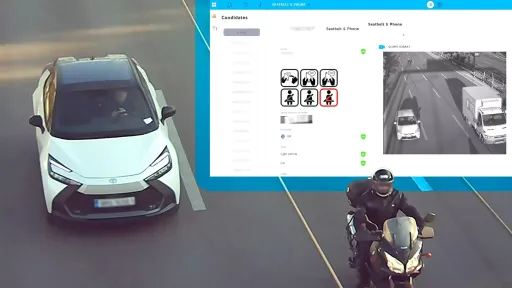
One of the strictest proposed measures concerns vehicles whose registration plates cannot be clearly seen or identified by traffic enforcement cameras and other technical monitoring systems.
Drivers will face a €2,000 fine and immediate removal of their driving licence for 60 days if even one registration plate is unreadable or cannot be recognised by the relevant technical systems.
The measure is intended to prevent drivers from avoiding automated traffic enforcement.
Changes to emergency lane and speed limits
The proposed legislation will allow roadside assistance vehicles to use the emergency lane (LEA) when responding to incidents on motorways.
A new offence will also be introduced for buses carrying more passengers than their authorised capacity.
The bill further clarifies the application of speed limits within built-up areas.
The maximum speed will be 30 kilometres per hour on:
- One-way roads with a single traffic lane.
- Two-way roads with one lane in each direction and no central dividing island.
- The 50-kilometre-per-hour limit will apply to:
- One-way roads with at least two traffic lanes separated by road markings.
- Two-way roads with at least two lanes in each direction, separated by road markings.
- Two-way roads with a central dividing island.
The proposed reforms are currently undergoing public consultation. Their implementation will depend on the completion of the legislative process and the final adoption of the bill.
Source:AMNA