€12.6 million fraud scheme involving fake hotel receipts uncovered in Greece

Two separate criminal networks allegedly supplied fake accommodation receipts to police officers, firefighters, coastguards and military personnel.
Greek authorities have uncovered an extensive fraud scheme involving fictitious hotel and accommodation receipts used by uniformed personnel to claim travel allowances for stays that never took place, with the estimated damage to public funds reaching €12.65 million.
Criminal charges for leading, establishing and participating in a criminal organisation, fraud against the state and money laundering have been brought against 16 of the 20 people arrested in connection with the case.
The remaining four face misdemeanour charges, and their cases have been separated for referral to the competent military court.
More than 1,200 uniformed personnel are named in the case file, while authorities are continuing to investigate the full extent of the alleged fraud.
Two networks supplied fictitious accommodation receipts
According to investigators, two separate criminal networks operated independently but used similar methods to provide police officers, coastguards, firefighters, military personnel and other public employees with fake hotel and accommodation receipts.
The scheme exploited the system of compensation for official travel outside employees' normal place of service.
Uniformed personnel who travelled legitimately for work were entitled to accommodation allowances. However, instead of paying for actual accommodation, they allegedly obtained fictitious receipts through the networks and submitted them to their services to claim reimbursement from the state.
In some cases, the receipts referred to real hotels and accommodation businesses where the employees had never stayed. In others, the properties either did not exist or could not accommodate the number of guests indicated in the documents.
Police officer and accountant among alleged organisers
Investigators identified different individuals at the centre of the two networks.
The first allegedly involved an active-duty police officer and former trade union representative, who was arrested in Ioannina together with his wife, an accountant known by the name "Markella".
Her accounting office allegedly served as a meeting point for uniformed personnel seeking fictitious accommodation documents.
The second network reportedly operated through a man known as "Giorgos", who allegedly arranged meetings near the Attica General Police Directorate and the courts in Athens.
He reportedly handed over folders containing accommodation receipts prepared in the names of individual clients.
Both networks allegedly charged between €150 and €300 for each transaction, depending on the value of the receipt.
Electronic payments used to bypass controls
Investigators also uncovered how the networks allegedly adapted their methods after electronic payment became mandatory for accommodation transactions exceeding €500.
According to the case file, participants would electronically pay the full amount shown on a fictitious receipt, despite never having stayed at the property.
They would then return to the network's office, where most of the money was allegedly refunded in cash, with the intermediaries keeping their commission.
In one example cited in the investigation, an employee paid €3,000 electronically for a supposed month-long stay and subsequently received €2,700 in cash. The network retained €300 as its fee.
This method allegedly allowed the transactions to leave an electronic payment record, making the fictitious accommodation expenses appear legitimate when submitted for public reimbursement.
More than 1,200 personnel under investigation
The case file includes 1,291 uniformed personnel, while authorities are also examining additional cases involving at least 60 coastguards, 23 police officers and 17 other public employees.
The latter group reportedly includes military personnel, emergency medical service workers and a court employee.
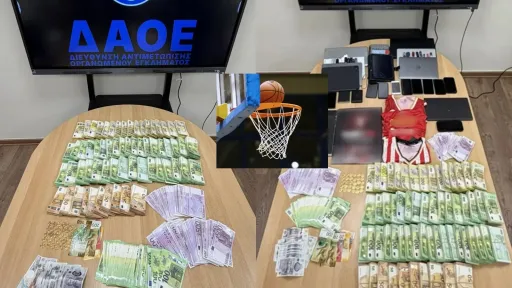
During searches of homes and offices, investigators seized approximately €400,000 in cash, fictitious receipts, documents, handwritten notes containing names and financial amounts, computers, mobile phones and point-of-sale terminals.
Investigation began following complaints in 2025
The case came to light after complaints were submitted to the Hellenic Police Internal Affairs Service in the summer of 2025.
A systematic investigation began in September of that year, focusing on identifying the two networks, examining accommodation documents and tracing electronic financial transactions.
Authorities are continuing to examine the evidence and the involvement of the individuals named in the case.
Source:efsyn.gr