Women earn most higher education degrees in EU

Women accounted for the majority of higher education graduates across every European Union member state in 2024, while business, administration and law remained the most popular fields of study, according to Eurostat data.
A total of 19.1 million people were enrolled in higher education across the EU in 2024. Almost six in 10 students were enrolled in undergraduate programmes, while 29.4% were pursuing master’s degrees and 3.8% were in doctoral programmes.
Short-cycle higher education programmes accounted for a further 7.9% of students.
Business, administration and law attracted 21.9% of higher education students across the EU, making it the largest field of study.
Health and welfare, and engineering, manufacturing and construction each accounted for 14.7% of students. Arts and humanities followed with 11.1%.
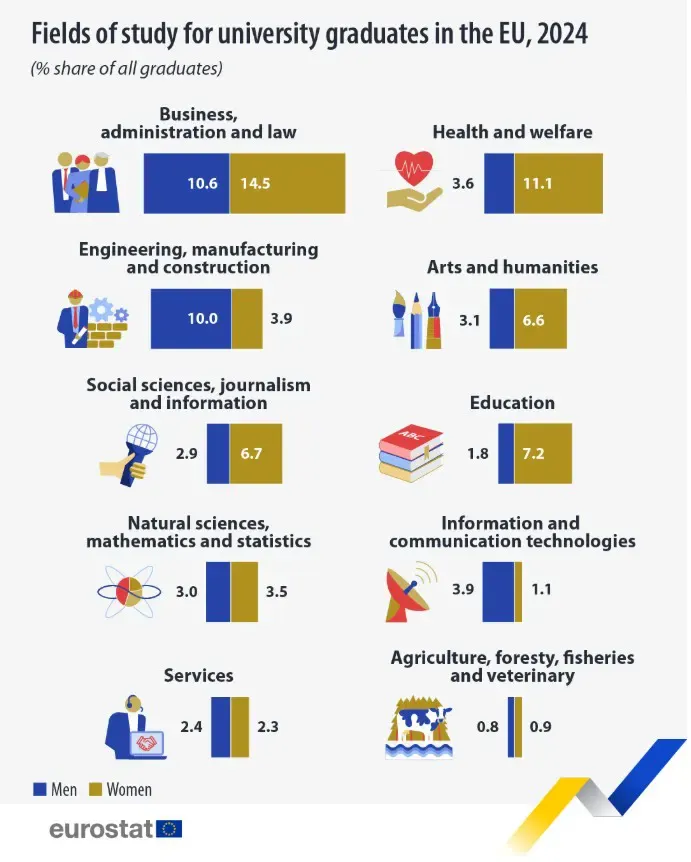
The pattern was similar among graduates. Business, administration and law accounted for 25.1% of degrees awarded in 2024, followed by health and welfare at 14.7%, engineering, manufacturing and construction at 13.9%, arts and humanities at 9.7%, and social sciences, journalism and information at 9.6%.
Women make up 57.8% of graduates
Around 4.5 million people graduated from higher education in the EU in 2024. Women accounted for 2.6 million of those graduates, compared with 1.9 million men.
Overall, women represented 57.8% of all graduates and outnumbered men in every EU member state.
France recorded the largest number of graduates, at around 885,100, followed by Germany with 635,300, Spain with 590,500, Italy with 543,800 and Poland with 404,700.
Sharp gender divide across fields
Women were particularly dominant in education, where the number of female graduates was around four times higher than the number of male graduates.
They also accounted for roughly three quarters of graduates in health and welfare, while women remained strongly represented in arts, humanities and social sciences.
Men, however, continued to dominate engineering, manufacturing and construction, accounting for more than seven in 10 graduates.
The gender gap was even wider in information and communication technologies, where the number of male graduates was 3.7 times higher than the number of female graduates.
Men and women were more evenly represented in agriculture, forestry, fisheries and veterinary studies, as well as in services.
Greece shows a different pattern
Greece stands out for a notable gap between the gender balance among enrolled students and graduates.
Women account for around 60% of higher education graduates in Greece, above the EU average. However, they represent just 49.4% of the country’s total student population.
Along with Ireland, where women account for 49% of students, Greece is one of only two EU countries where men slightly outnumber women among enrolled higher education students.
Greece leads in undergraduate enrolment
Greece also has one of the EU’s highest shares of students enrolled in undergraduate and postgraduate programmes combined, at 96.1%.
Undergraduate students alone account for 84% of the country’s higher education population, the highest share in the EU.
By contrast, only 12.1% of students in Greece are enrolled in postgraduate programmes, the lowest proportion among EU member states.
The figures highlight a persistent gender divide in European higher education, with women dominating overall graduate numbers while men remain significantly more represented in technical and technology-related fields.
Source:ERT