Student-backed opposition projected to win Serbia election as Vucic concedes defeat

Serbia’s student-backed opposition was projected to secure an outright parliamentary majority in Sunday’s snap elections, as former President Aleksandar Vucic acknowledged defeat and thousands of people took to the streets to celebrate the preliminary results.
The “Students win” electoral list was projected to win 139 seats in the 250-member National Assembly, compared with 104 for Vucic’s “United Serbia” coalition, according to projections by polling agency Ipsos and the Center for Free Elections and Democracy (CeSID), based on approximately 60% of the processed sample.
The projections put the student-backed movement above the 126 seats required for a parliamentary majority. However, the figures remained preliminary and awaited confirmation by Serbia’s Republic Electoral Commission.
The Socialist Party of Serbia (SPS), led by Ivica Dacic, was projected to fall below the 3% electoral threshold, potentially ending its parliamentary representation after more than three decades. Dacic’s “Factor of stability” coalition was estimated to have received 2.3% of the vote.
Vucic acknowledges defeat and alleges foreign interference
Speaking at the headquarters of his Serbian Progressive Party (SNS) in Belgrade, Vucic acknowledged that his electoral list had lost.
“Based on the stratified sample, it is clear that we have lost these elections,” he said, while estimating that the student-backed list would secure between 135 and 140 seats.
Vucic blamed the outcome on what he described as interference by several European countries and the “American deep state,” but did not provide evidence to substantiate the allegations.
Ipsos and CeSID projected that the student-backed list had secured 52% of the vote, against 39.3% for Vucic’s coalition. A separate projection by election monitoring organization CRTA put the figures at 51.47% and 40.42%, respectively.
The projected result marked a major setback for the SNS, which had dominated Serbian politics since 2012. In the December 2023 parliamentary elections, the SNS-led coalition won 46.75% of the vote and 129 seats.
Thousands celebrate across Serbian cities
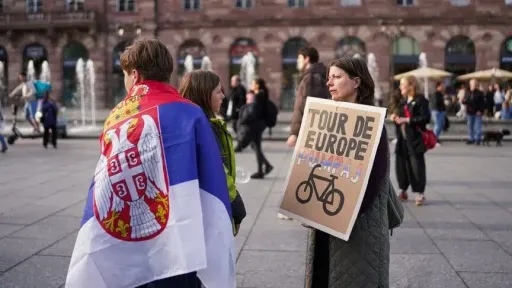
Thousands of people gathered in Belgrade, Novi Sad, Nis, Kragujevac, Kraljevo, Smederevo, Valjevo, Vranje and Cacak to celebrate the projected victory.
In the capital, several thousand people assembled at Republic Square before marching toward Slavija Square. Crowds waved flags, sang, set off fireworks and chanted slogans in support of the student-backed movement, while traffic was temporarily suspended in parts of the city center.
Local media reported that the celebrations proceeded without major incidents.
Ivana Petrovic, a parliamentary candidate on the student-backed list, described the result as a victory for justice and democracy, crediting citizens who had called for political change.
Radomir Saicic, another candidate, declared victory and urged supporters to remain peaceful.
“This is a victory of courage over fear, a victory of hope over indifference, a victory of the belief that Serbia can and must be different,” he said.
Saicic said the movement would begin work on strengthening the rule of law and rebuilding state institutions, while warning supporters against provocations.
Regional leaders congratulate student-backed movement
Montenegrin President Jakov Milatovic congratulated the student-backed list, expressing hope that the outcome would open a new chapter in relations between the neighboring countries based on friendship, dialogue and a shared European future.
Milorad Dodik, leader of the Alliance of Independent Social Democrats in Bosnia and Herzegovina, also congratulated the movement while thanking Vucic for his cooperation with Bosnia’s Republika Srpska entity.
Dodik said he expected close ties and mutual support between Serbia and Republika Srpska to continue under the country’s new political leadership.
Bosniak minority parties face changes in representation
The preliminary projections also indicated limited representation for several parties associated with Serbia’s Bosniak community, particularly in the southwestern Sandzak region.
Electoral lists headed by Rasim Ljajic and the Party of Democratic Action of Sandzak (SDA Sandzaka), led by Sulejman Ugljanin, were each projected to secure one seat.
The Alliance of Vojvodina Hungarians was expected to win three seats, while the Albanian Coalition was projected to secure two.
Recognized national minority lists are exempt from Serbia’s standard 3% electoral threshold under the country’s electoral law. Their final representation will depend on the official results.
High turnout and reports of irregularities
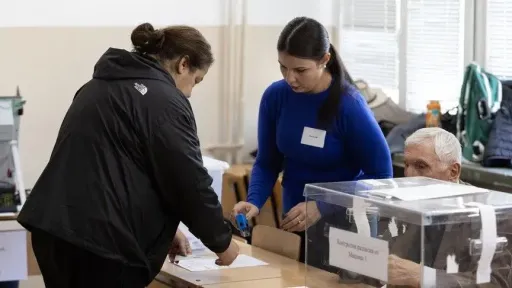
The election was marked by long queues at polling stations and reports of possible irregularities.
Ipsos and CeSID estimated turnout at nearly 70%, excluding polling stations abroad, compared with approximately 58.7% in the December 2023 parliamentary elections.
CeSID said it had received more than 300 reports of possible irregularities by 8 p.m. The allegations included voting without identification, photographing completed ballots, group voting, technical problems, suspected voter intimidation and vote buying.
The organization said the reports were still being verified.
Vote follows nearly two years of student-led protests
The snap election followed nearly two years of anti-government demonstrations triggered by the collapse of a railway station canopy in Novi Sad in November 2024, which killed 16 people.
The tragedy sparked widespread protests led by university students, who demanded accountability and action against alleged corruption. The movement subsequently emerged as a major political challenger to Vucic’s SNS.
Sunday’s vote marked Serbia’s 15th parliamentary election since the reintroduction of multiparty politics in 1990 and its 10th early election.
The Republic Electoral Commission was expected to release further results as vote counting continued.
Source:AA