Mustafa Trampa calls for deeper understanding of the spiritual heritage of the Balkans

Mustafa Trampa, Mufti of İskeçe (Xanthi) and Chairman of the Advisory Board of the Turkish Minority of Western Thrace, has called for a deeper understanding of the spiritual significance of historical monuments across the Balkans, arguing that their value extends beyond their physical and architectural features.
Trampa made the remarks at the 3rd International Balkan Symposium, organised by Tekirdağ Namık Kemal University (NKU) in Türkiye. The event brought together academics and representatives from several Balkan countries to discuss the region’s historical, cultural and intellectual heritage.
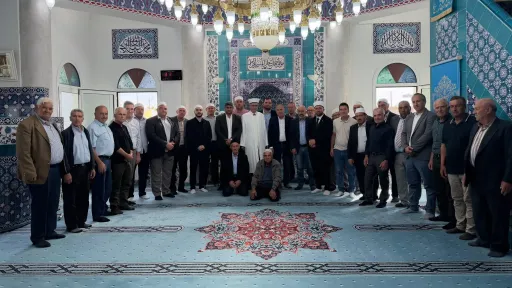
Ibrahim Şerif, Mufti of Gümülcine (Komotini), also attended the symposium, alongside religious representatives, academics and students from countries including Kosovo, North Macedonia, Greece, Bulgaria, Albania and Serbia.
“HISTORICAL MONUMENTS HAVE A SPIRIT AND CHARACTER”
Speaking at the symposium, Trampa said that historical monuments in the Balkans, particularly in Western Thrace, should be understood not only as physical structures but also through the spiritual meaning and cultural memory they embody.
Referring to mosques, bridges, inscriptions, clock towers and other historical structures, he argued that each monument possesses its own character and significance.
Trampa emphasised that mosques, in particular, should not be viewed merely as architectural buildings. He described them as places that direct people towards a transcendent being and foster a sense of unity and belonging.
Although he noted that he was not a historian, Trampa said he wanted to approach the subject from a different perspective, highlighting the relationship between historical heritage, spirituality and human experience.
He called for the region’s monuments and the achievements of its scientific and artistic traditions to be interpreted with greater attention to these dimensions.
BALKANS’ SHARED HISTORY EXTENDS BEYOND BORDERS
Ahmet Alemdar, Deputy President of Türkiye’s Presidency for Turks Abroad and Related Communities (YTB), said that bringing the Balkans’ rich intellectual, cultural and scholarly heritage to light could contribute to a deeper shared historical memory.
Alemdar argued that the Balkans cannot be understood through maps alone. Streets, squares, libraries and memories preserved by local communities also play an important role in understanding the region’s past.
He referred to cities including Edirne, Plovdiv, Skopje, Tirana, Thessaloniki, Manastır, Sarajevo and Mostar as places that preserve traces of a shared history. He also stressed the importance of studying not only historical monuments but also the scholars and artists who contributed to their creation.
Halit Eren, a professor in the History Department of NKU’s Faculty of Arts and Sciences and an adviser to the university rector, highlighted the importance of examining intellectual and artistic production alongside political events and changing borders.
He identified madrasas, schools, libraries, charitable foundations, architectural works, literary texts, musical traditions and handicrafts as important areas of historical research.
BULGARIAN MUSLIM LEADER SHARES HISTORICAL EXPERIENCES
Ahmed Hasanov, Chief Mufti of Bulgaria’s Muslims, also addressed the symposium, sharing experiences from periods when expressing Turkish identity and speaking Turkish were prohibited in Bulgaria.
Ibrahim Şerif, Mufti of Gümülcine (Komotini), and Basri Eminefendi, Mufti of the Kardzhali region in Bulgaria, also delivered speeches during the event.
Their participation highlighted the presence of religious and community representatives in discussions about the Balkans’ historical and cultural legacy.
SYMPOSIUM EXAMINES THE REGION’S CULTURAL AND INTELLECTUAL HERITAGE
The opening programme took place at NKU’s Rectorate Conference Hall in Tekirdağ. It was attended by Süleymanpaşa District Governor Mahmut Nedim Tunçer, Trakya Development Agency Secretary-General Mahmut Şahin, academics from different countries and students.
In his opening remarks, NKU Rector Professor Mümin Şahin underlined the Balkans’ importance to Türkiye and stressed the need to understand the past accurately in order to move forward with confidence.
Şahin also highlighted the university’s historical and cultural connections with the Balkans and Rumelia, expressing an ambition to develop joint social, cultural and educational projects with communities in the region and elsewhere.
The two-day 3rd International Balkan Symposium is scheduled to conclude on October 16, with further academic presentations planned.