KEDE approves Administration’s proposal on New Local Government Code
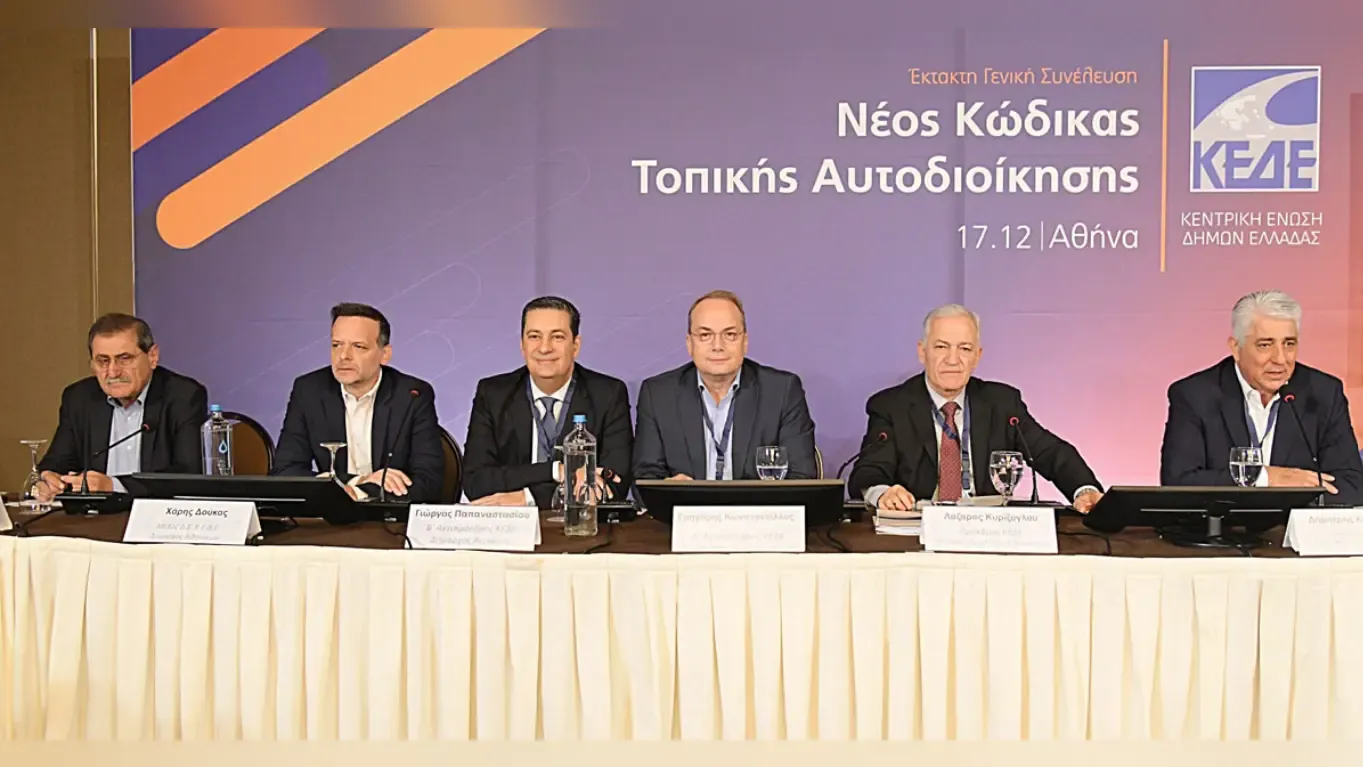
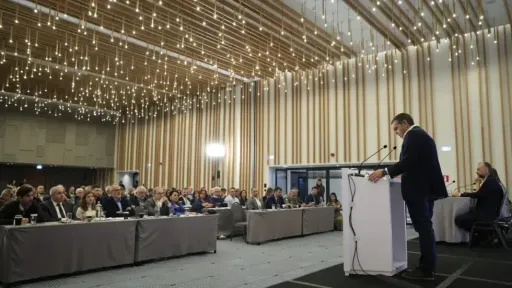
The Central Union of Greek Municipalities (KEDE) has approved the administration’s proposal regarding the new Local Government Code promoted by the government, during an extraordinary General Assembly held on Wednesday, Dec. 17, with the participation of 418 delegates, including mayors and municipal councilors.
The assembly took place in the presence of the political leadership of the Ministry of Interior, including Interior Minister Theodoros Livanios and Deputy Ministers Vassilis Charalambogiannis and Vassilis Spanakis. KEDE presented its positions, proposals and observations on the draft of the new Local Government Code.
Following statements by all political groupings represented on KEDE’s Board of Directors, a vote was held on the proposal submitted by the Board’s majority. Members of the main opposition faction led by Haris Doukas withdrew from the vote, members of the “Laiki Syspeirosi” voted against, while members of the majority faction led by KEDE President Lazaros Kyrizoglou voted in favor.
The administration’s proposal received 281 votes out of 418 registered delegates, corresponding to 67.2 percent approval.
Kyrizoglou: A Positive First Step, But Not a Complete Reform
Opening the proceedings, KEDE President Lazaros Kyrizoglou reiterated the Union’s long-standing position in favor of comprehensive administrative reform, strengthening local government with greater responsibilities, resources, staffing and tools.
He stressed the necessity of codifying fragmented local government legislation and noted that KEDE actively participated for a full year in the Ministry of Interior’s committees and subcommittees drafting the new Code. According to Kyrizoglou, nearly 500 regulatory texts from the period 1975–2022 were recorded during this process.
While acknowledging the substantial work carried out by the relevant committees, Kyrizoglou underlined that the new Code addresses a long-standing need of more than two decades by tackling excessive legislation, bureaucracy and administrative inefficiency. However, he described it as a very positive and necessary first step, rather than the comprehensive administrative reform envisaged by the Constitution and demanded by local authorities.
He reiterated KEDE’s calls for the restoration of central autonomous resources, adequate staffing of municipalities, support for small mountainous and island municipalities, and clearer governance of inter-municipal responsibilities in metropolitan areas.
Livanios: Focus on Simplifying Procedures for Citizens
Interior Minister Theodoros Livanios, addressing the assembly, acknowledged that local government in Greece has operated for decades under fragmented legislation, unclear procedures and institutional fatigue. He said the new Local Government Code aims to bring order to the system through a unified and systematic approach, without regulating sector-specific competences, which will be addressed through separate legislative initiatives.
Livanios explained that the Code is structured into five plus one thematic “books,” focusing on simplifying procedures, regulating key operational issues and addressing problems common to all municipalities, during a politically neutral period.
He highlighted the recording of responsibilities based on the triptych of resources, personnel and infrastructure, as well as the simplification and unification of tendering procedures, with the ultimate goal of facilitating citizens’ interactions with municipalities and improving everyday local governance.
Ongoing Institutional Monitoring
In closing, Kyrizoglou emphasized that KEDE’s Board of Directors will closely monitor all subsequent stages until the new Code is voted on in Parliament and will continue its institutional interventions, aiming for the new statutory framework of local government to align with European standards and pave the way for a substantive reform in decentralization and local self-government.