Foreign minister says Athens seeks peace but will defend sovereign rights

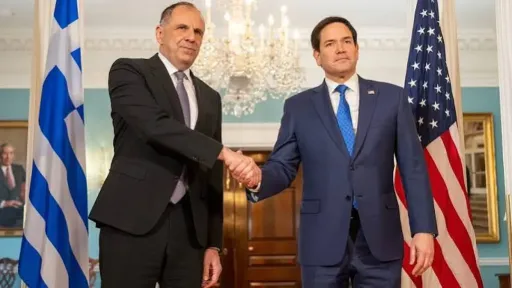
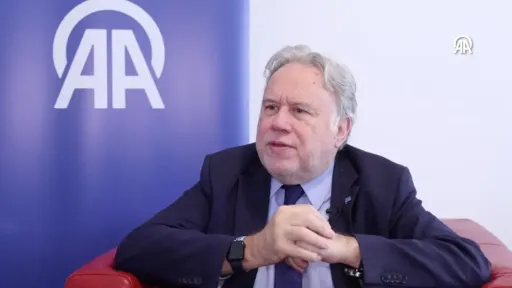
Greece wants to maintain peace and dialogue with Turkiye but will respond with “every appropriate means” to any attempt to violate its sovereign rights, Foreign Minister Giorgos Gerapetritis said in an interview in tovima outlining Athens’ strategy in the Aegean and eastern Mediterranean.
Gerapetritis defended the government’s “calm waters” policy, arguing that the approach has reduced tensions while giving Greece time to strengthen its economy, armed forces and international alliances.
“Yes, we want peace. But we want it from a position of strength,” he said.
Athens says calm waters strengthened Greece
The minister said the policy was introduced after a prolonged period of escalating tensions with Turkey that raised the risk of armed conflict.
According to Gerapetritis, the approach has helped reduce violations of Greek airspace, limit migration flows from the east and prevent major crises between the two countries.
He also pointed to Greece’s military modernization, including Rafale fighter jets, upgraded F-16s and Belharra frigates, as well as the planned acquisition of F-35 aircraft.
Greece, he said, has also expanded its diplomatic partnerships with the United States, France, Israel, Egypt, India and Gulf countries.
Athens defends dialogue with Turkiye
Gerapetritis rejected claims that the Athens Declaration and dialogue with Ankara have failed.
He noted that Greek governments have engaged in talks with Turkiye since the restoration of democracy, including 64 rounds of exploratory contacts that, in his assessment, produced little substantive progress.
The Athens Declaration, he said, created a structured three-pillar dialogue that provides a framework for de-escalation and peaceful dispute resolution while allowing both sides to maintain their legal positions.
The minister said maintaining communication is particularly important amid wars and instability across the wider region.
Greece rejects Turkish maritime claims
Gerapetritis described Turkiye’s recently announced environmental marine parks as illegal, arguing that they extend beyond Turkish territorial waters into undelimited international waters on what Greece considers its continental shelf.
“Any attempt to violate our sovereign rights will be met by every appropriate means,” he said.
He stressed, however, that Greece’s primary objective remains the peaceful resolution of disputes and that military preparedness should be accompanied by diplomacy and adherence to international law.
Athens urges international court settlement
The foreign minister said Greece wants Turkiye to bring the dispute over the delimitation of the continental shelf and exclusive economic zones before the International Court of Justice.
He rejected Turkiye’s claims concerning the “Blue Homeland,” disputed zones and the demilitarization of Greek islands, describing them as long-standing positions that Athens does not expect Ankara to abandon.
Gerapetritis said Greece would continue presenting its own legal arguments and warned that any Turkish legislation on maritime jurisdiction that departs from international law could face consequences from the international community.
Greece expands maritime initiatives
The minister pointed to several recent Greek initiatives, including the extension of territorial waters in the Ionian Sea, agreements delimiting exclusive economic zones with Italy and Egypt, energy exploration south of Crete and the introduction of Marine Spatial Planning.
He also defended Greece’s plans for national marine parks in the Aegean and Ionian seas, saying they are environmental measures designed to protect biodiversity and marine habitats.
Gerapetritis rejected criticism that Athens is exercising self-restraint, arguing that Greece’s actions are designed to remain firmly within international law.
12-mile territorial waters remain an option
Asked whether Greece could extend its territorial waters south of Crete to 12 nautical miles, Gerapetritis said the country retains the right to do so unilaterally at a time and in a manner determined by the Greek state.
He described the right to extend territorial waters as inalienable.
Greece maintains strategic alliances
Gerapetritis emphasized Greece’s partnerships with Egypt, Cyprus, Saudi Arabia and Israel, describing them as strategic relationships that strengthen the country’s position in the region.
He defended the deployment of a Greek Patriot battery in Saudi Arabia, saying the system has a purely defensive and deterrent role and contributes to the protection of critical infrastructure and European energy security.
He also said Greece would continue cooperating closely with Cyprus on the Greece-Cyprus electricity interconnection, following the participation of French company Meridiam in the Great Sea Interconnector project.
Athens says it does not rely on outside backing
Responding to questions about Turkiye’s relationship with Washington, Gerapetritis said Greece does not depend on external backing and instead seeks to build its own national strength.
He cited Greece’s participation in European defense initiatives, its F-35 and F-16 programs, its response to migration pressures at the Evros border and its role in European naval operations in the Red Sea and central Mediterranean.
He also pointed to Greece’s upcoming presidency of the UN Security Council in October and its presidency of the Council of the European Union in the second half of 2027.
Minister says dialogue does not mean retreat
Gerapetritis dismissed domestic criticism that the “calm waters” policy represents weakness.
He said dialogue should not be confused with concessions or abandonment of national positions.
“Without dialogue there can be no solution to any problem,” he said, arguing that the policy had allowed Greece to avoid major crises while strengthening its economy, military capabilities and diplomatic influence.
The minister said Greece today is in a stronger position than it was in 2023, with greater military capabilities, stronger international partnerships and clearer legal positions on maritime issues.
“Yes, we want peace. But we want it from a position of strength,” Gerapetritis said. “This is the Greece of today.”
Source:tovima